



Kentucky Mortgage Deed Overview
Kentucky is a mortgage state, meaning lenders use a mortgage deed rather than a deed of trust to secure real property loans. The borrower retains title to the property, and the mortgage creates a lien that the lender can enforce through judicial foreclosure if the borrower defaults. All mortgage deeds must be recorded with the County Clerk in the county where the property is located to be effective against third parties.
Kentucky charges a real property transfer tax of $0.50 per $500 of consideration, which applies to the loan amount being secured. Recording fees start around $33 for standard documents. Kentucky's judicial foreclosure process runs through the circuit courts, with master commissioners handling sales rather than sheriffs, which is a distinctive feature of Kentucky practice. Spousal rights to the homestead should be addressed whenever the property is a primary residence.
$33
Recording fee
$0.50 per $500
Transfer tax
Required
Notarization
0
Witnesses required
Kentucky Requirements
To record a mortgage deed in Kentucky, the document must be properly acknowledged before a notary and formatted to meet County Clerk standards. Kentucky requires a complete notarial certificate including the notary's commission expiration date. The document must show the full legal description of the property, a return address for the recorded instrument, and all party names must be printed or typed legibly beneath each signature line to facilitate indexing.
Kentucky Specific Note
Kentucky's $0.50 per $500 transfer tax applies to the mortgage amount and is collected at the time of recording. This is in addition to the County Clerk's recording fee. If the property is jointly owned or is the mortgagor's primary residence, a non-borrowing spouse may need to sign the mortgage to release homestead or dower rights, even if they are not on the loan.
Document Requirements
- Notarization: Must be notarized by a Kentucky notary public or authorized notary
- Witnesses: Kentucky requires 0 additional witness(es)
- Legal Description: Complete legal description as it appears on the current deed of record
- Parcel Number: Assessor's parcel number or tax ID
- Return Address: Mailing address for returning the recorded document
- Formatting: Standard formatting with adequate margins, black ink, minimum 10-point font
How to File in Kentucky
Recording a Kentucky mortgage deed requires coordination between the mortgagor, the notary, and the County Clerk. If a non-borrowing spouse also needs to sign, build that step into the timeline to avoid delays. Here is a practical walk-through of the process.
Draft and Review the Document
Complete all fields with full legal names, the verbatim legal description from the current deed of record, the parcel ID from the property valuation administrator's records, the loan amount, and the return address for the recorded document. If both spouses need to sign, confirm that before scheduling notarization.
Have All Required Parties Sign Before a Notary
The mortgagor (and any spouse joining to release homestead rights) must sign before a Kentucky notary public. The notary must complete a proper acknowledgment that includes the notary's commission expiration date. No additional witnesses are required in Kentucky for a standard mortgage deed.
Submit to the County Clerk
Bring the original notarized document to the County Clerk's office in the county where the property is located. Some County Clerks accept e-recording; call ahead to confirm. Documents submitted by mail are also accepted, though you will need to include a check and a self-addressed return envelope.
Pay Recording Fee and Transfer Tax
Kentucky charges both a recording fee (around $33 for standard documents) and a real estate transfer tax of $0.50 per $500 of the mortgage amount. Both are due at the time of recording. The County Clerk will calculate the transfer tax based on the loan amount shown in the document.
Retain the Recorded Original
After recording, the County Clerk returns the document with the recording information stamped on it, including the date and time of recording. Keep this document stored safely. The mortgage is effective against subsequent purchasers and creditors from the moment it is indexed by the County Clerk.
Kentucky Fees & Costs
Typical costs for filing in Kentucky. Actual fees may vary by county.
| Fee / Tax | Amount |
|---|---|
| Recording Fee | $33 |
| Transfer Tax | $0.50 per $500 |
| Notarization | $5 - $25 per signature |
| Certified Copy | $1 - $10 per page |
| Attorney Review (optional) | $150 - $500 |
Kentucky Tax Implications
Kentucky's real estate transfer tax of $0.50 per $500 applies at the time of recording and is based on the consideration shown in the mortgage, which is typically the loan amount. On a $300,000 mortgage, the transfer tax comes to $300. Certain transfers are exempt, including transfers to or from governmental entities and certain intra-family transactions, but most standard lender mortgages are taxable.
Kentucky does not have a state income tax rate tied directly to mortgage interest, but borrowers who itemize on their federal return may deduct qualifying mortgage interest on primary and secondary residences subject to the current federal loan limits. For investment properties, mortgage interest is generally deductible as a business expense against rental income, though passive activity rules may limit or defer the deduction depending on the borrower's income and activity level.
Property taxes in Kentucky are assessed by the county property valuation administrator and are due in the fall of each year. A new mortgage does not change the assessed value of the property, but a transfer of ownership typically triggers a new assessment at the time of the sale. Lenders routinely require borrowers to fund a property tax escrow account as part of the monthly mortgage payment to ensure taxes are paid on time and the lien remains the senior encumbrance on the property.
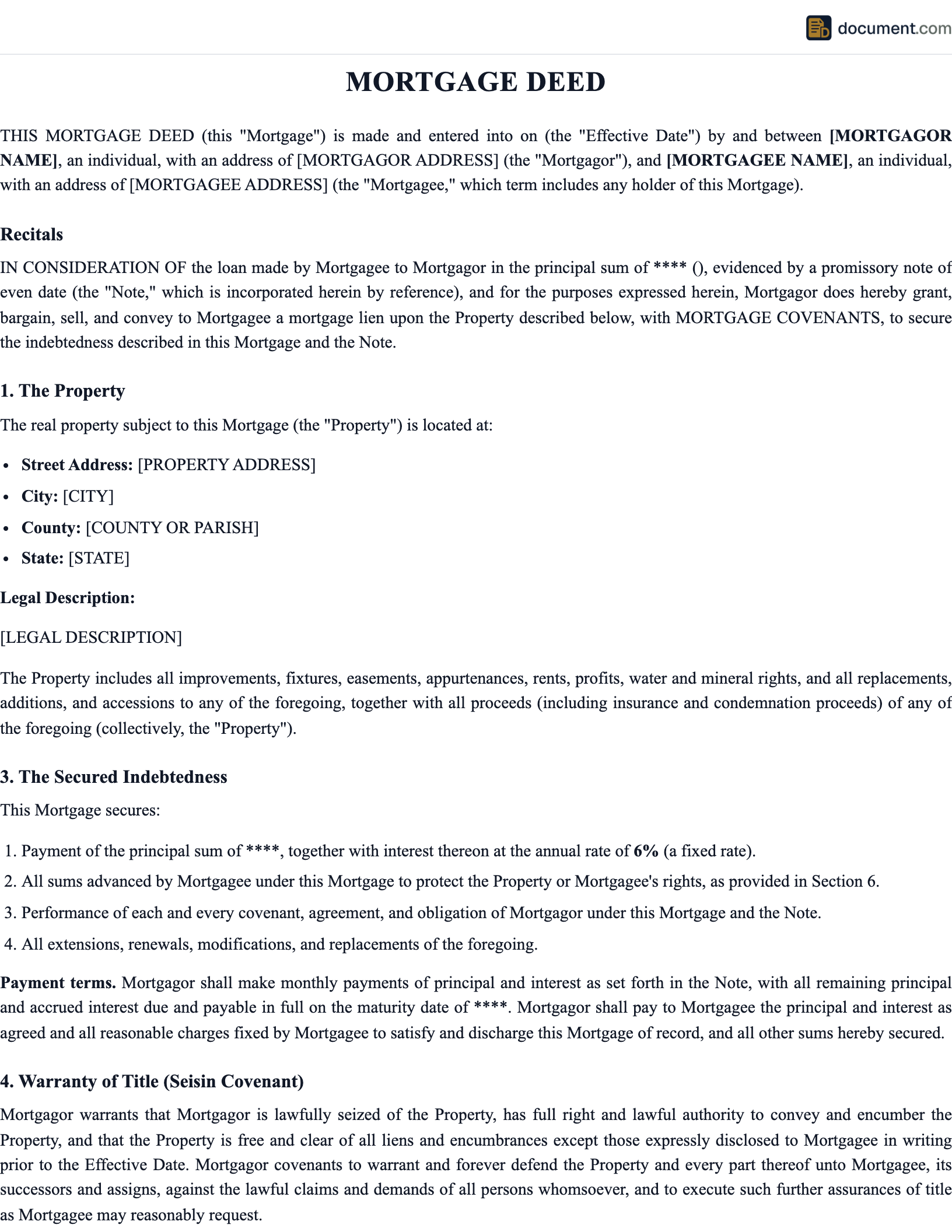
Sample Kentucky Mortgage Deed
Preview of our Kentucky-specific template. Your document will include all fields required for recording in any Kentucky county.
MORTGAGE DEED
STATE OF KENTUCKY
Legal Document
PARTY INFORMATION
Name: [Full Legal Name]
Address: [Kentucky Address]
County: [County]
PROPERTY DESCRIPTION
County: [County] State: Kentucky
Legal Description: [Per Recorded Plat]
Parcel No.: [APN]
Kentucky Mortgage Deed FAQ
Common questions about filing in Kentucky, including requirements, fees, and tax implications.
Official Kentucky Resources
Official state resources for verifying requirements and finding your local recording office.
Important Considerations
Kentucky's judicial foreclosure requirement means that a lender cannot quickly foreclose outside of court. This is generally better for borrowers than non-judicial states, but it also means that errors in the mortgage document can surface in court proceedings years later and complicate or delay enforcement. Getting the instrument right at closing protects both sides.
Spousal rights are a persistent source of problems in Kentucky mortgage transactions. If the mortgaged property is the primary residence of a married borrower, Kentucky courts have held that an unjoined spouse retains homestead and dower rights that are not extinguished by the mortgage. Lenders who skip the non-borrowing spouse signature have found their mortgages partially or wholly unenforceable in foreclosure proceedings. Make this check a standard part of your closing process.
The master commissioner system is worth understanding before going to closing. If a borrower defaults and the lender forecloses, the master commissioner sets the auction, publishes required notices, and administers the sale. Buyers at Kentucky foreclosure sales should understand that they are purchasing the property as-is, subject to any senior liens not extinguished by the foreclosure, and that the right of redemption ends once the court confirms the sale.
Kentucky Practice Note
Every County Clerk in Kentucky handles recording somewhat differently in terms of cover sheet requirements, accepted payment methods, and e-recording availability. Before submitting your mortgage deed, call the specific County Clerk's office to confirm the current fee schedule and any local formatting preferences. Jefferson and Fayette counties in particular have busy offices with their own procedures.
Related Documents
Depending on your situation, you may need additional documents alongside this one. Below are commonly related documents that are frequently used together in real estate transactions.
Important Considerations
Before proceeding with your document, there are several important factors to consider. Each real estate transaction is unique, and understanding the specific requirements and implications of your situation will help ensure a smooth and legally compliant process.
Real estate laws and regulations are subject to change, and local requirements may differ from state-level rules. It is always advisable to verify current requirements with your local recording office before submitting any documents for recording.
If your transaction involves complex circumstances such as multiple parties, commercial properties, trusts, estates, or interstate elements, consulting with a licensed real estate attorney is strongly recommended. An attorney can provide guidance specific to your situation and help you avoid potential legal issues.
Keep copies of all documents related to your real estate transaction in a safe place. Recorded documents become part of the public record, but having your own copies ensures you can reference the terms and conditions at any time. Digital copies stored securely are also recommended as a backup.
Professional Recommendation
While our templates are designed to be comprehensive and legally compliant, we recommend having your completed document reviewed by a licensed attorney before recording, especially for high-value transactions or complex situations. Many attorneys offer flat-fee document review services that provide peace of mind at a reasonable cost.
Related Documents
Depending on your situation, you may need additional documents alongside this one. Below are commonly related documents that are frequently used together in real estate transactions.
Create your Kentucky Mortgage Deed in under 5 minutes.
Answer a few questions and download a Kentucky-compliant document, ready for the state agency.