



Kansas Mortgage Deed Overview
Kansas uses the mortgage as its standard security instrument for real property loans rather than a deed of trust. A Kansas mortgage deed creates a lien on the borrower's property in favor of the lender while the borrower retains title. Recording the mortgage with the county Register of Deeds gives public notice of the lien and protects the lender's priority against later creditors and purchasers.
Kansas does not impose a state mortgage tax or real estate transfer tax, which keeps recording costs modest. Recording fees start around $21 for the first page. Notarization is required but no witnesses beyond the notary are needed. Because Kansas requires judicial foreclosure, lenders typically conduct thorough title searches before closing to understand the full lien picture before making the loan.
$21
Recording fee
None
Transfer tax
Required
Notarization
0
Witnesses required
Kansas Requirements
To be accepted by the Register of Deeds, a Kansas mortgage deed must be properly executed, notarized, and formatted. The document should include a clear return address for the recorded instrument, the legal description taken verbatim from the current deed of record, and a parcel ID number for the county appraiser's records. Margins of at least one inch on all sides are required, and the first page typically needs a three-inch clear area at the top for the recording stamp.
Kansas Specific Note
Kansas has no state mortgage tax and no transfer tax, so the primary cost at recording is the per-page fee (typically $21 for the first page, with additional charges for each subsequent page). Many Kansas counties have adopted the statewide cover sheet format, but requirements vary, so verify with your specific Register of Deeds before you submit.
Document Requirements
- Notarization: Must be notarized by a Kansas notary public or authorized notary
- Witnesses: Kansas requires 0 additional witness(es)
- Legal Description: Complete legal description as it appears on the current deed of record
- Parcel Number: Assessor's parcel number or tax ID
- Return Address: Mailing address for returning the recorded document
- Formatting: Standard formatting with adequate margins, black ink, minimum 10-point font
How to File in Kansas
Recording a mortgage deed in Kansas follows a predictable process, but paying attention to county-level details can save you a return trip to the office. Here is what to expect from start to finish.
Prepare the Document
Fill in all party names and addresses using their full legal names, insert the exact legal description from the current deed of record, and include the county appraiser parcel ID. Double-check that the property county matches the county where you plan to record.
Obtain Notarization
The mortgagor must sign in front of a Kansas-commissioned notary public. No witnesses are required beyond the notary. Kansas allows remote online notarization, so you may be able to complete this step digitally if your notary is set up for it.
Submit to the Register of Deeds
Bring or mail the original notarized document to the Register of Deeds in the county where the property sits. Many Kansas counties also accept e-recording through approved submission vendors, which avoids shipping delays.
Pay the Recording Fee
Kansas charges a per-page recording fee. The first page is typically $21, with an additional fee for each subsequent page. There is no state mortgage tax or transfer tax due at recording, so your total cost is usually modest.
Retain the Recorded Copy
After recording, the Register's office will return the document with a stamp showing the book and page or instrument number. Keep this recorded copy in a secure place, as it serves as evidence that the mortgage was perfected against third parties on the recording date.
Kansas Fees & Costs
Typical costs for filing in Kansas. Actual fees may vary by county.
| Fee / Tax | Amount |
|---|---|
| Recording Fee | $21 |
| Transfer Tax | None |
| Notarization | $5 - $25 per signature |
| Certified Copy | $1 - $10 per page |
| Attorney Review (optional) | $150 - $500 |
Kansas Tax Implications
Kansas imposes no state mortgage registration tax and no real estate transfer tax, which sets it apart from many neighboring states. The recording fee is the only state-level cost due at the time of recording. This does not mean borrowers have no tax considerations, but the tax issues tend to be on the income and property side rather than tied to the mortgage instrument itself.
Kansas property taxes are administered at the county level. Mortgaged property is assessed annually, and the assessed value can change based on market conditions or improvements. A new mortgage does not trigger a property tax reassessment in Kansas, but a change in ownership can. If the underlying transaction involves a sale, check with the county appraiser's office about any valuation adjustments that may follow.
On the federal side, mortgage interest paid on a primary or secondary residence is generally deductible if the borrower itemizes on their federal return, subject to the applicable loan limits under the current tax code. If the mortgage is for investment property, different deduction rules may apply. Borrowers receiving seller financing or assuming an existing mortgage should consult a tax advisor to understand how the transaction is characterized for tax purposes.
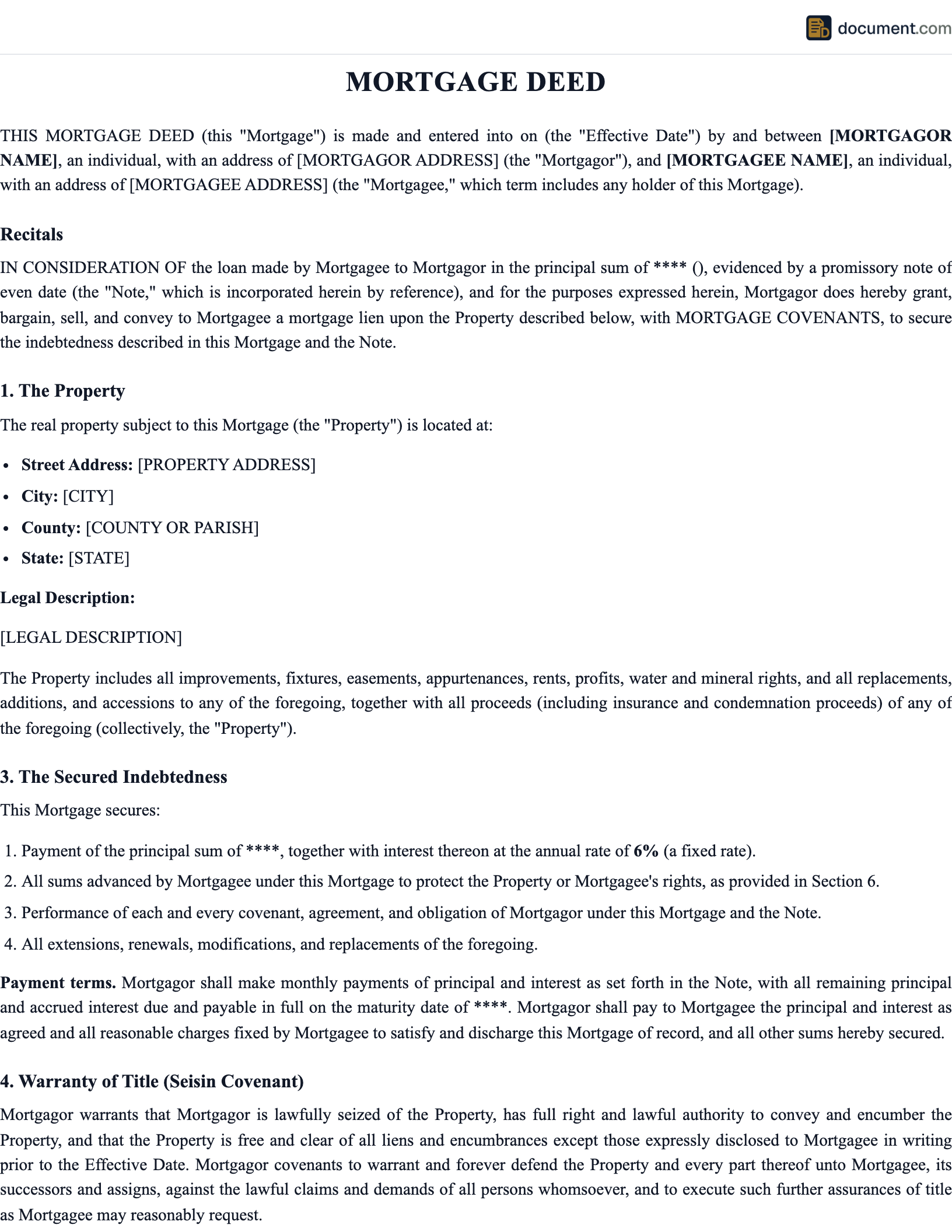
Sample Kansas Mortgage Deed
Preview of our Kansas-specific template. Your document will include all fields required for recording in any Kansas county.
MORTGAGE DEED
STATE OF KANSAS
Legal Document
PARTY INFORMATION
Name: [Full Legal Name]
Address: [Kansas Address]
County: [County]
PROPERTY DESCRIPTION
County: [County] State: Kansas
Legal Description: [Per Recorded Plat]
Parcel No.: [APN]
Kansas Mortgage Deed FAQ
Common questions about filing in Kansas, including requirements, fees, and tax implications.
Official Kansas Resources
Official state resources for verifying requirements and finding your local recording office.
Important Considerations
Because Kansas requires judicial foreclosure rather than a faster non-judicial process, both lenders and borrowers benefit from taking the time to get the mortgage document right at the outset. A defective acknowledgment or incorrect legal description can complicate a foreclosure action significantly, and courts have dismissed foreclosure cases over instrument defects. Precision at the drafting stage saves considerable expense later.
If the property being mortgaged is jointly owned by spouses, Kansas homestead law requires that both spouses execute the mortgage regardless of how title is held. Failure to obtain both signatures on a homestead property can render the mortgage unenforceable against the non-signing spouse's interest. This is one of the most common errors attorneys see in Kansas mortgage transactions and is worth verifying before closing.
Kansas farmers and rural landowners using agricultural property as collateral should be aware that agricultural mortgages may have different redemption periods and treatment under state law compared to residential mortgages. Lenders routinely include specific agricultural covenants in farm mortgages, covering issues like crop insurance, conservation compliance, and tenant lease notification. These are not standard residential mortgage terms and require careful review.
Kansas Practice Note
Verify with your specific county Register of Deeds before submitting. Fee schedules, cover sheet requirements, and e-recording availability differ across Kansas's 105 counties. A quick call before you file prevents rejection and the need to re-record.
Related Documents
Depending on your situation, you may need additional documents alongside this one. Below are commonly related documents that are frequently used together in real estate transactions.
Important Considerations
Before proceeding with your document, there are several important factors to consider. Each real estate transaction is unique, and understanding the specific requirements and implications of your situation will help ensure a smooth and legally compliant process.
Real estate laws and regulations are subject to change, and local requirements may differ from state-level rules. It is always advisable to verify current requirements with your local recording office before submitting any documents for recording.
If your transaction involves complex circumstances such as multiple parties, commercial properties, trusts, estates, or interstate elements, consulting with a licensed real estate attorney is strongly recommended. An attorney can provide guidance specific to your situation and help you avoid potential legal issues.
Keep copies of all documents related to your real estate transaction in a safe place. Recorded documents become part of the public record, but having your own copies ensures you can reference the terms and conditions at any time. Digital copies stored securely are also recommended as a backup.
Professional Recommendation
While our templates are designed to be comprehensive and legally compliant, we recommend having your completed document reviewed by a licensed attorney before recording, especially for high-value transactions or complex situations. Many attorneys offer flat-fee document review services that provide peace of mind at a reasonable cost.
Related Documents
Depending on your situation, you may need additional documents alongside this one. Below are commonly related documents that are frequently used together in real estate transactions.
Create your Kansas Mortgage Deed in under 5 minutes.
Answer a few questions and download a Kansas-compliant document, ready for the state agency.