



Indiana Mortgage Deed Overview
Indiana is a mortgage state that relies on judicial foreclosure through its circuit and superior court system. Mortgage deeds are recorded at the County Recorder's office in the county where the property is located, and Indiana's 92 counties each maintain their own real property records. Indiana has no mortgage tax and no general real estate transfer tax, which makes recording costs comparatively straightforward. The state does have a homestead mortgage signature rule that catches many borrowers off guard.
When a mortgagor's property serves as the family homestead, both spouses must sign the mortgage deed regardless of how title is held. This protection exists to prevent one spouse from encumbering the home without the other's knowledge or consent. Recording fees in Indiana are set by statute at $25 for the first page and $5 per additional page. All mortgage deeds must be notarized, and no witnesses beyond the notary are required.
$20
Recording fee
None
Transfer tax
Required
Notarization
0
Witnesses required
Indiana Requirements
Indiana recording requirements are consistent across all 92 counties because fees and required document elements are set by state statute. This predictability makes Indiana straightforward for out-of-state lenders. The main substantive requirement that distinguishes Indiana from many states is the homestead spousal consent rule: for any property used as a primary residence, both spouses must sign the mortgage deed even if only one holds title. Lenders who fail to obtain the non-titled spouse's signature on a homestead mortgage risk having the mortgage declared unenforceable against that spouse's interest.
Indiana Specific Note
Indiana's homestead mortgage signature rule is not optional. Under Indiana Code 32-29-1-5, a mortgage on property that is or will be used as the mortgagor's residence requires the signature of both the mortgagor and spouse. This applies even if the property is held in one spouse's name only. Recording fees are $25 for the first page and $5 for each additional page. No mortgage or transfer tax applies.
Document Requirements
- Notarization: Must be notarized by an Indiana notary public or authorized notary
- Witnesses: Indiana requires 0 additional witness(es)
- Legal Description: Complete legal description as it appears on the current deed of record
- Parcel Number: Assessor's parcel number or tax ID
- Return Address: Mailing address for returning the recorded document
- Formatting: Standard formatting with adequate margins, black ink, minimum 10-point font
How to File in Indiana
Indiana's process is clean and well-standardized across all 92 counties. Fees are set by statute, so there are no surprises. The homestead signature step is the one most commonly overlooked.
Prepare the Mortgage Deed
Complete all required fields: full legal names of mortgagor and mortgagee, the property's legal description from county deed records, the key number (parcel ID), the principal loan amount and a reference to the promissory note, the maturity date or loan term, and a return mailing address. If the property is the mortgagor's homestead, include signature lines for both spouses.
Obtain All Required Signatures and Notarization
The mortgagor must sign before a notary public. If the property is the homestead, the mortgagor's spouse must also sign and be acknowledged before the notary, even if not on title. No additional witnesses are needed. Indiana permits remote online notarization for signers who cannot appear in person.
Record With the County Recorder
Submit the notarized mortgage deed to the County Recorder in the county where the property sits. Most Indiana counties now accept e-recording through services like Simplifile or CSC. If submitting by mail or in person, call ahead to confirm current hours and accepted payment methods.
Pay the Statutory Recording Fee
Indiana statute sets the recording fee at $25 for the first page and $5 for each additional page. There is no mortgage tax, no documentary stamp tax, and no transfer tax. The total for a standard mortgage deed is predictable before you arrive.
Distribute Copies and Update Property Records
The recorder returns the document with the instrument number and recording date. Provide a copy to the borrower, retain a copy for the lender's files, and forward a copy to the title company if one was involved. Notify the county assessor if there are any property tax exemption implications resulting from the transaction.
Indiana Fees & Costs
Typical costs for filing in Indiana. Actual fees may vary by county.
| Fee / Tax | Amount |
|---|---|
| Recording Fee | $20 |
| Transfer Tax | None |
| Notarization | $5 - $25 per signature |
| Certified Copy | $1 - $10 per page |
| Attorney Review (optional) | $150 - $500 |
Indiana Tax Implications
Indiana stands out for having no mortgage recording tax and no general real estate transfer tax. Recording a mortgage deed in Indiana is as close to cost-free from a tax perspective as you will find among the states. The only costs are the statutory recording fees, which are among the most predictable in the country because they are set by state law rather than varying by county.
Indiana does have a state income tax, and there can be federal and state income tax consequences in connection with property transactions. If a lender forgives a deficiency balance following foreclosure, the cancelled amount may be treated as ordinary income to the borrower, potentially taxable under both federal law and Indiana income tax rules. The Mortgage Forgiveness Debt Relief Act provides a federal exclusion for certain primary residence debt, but the exclusion has its own conditions and limitations.
Indiana property taxes are administered at the county level with rates varying by township and municipality. The state provides a homestead standard deduction and a supplemental homestead deduction for owner-occupied primary residences, which together can significantly reduce the assessed value subject to tax. These exemptions are not automatic after a property transfers; they must be applied for with the county assessor. A lender who takes title through foreclosure and then resells the property should be aware that the buyer will need to file for any applicable exemptions in the first year of ownership.
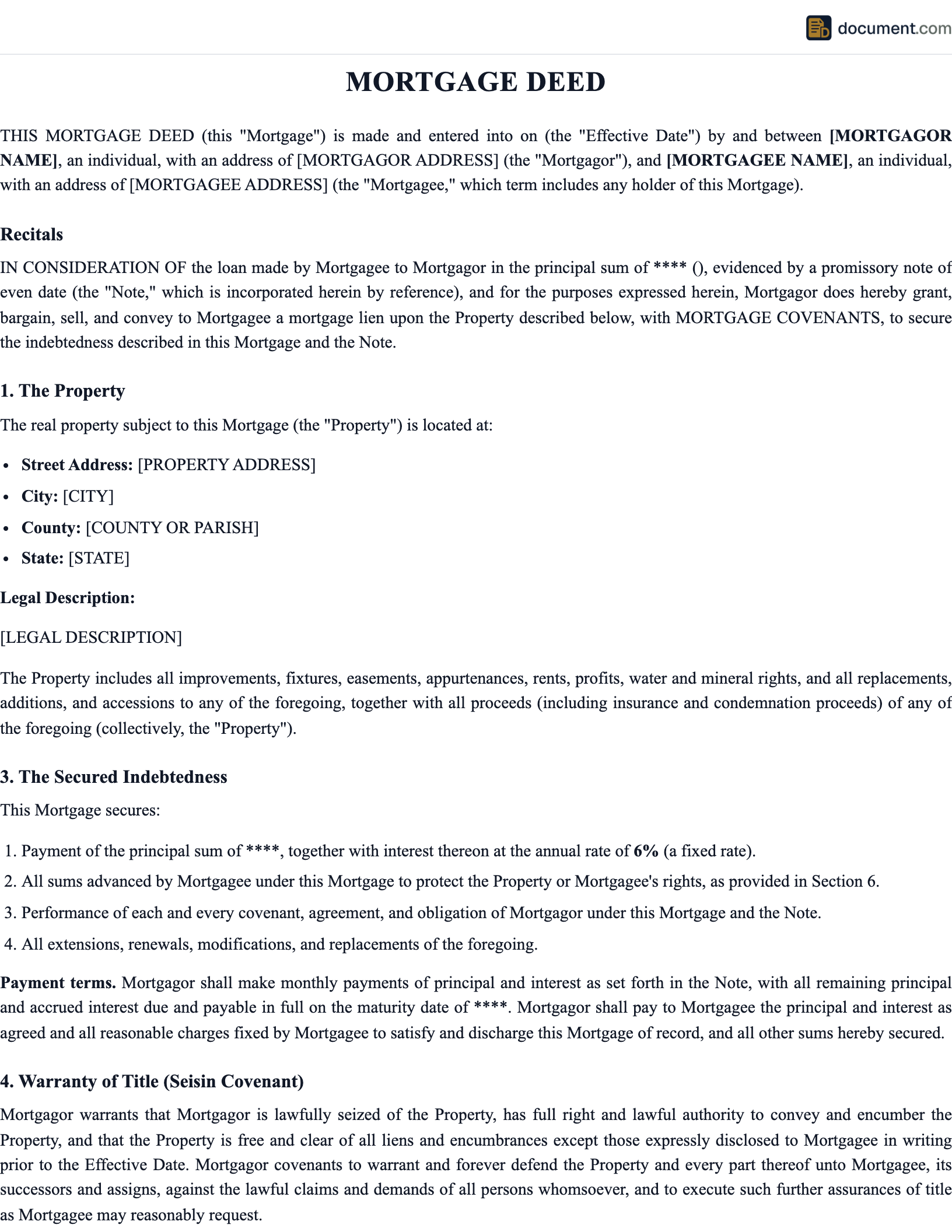
Sample Indiana Mortgage Deed
Preview of our Indiana-specific template. Your document will include all fields required for recording in any Indiana county.
MORTGAGE DEED
STATE OF INDIANA
Legal Document
PARTY INFORMATION
Name: [Full Legal Name]
Address: [Indiana Address]
County: [County]
PROPERTY DESCRIPTION
County: [County] State: Indiana
Legal Description: [Per Recorded Plat]
Parcel No.: [APN]
Indiana Mortgage Deed FAQ
Common questions about filing in Indiana, including requirements, fees, and tax implications.
Official Indiana Resources
Official state resources for verifying requirements and finding your local recording office.
Important Considerations
The homestead spousal signature rule is the single issue most likely to cause problems with an Indiana mortgage deed. Under Indiana Code 32-29-1-5, a mortgage on homestead property is not valid unless both spouses join in the execution. This applies even if the property is titled in only one spouse's name, and it applies regardless of whether the mortgage is for a purchase, refinance, or home equity line. Lenders who skip this step may face an unenforceable mortgage if the matter is ever litigated.
Indiana's judicial foreclosure process is thorough but takes time. The sheriff's sale process, combined with the court timeline, means that from first missed payment to completed sale typically runs 6 to 18 months depending on how contested the proceeding is. Private lenders making Indiana loans should factor this into their risk assessment. Institutional lenders already price this in, but private or seller-financed transactions may not.
Indiana's recording fee structure is one of the clearest in the country: $25 for the first page, $5 per additional page, no mortgage tax, no transfer tax. For a borrower or lender calculating total transaction costs, Indiana is refreshingly predictable on this point. The main variables are title insurance premiums and attorney fees, both of which vary by provider and transaction complexity.
When an Indiana Real Estate Attorney Helps Most
Indiana transactions often close through title companies rather than attorneys, but attorney involvement is recommended when the mortgage involves a family loan, seller financing, commercial property, or any situation where the homestead rule might be unclear. The Indiana State Bar Association maintains a lawyer referral service at indianabar.org that can connect you with real estate counsel in your county.
Related Documents
Depending on your situation, you may need additional documents alongside this one. Below are commonly related documents that are frequently used together in real estate transactions.
Important Considerations
Before proceeding with your document, there are several important factors to consider. Each real estate transaction is unique, and understanding the specific requirements and implications of your situation will help ensure a smooth and legally compliant process.
Real estate laws and regulations are subject to change, and local requirements may differ from state-level rules. It is always advisable to verify current requirements with your local recording office before submitting any documents for recording.
If your transaction involves complex circumstances such as multiple parties, commercial properties, trusts, estates, or interstate elements, consulting with a licensed real estate attorney is strongly recommended. An attorney can provide guidance specific to your situation and help you avoid potential legal issues.
Keep copies of all documents related to your real estate transaction in a safe place. Recorded documents become part of the public record, but having your own copies ensures you can reference the terms and conditions at any time. Digital copies stored securely are also recommended as a backup.
Professional Recommendation
While our templates are designed to be comprehensive and legally compliant, we recommend having your completed document reviewed by a licensed attorney before recording, especially for high-value transactions or complex situations. Many attorneys offer flat-fee document review services that provide peace of mind at a reasonable cost.
Related Documents
Depending on your situation, you may need additional documents alongside this one. Below are commonly related documents that are frequently used together in real estate transactions.
Create your Indiana Mortgage Deed in under 5 minutes.
Answer a few questions and download a Indiana-compliant document, ready for the state agency.