



Idaho Mortgage Deed Overview
Idaho leans heavily on deeds of trust for real estate financing, so mortgage deeds are less common here than in traditional mortgage states. That said, a mortgage deed is a perfectly valid security instrument under Idaho law, and there are situations where parties specifically choose this form. The key practical difference is that mortgage deeds require judicial foreclosure through the district courts if the borrower defaults, rather than the faster trustee sale process available under a deed of trust.
Idaho levies no mortgage tax and no general real estate transfer tax, which keeps recording costs low. Fees at the county recorder run about $10 for the first page with modest per-page charges after that. One area that demands careful attention: Idaho is a community property state, so both spouses must sign a mortgage on community property even if only one holds title. Getting that signature requirement wrong can cloud the lien and complicate enforcement.
$10
Recording fee
None
Transfer tax
Required
Notarization
0
Witnesses required
Idaho Requirements
Idaho's recording requirements are relatively straightforward compared to many states. Documents must be notarized and must contain a complete legal description drawn from the county records. The county assessor's parcel number should appear on the face of the document. Idaho imposes no mortgage tax and no transfer tax, so the only fees are the recorder's per-page charges. The community property spousal consent requirement is the single most common source of recording rejections on mortgage deeds in Idaho.
Idaho Specific Note
Idaho is a community property state. If the mortgagor is married, both spouses must sign the mortgage deed for it to be valid against community property interests, regardless of whose name appears on the title. A mortgage signed by only one spouse on community property can be challenged as unenforceable against the other spouse's share. Confirm marital status and spousal consent requirements before execution.
Document Requirements
- Notarization: Must be notarized by an Idaho notary public or authorized notary
- Witnesses: Idaho requires 0 additional witness(es)
- Legal Description: Complete legal description as it appears on the current deed of record
- Parcel Number: Assessor's parcel number or tax ID
- Return Address: Mailing address for returning the recorded document
- Formatting: Standard formatting with adequate margins, black ink, minimum 10-point font
How to File in Idaho
Recording a mortgage deed in Idaho is relatively low-friction. There is no transfer tax form to complete, and fees are modest. The community property signature check is the step most people miss.
Prepare the Mortgage Deed
Complete all fields: full legal names of both mortgagor and mortgagee, the property's legal description from the county records, the assessor's parcel number, the loan amount, and a return mailing address. If the mortgagor is married, include both spouses as signatories.
Obtain Notarized Signatures
All parties required to sign must appear before a notary public. In a community property situation, both spouses sign and are both acknowledged. No additional witnesses are required beyond the notary. Remote online notarization is permitted in Idaho for signers who cannot appear in person.
Record With the County Recorder
Take or mail the notarized document to the county recorder in the county where the property is located. Many Idaho counties accept e-recording through services like Simplifile or eRecording Partners. Call ahead to confirm the recorder's current submission methods and hours.
Pay the Recording Fee
Idaho charges per-page recording fees. Expect roughly $10 for the first page and a few dollars per additional page. There is no mortgage tax, no documentary stamp tax, and no transfer tax to calculate. Payment methods vary by county, so call ahead if you plan to pay by check or card.
Retain and Distribute Copies
The recorder returns the document stamped with the instrument number and recording date. Provide a copy to the borrower, the lender, and the title company if one is involved. The instrument number is the key identifier for future reference in county records.
Idaho Fees & Costs
Typical costs for filing in Idaho. Actual fees may vary by county.
| Fee / Tax | Amount |
|---|---|
| Recording Fee | $10 |
| Transfer Tax | None |
| Notarization | $5 - $25 per signature |
| Certified Copy | $1 - $10 per page |
| Attorney Review (optional) | $150 - $500 |
Idaho Tax Implications
Idaho does not impose a state mortgage tax or a general real estate transfer tax. This is a meaningful advantage over states like New York, Florida, or Tennessee, where mortgage taxes and documentary stamp taxes can add thousands of dollars to the cost of a transaction. In Idaho, the only government fees associated with recording a mortgage deed are the county recorder's per-page charges, which are modest.
Idaho does have an income tax, and if property is ever sold after a foreclosure sale, both the lender and the borrower may face federal and state income tax consequences. A lender who forgives a deficiency balance after foreclosure may be required to issue a 1099-C for cancelled debt, which the borrower may need to report as income unless an exclusion applies. Idaho conforms to many federal tax rules, so the treatment is generally consistent with federal law.
Property taxes in Idaho are administered at the county level. The state provides a homeowner's exemption that reduces the taxable value of a primary residence by 50%, up to a statutory cap that adjusts periodically. Investment properties and vacation homes do not qualify. Recording a mortgage does not itself trigger reassessment, but a sale does result in an updated assessment at market value for property tax purposes in the year following the sale.
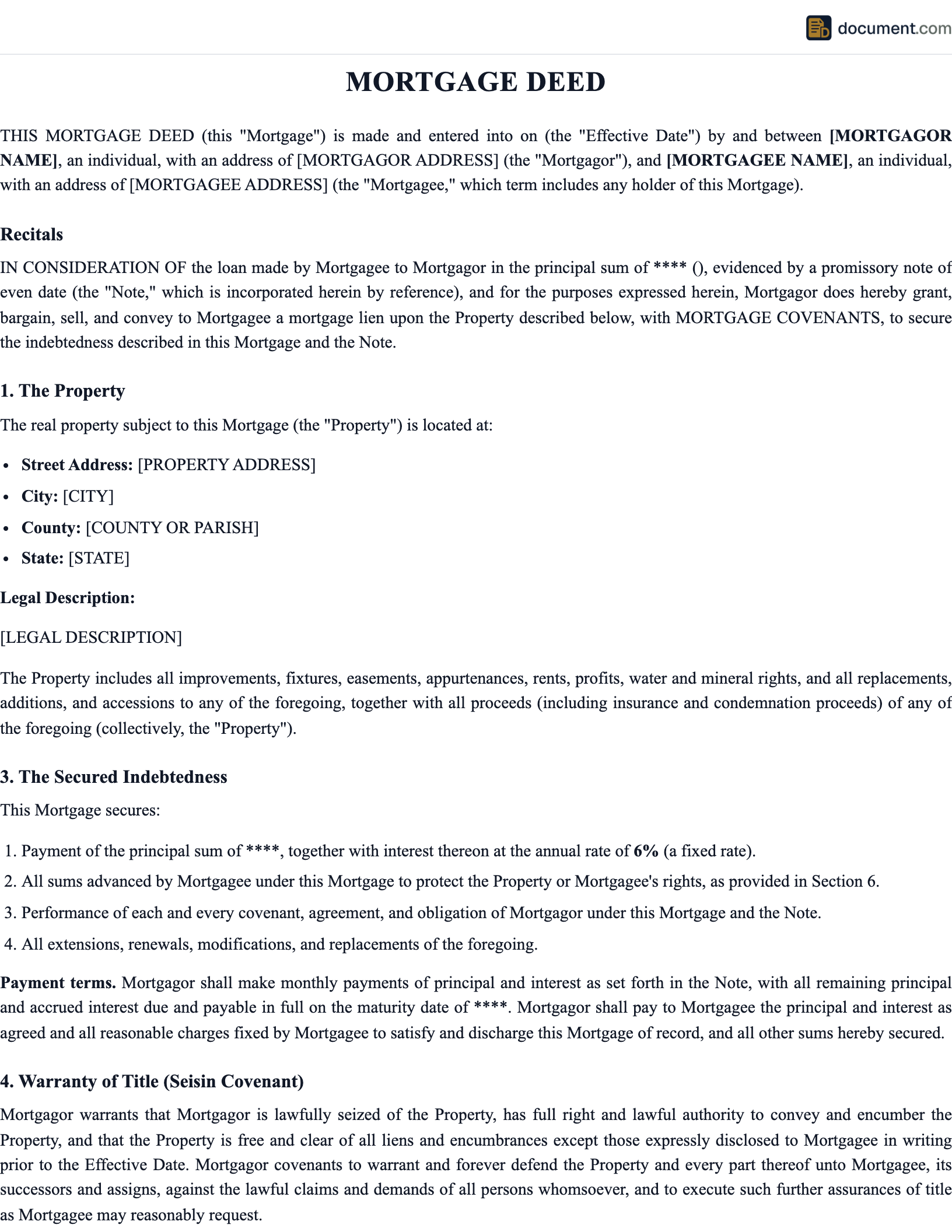
Sample Idaho Mortgage Deed
Preview of our Idaho-specific template. Your document will include all fields required for recording in any Idaho county.
MORTGAGE DEED
STATE OF IDAHO
Legal Document
PARTY INFORMATION
Name: [Full Legal Name]
Address: [Idaho Address]
County: [County]
PROPERTY DESCRIPTION
County: [County] State: Idaho
Legal Description: [Per Recorded Plat]
Parcel No.: [APN]
Idaho Mortgage Deed FAQ
Common questions about filing in Idaho, including requirements, fees, and tax implications.
Official Idaho Resources
Official state resources for verifying requirements and finding your local recording office.
Important Considerations
The community property signature requirement stands out as the most frequently overlooked issue in Idaho mortgage deed transactions. Even if the mortgage is for a business purpose or involves property that one spouse treats as separate, the safer practice is to have both spouses sign if there is any question about the property's characterization. A lender who records a mortgage signed by only one spouse on community property may end up with an unenforceable lien against the other spouse's interest, which creates serious problems in a foreclosure.
Because Idaho is primarily a deed of trust state, lenders and title companies in Idaho are generally set up for that instrument rather than a traditional mortgage deed. If you are using a mortgage deed in a context where most comparable transactions use a deed of trust, be prepared to explain the choice and confirm that your lender's counsel has reviewed the document for Idaho compliance. The practical difference in a non-default scenario is minimal, but the foreclosure pathway is significantly different.
Idaho's recording system is county-based, and county practices vary. Smaller counties may have limited hours, may not accept e-recording, and may have longer turnaround times than larger counties like Ada or Canyon. If your timeline is tight, call the recorder's office before assuming same-day or next-day recording is possible.
When to Consult an Idaho Attorney
If the transaction involves community property, multiple parcels, a family loan with complex terms, or agricultural land with water rights attached, an Idaho real estate attorney can add real value. Idaho water rights are often tied to land and can be affected by how a mortgage is drafted and enforced. The Idaho State Bar's Find a Lawyer tool at isb.idaho.gov can connect you with attorneys by county and practice area.
Related Documents
Depending on your situation, you may need additional documents alongside this one. Below are commonly related documents that are frequently used together in real estate transactions.
Important Considerations
Before proceeding with your document, there are several important factors to consider. Each real estate transaction is unique, and understanding the specific requirements and implications of your situation will help ensure a smooth and legally compliant process.
Real estate laws and regulations are subject to change, and local requirements may differ from state-level rules. It is always advisable to verify current requirements with your local recording office before submitting any documents for recording.
If your transaction involves complex circumstances such as multiple parties, commercial properties, trusts, estates, or interstate elements, consulting with a licensed real estate attorney is strongly recommended. An attorney can provide guidance specific to your situation and help you avoid potential legal issues.
Keep copies of all documents related to your real estate transaction in a safe place. Recorded documents become part of the public record, but having your own copies ensures you can reference the terms and conditions at any time. Digital copies stored securely are also recommended as a backup.
Professional Recommendation
While our templates are designed to be comprehensive and legally compliant, we recommend having your completed document reviewed by a licensed attorney before recording, especially for high-value transactions or complex situations. Many attorneys offer flat-fee document review services that provide peace of mind at a reasonable cost.
Related Documents
Depending on your situation, you may need additional documents alongside this one. Below are commonly related documents that are frequently used together in real estate transactions.
Create your Idaho Mortgage Deed in under 5 minutes.
Answer a few questions and download a Idaho-compliant document, ready for the state agency.