
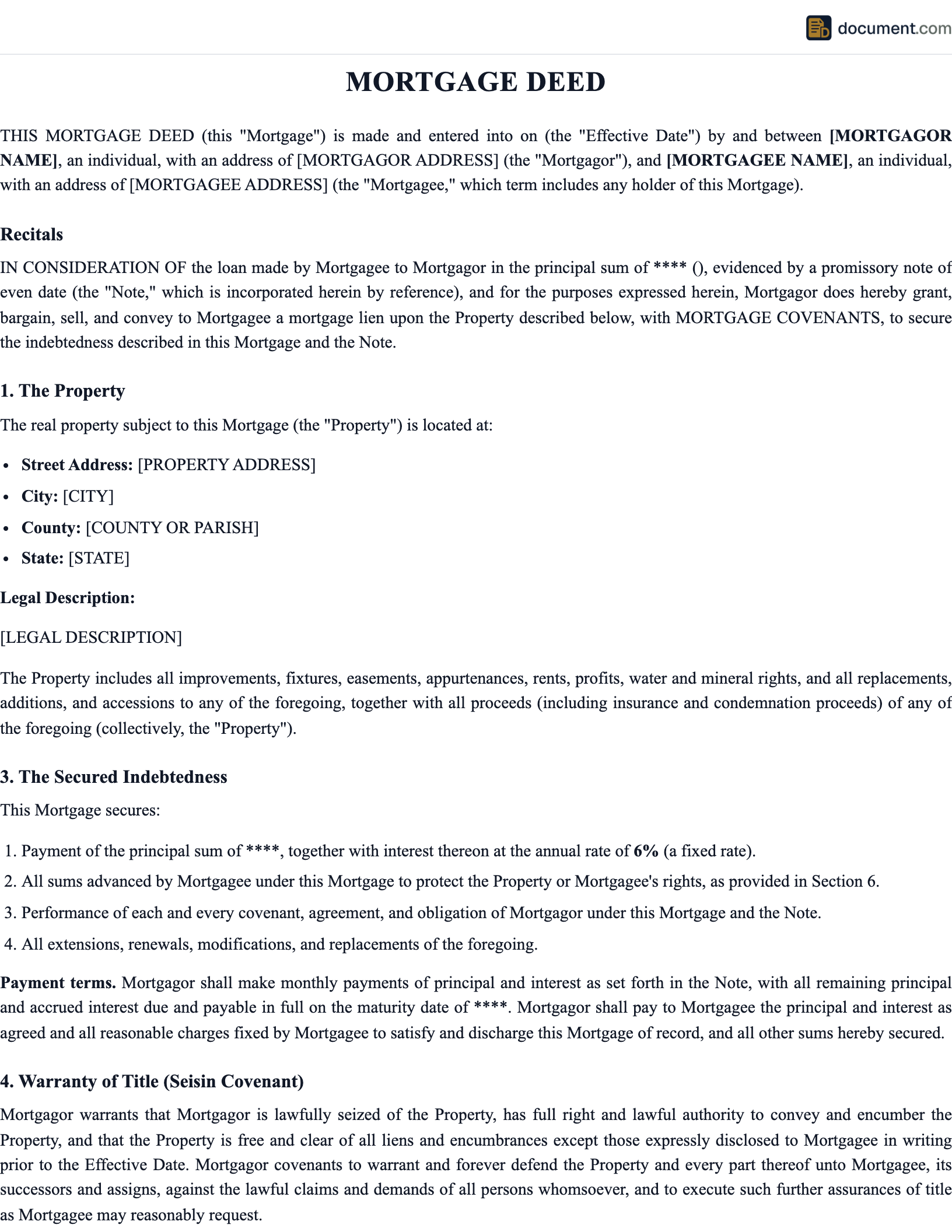



Hawaii Mortgage Deed Overview
Hawaii is one of only a handful of states with a centralized recording system. Rather than filing at a county office, all real property documents go to the Bureau of Conveyances in Honolulu, which is administered by the Department of Land and Natural Resources. This includes mortgage deeds, warranty deeds, and liens across all four counties. If your property sits in the Land Court system rather than the regular system, the mortgage must be filed as a Land Court instrument, a distinction that matters enormously for enforceability.
Hawaii imposes a conveyance tax on real property transfers, calculated as a percentage of the consideration with rates ranging from $0.10 to $1.25 per $100 depending on value and owner-occupancy status. Recording fees start at $36. All mortgage deeds must be notarized, and Hawaii does not require witnesses beyond the notary. Given that Hawaiian properties frequently carry very high values, the stakes of getting the documentation right are significant.
$36
Recording fee
$0.10-$1.25 per $100
Transfer tax
Required
Notarization
0
Witnesses required
Hawaii Requirements
Before filing with the Bureau of Conveyances, check two things: whether your property is in the regular system or the Land Court system, and whether the conveyance tax applies to your transaction. Land Court documents require a separate filing process and different cover sheets. Regular system documents must include the TMK (tax map key) parcel number for the property. Both systems require proper notarization and meet the Bureau's formatting standards for margins, ink, and legibility.
Hawaii Specific Note
Hawaii properties may be registered in either the regular recording system or the Land Court (Torrens) system. Filing in the wrong system does not perfect your lien. Confirm your property's system by checking the existing deed or contacting the Bureau of Conveyances directly at (808) 587-0147 before preparing your document. The conveyance tax form P-64A or P-64B must accompany most filings.
Document Requirements
- Notarization: Must be notarized by a Hawaii notary public or authorized notary
- Witnesses: Hawaii requires 0 additional witness(es)
- Legal Description: Complete legal description as it appears on the current deed of record
- Parcel Number: Assessor's parcel number or tax ID
- Return Address: Mailing address for returning the recorded document
- Formatting: Standard formatting with adequate margins, black ink, minimum 10-point font
How to File in Hawaii
Hawaii's recording process runs through a single state agency, which simplifies some things and complicates others. Here is what to expect from start to finish.
Confirm the Recording System
Check your existing title documents to determine whether the property is in the regular system or the Land Court system. The distinction controls which cover sheet and filing procedure you use. If unsure, call the Bureau of Conveyances at (808) 587-0147 and provide your TMK number.
Prepare the Mortgage Deed and Conveyance Tax Form
Complete the mortgage deed with full legal names, the property's legal description and TMK parcel number, and the loan amount. Prepare either form P-64A (for taxable transfers) or P-64B (for exempt transfers) to accompany the filing.
Get the Document Notarized
Sign the mortgage deed before a Hawaii-licensed notary public. No additional witnesses are required. If you are off-island, remote online notarization is permitted under HRS Chapter 456E with an approved remote notary platform.
File With the Bureau of Conveyances
Submit the notarized mortgage deed and conveyance tax form to the Bureau of Conveyances at 1151 Punchbowl St., Room 120, Honolulu. E-recording is also available through approved submitters if your closing agent or attorney is set up with the system.
Pay Fees and Retain the Recorded Document
Pay the recording fee (starting at $36) and any applicable conveyance tax. The Bureau stamps the document with the recording date and instrument number and returns it. Keep the recorded original in a secure location and provide copies to all parties.
Hawaii Fees & Costs
Typical costs for filing in Hawaii. Actual fees may vary by county.
| Fee / Tax | Amount |
|---|---|
| Recording Fee | $36 |
| Transfer Tax | $0.10-$1.25 per $100 |
| Notarization | $5 - $25 per signature |
| Certified Copy | $1 - $10 per page |
| Attorney Review (optional) | $150 - $500 |
Hawaii Tax Implications
Hawaii's conveyance tax is the most prominent state-level tax affecting mortgage deeds. It is imposed on the grantee and calculated on the actual consideration or fair market value of the interest transferred. The rate structure is tiered: transactions below $600,000 generally pay $0.10 per $100, while higher-value transfers reach $1.25 per $100 at the top end. Buyers who commit to using the property as their primary residence qualify for lower rates under the owner-occupant schedule.
Certain transfers are exempt from the conveyance tax, including transfers to or from the United States or the State of Hawaii, transfers between spouses incident to divorce, and transfers to a revocable living trust where the transferor retains beneficial ownership. Form P-64B is used to claim an exemption at filing. The Hawaii Department of Taxation can audit conveyance tax filings, so exemption claims should be well-documented.
Hawaii's property tax is administered at the county level, and each county sets its own rates and exemption schedules. Honolulu, Maui, Hawaii County, and Kauai each operate independently. Residential property that serves as an owner's primary residence typically qualifies for a homeowner exemption that reduces the assessed value. Investors and second-home owners face higher effective rates. A change in ownership can affect the homeowner exemption status, so review county records after any ownership transfer involving a mortgage.
Sample Hawaii Mortgage Deed
Preview of our Hawaii-specific template. Your document will include all fields required for recording in any Hawaii county.
MORTGAGE DEED
STATE OF HAWAII
Legal Document
PARTY INFORMATION
Name: [Full Legal Name]
Address: [Hawaii Address]
County: [County]
PROPERTY DESCRIPTION
County: [County] State: Hawaii
Legal Description: [Per Recorded Plat]
Parcel No.: [APN]
Hawaii Mortgage Deed FAQ
Common questions about filing in Hawaii, including requirements, fees, and tax implications.
Official Hawaii Resources
Official state resources for verifying requirements and finding your local recording office.
Important Considerations
The Land Court versus regular system distinction is the most consequential Hawaii-specific issue to resolve before drafting a mortgage deed. If you file a regular system document against Land Court property, your mortgage does not attach to the title in the Land Court certificate, and the lender has no enforceable lien. This is not a technicality that courts routinely overlook. Confirming the recording system before you prepare anything else is worth a quick phone call to the Bureau of Conveyances.
Hawaii's judicial foreclosure requirement for traditional mortgage deeds means that any default situation will take time and money to resolve. Lenders operating in Hawaii often prefer deeds of trust structured to allow non-judicial foreclosure under HRS 667 Part I for exactly this reason. If you are a lender choosing between document types, understand the foreclosure timeline difference before deciding. If you are a borrower, understand that a mortgage deed in Hawaii carries strong procedural protections that require court oversight before you can lose the property.
Hawaii property values are among the highest in the nation, and title insurance is essential. Gaps in the chain of title, unresolved ancient grants, and boundary issues affecting agricultural and kuleana lands can create serious problems that title searches uncover and title insurance covers. Owner's title insurance is strongly recommended in addition to any lender's policy.
Working With a Hawaii Real Estate Attorney
Given the complexity of Hawaii's dual title systems, conveyance tax rules, and judicial foreclosure requirements, having a licensed Hawaii real estate attorney review your mortgage deed before filing is particularly valuable here. Many Hawaii attorneys offer fixed-fee document review services for straightforward residential transactions. The Hawaii State Bar Association's lawyer referral service can help you find someone with real property experience on your island.
Related Documents
Depending on your situation, you may need additional documents alongside this one. Below are commonly related documents that are frequently used together in real estate transactions.
Important Considerations
Before proceeding with your document, there are several important factors to consider. Each real estate transaction is unique, and understanding the specific requirements and implications of your situation will help ensure a smooth and legally compliant process.
Real estate laws and regulations are subject to change, and local requirements may differ from state-level rules. It is always advisable to verify current requirements with your local recording office before submitting any documents for recording.
If your transaction involves complex circumstances such as multiple parties, commercial properties, trusts, estates, or interstate elements, consulting with a licensed real estate attorney is strongly recommended. An attorney can provide guidance specific to your situation and help you avoid potential legal issues.
Keep copies of all documents related to your real estate transaction in a safe place. Recorded documents become part of the public record, but having your own copies ensures you can reference the terms and conditions at any time. Digital copies stored securely are also recommended as a backup.
Professional Recommendation
While our templates are designed to be comprehensive and legally compliant, we recommend having your completed document reviewed by a licensed attorney before recording, especially for high-value transactions or complex situations. Many attorneys offer flat-fee document review services that provide peace of mind at a reasonable cost.
Related Documents
Depending on your situation, you may need additional documents alongside this one. Below are commonly related documents that are frequently used together in real estate transactions.
Create your Hawaii Mortgage Deed in under 5 minutes.
Answer a few questions and download a Hawaii-compliant document, ready for the state agency.