



Georgia Mortgage Deed Overview
Georgia is one of a small number of states that uses a deed to secure debt, also called a security deed, as its standard real property security instrument rather than a traditional mortgage or deed of trust. The distinction is fundamental: under a Georgia security deed, the borrower actually transfers legal title to the lender for the duration of the loan. The lender holds title while the borrower retains possession and use. When the debt is satisfied, the lender executes a cancellation or reconveyance that returns title to the borrower. This is not a mortgage, and it is not a deed of trust. It is Georgia's own system.
The practical consequence of this title structure is that Georgia security deed holders can foreclose through a non-judicial power of sale, which is much faster than the judicial foreclosure required in traditional mortgage states. This makes Georgia one of the fastest foreclosure states in the country. All security deeds and related recorded instruments go through the clerk of superior court in the county where the property is located. Georgia has 159 counties, and each county maintains its own land records. Georgia imposes an intangible recording tax on security deeds at $1.50 per $500 of the secured amount, which is a meaningful closing cost on larger loans.
$25
Recording fee
$1.00 per $1,000
Transfer tax
Required
Notarization
0
Witnesses required
Georgia Requirements
Georgia's clerks of superior court follow statewide statutory requirements for recorded documents, but individual county offices can have specific preferences regarding cover sheets, margin requirements, and submitted copy quality. Because Georgia has 159 counties, the volume and processing capacity of each office varies significantly. A clerk in a small rural county may process documents more slowly than the Fulton or Gwinnett County clerks, which handle high volumes of transactions in the Atlanta metro area.
Georgia Specific Note
Georgia does not use a traditional mortgage deed as its standard security instrument. The deed to secure debt (security deed) is the instrument used in Georgia real property lending. Security deeds require two witnesses plus a notary and are subject to Georgia's intangible recording tax of $1.50 per $500 of the secured debt. The power of sale in a security deed allows non-judicial foreclosure, which is much faster than judicial foreclosure in traditional mortgage states. If you need a mortgage deed specifically rather than a security deed, consult a Georgia attorney to confirm the instrument will meet your lender's requirements.
Document Requirements
- Notarization: Must be notarized by a Georgia notary public or authorized notary
- Witnesses: Georgia requires 0 additional witness(es)
- Legal Description: Complete legal description as it appears on the current deed of record
- Parcel Number: Assessor's parcel number or tax ID
- Return Address: Mailing address for returning the recorded document
- Formatting: Standard formatting with adequate margins, black ink, minimum 10-point font
How to File in Georgia
Recording a security deed in Georgia involves the clerk of superior court in the county where the property is located. Because Georgia has 159 counties, identifying the correct county is step one. The intangible recording tax must be calculated and paid at submission, and execution must be complete before the document is presented for recording.
Draft the Security Deed
Prepare the deed to secure debt with all required elements: the grantor's full legal name, the grantee's full legal name, the complete legal description from the current deed of record, the county tax parcel number, the secured loan amount, and a power of sale provision. Include a description of the promissory note being secured by cross-reference to the note date, amount, and maturity date.
Execute with Two Witnesses and a Notary
The grantor (borrower) must sign the security deed in the presence of two witnesses and a notary public. All parties must be physically present. The two witnesses must also sign the document. Georgia does not currently permit remote online notarization for recorded real property instruments, so an in-person signing is required. Plan the signing appointment accordingly.
Identify the Correct Superior Court Clerk
Locate the clerk of superior court for the county where the property sits. Georgia has 159 counties, so confirm the county carefully, particularly for properties near county lines. Contact the clerk's office to confirm current recording fees, intangible tax rates, accepted payment methods, and e-recording availability.
Pay the Intangible Recording Tax and Recording Fee
Calculate the intangible recording tax at $1.50 per $500 of the secured debt (or fraction thereof) before submitting. For a $300,000 loan that is $900 in intangible tax. In addition, pay the clerk's per-page recording fee. Have both payments ready when you submit, as the clerk will not process the document without payment.
Retain the Recorded Original
After recording, the clerk returns the original stamped with the official recording information including book, page, and date. Keep the original in a secure location. The grantee (lender) typically holds the original recorded security deed during the loan term. A copy should be provided to the grantor (borrower) for their records.
Georgia Fees & Costs
Typical costs for filing in Georgia. Actual fees may vary by county.
| Fee / Tax | Amount |
|---|---|
| Recording Fee | $25 |
| Transfer Tax | $1.00 per $1,000 |
| Notarization | $5 - $25 per signature |
| Certified Copy | $1 - $10 per page |
| Attorney Review (optional) | $150 - $500 |
Georgia Tax Implications
Georgia's intangible recording tax is a one-time tax imposed when a security deed or mortgage deed is recorded. The rate is $1.50 per $500 of the principal amount secured, or $3 per $1,000. On a $500,000 loan, the intangible tax is $1,500. This tax is paid to the clerk of superior court at the time of recording and is a non-recurring cost. Georgia does not impose an annual intangible tax on outstanding mortgage balances, which was eliminated years ago.
Georgia also imposes a real estate transfer tax on the conveyance of real property at $1 per $1,000 of consideration. This tax applies to the deed conveying ownership, not to the security deed. In a purchase transaction, both the warranty deed and the security deed are typically recorded at the same time. The transfer tax on the deed and the intangible recording tax on the security deed are calculated and paid separately at closing.
Georgia has a state income tax, and interest income received by a private lender on a Georgia-secured loan is taxable at the state level in addition to federal income tax. Georgia's top individual income tax rate applies to investment income including mortgage interest. Borrowers who use the mortgaged property as a primary residence may be able to deduct qualified mortgage interest on their federal return under the standard deduction thresholds, but Georgia's own income tax treatment of mortgage interest deductions should be confirmed with a Georgia tax professional.
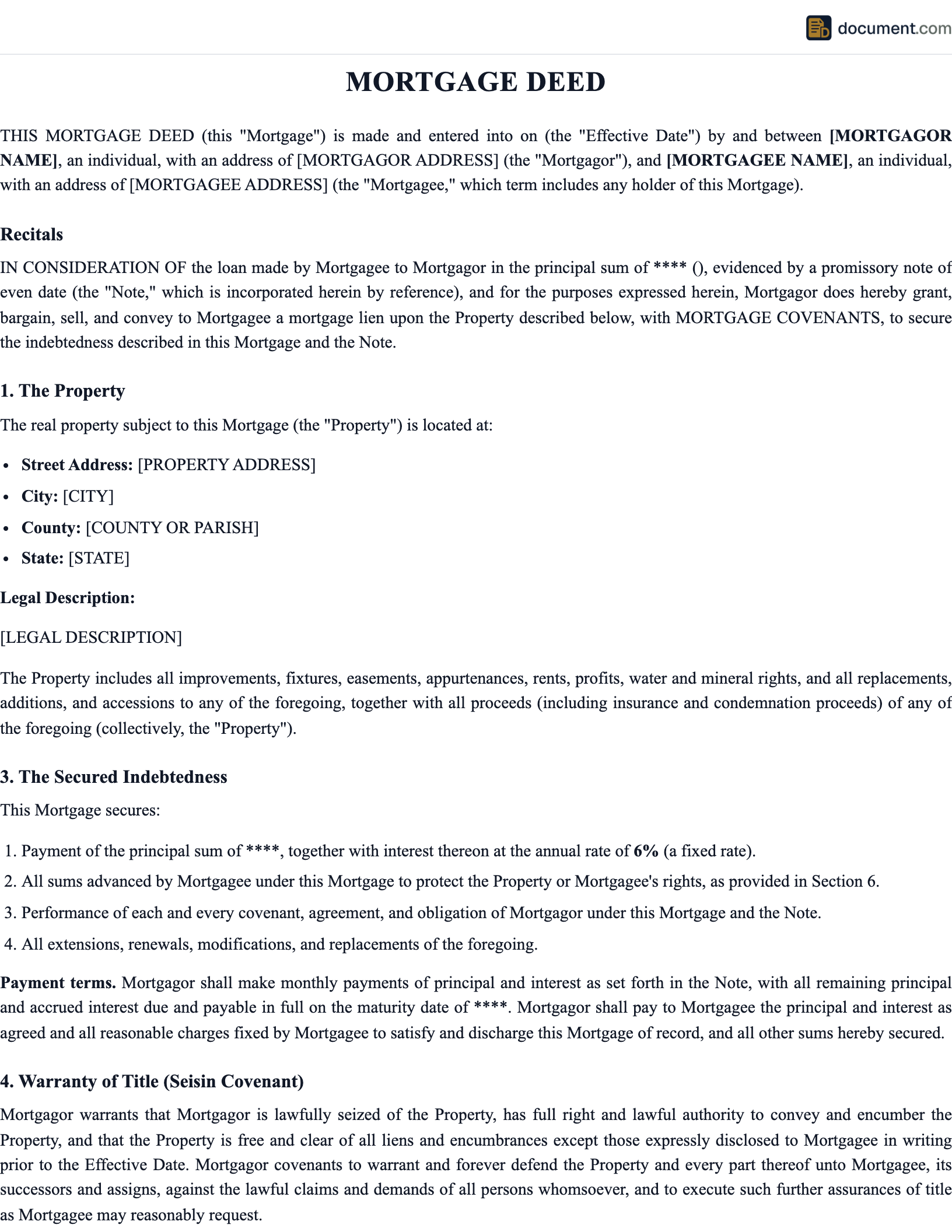
Sample Georgia Mortgage Deed
Preview of our Georgia-specific template. Your document will include all fields required for recording in any Georgia county.
MORTGAGE DEED
STATE OF GEORGIA
Legal Document
PARTY INFORMATION
Name: [Full Legal Name]
Address: [Georgia Address]
County: [County]
PROPERTY DESCRIPTION
County: [County] State: Georgia
Legal Description: [Per Recorded Plat]
Parcel No.: [APN]
Georgia Mortgage Deed FAQ
Common questions about filing in Georgia, including requirements, fees, and tax implications.
Official Georgia Resources
Official state resources for verifying requirements and finding your local recording office.
Important Considerations
Georgia's deed to secure debt system is the most important Georgia-specific fact to understand before working on any secured real property transaction in this state. Because title actually transfers to the lender under a security deed, the legal framework for what a "mortgage" means in Georgia is fundamentally different from states like Florida or Connecticut. If someone refers to a "Georgia mortgage," they almost certainly mean a security deed. Very few Georgia real estate transactions use a traditional mortgage deed.
The power of sale provision in a Georgia security deed enables the grantee to foreclose non-judicially if the grantor defaults. The process requires advertising in the county's legal organ newspaper for four consecutive weeks before the foreclosure sale, which is held on the first Tuesday of the month at the county courthouse. Georgia's non-judicial foreclosure process is one of the fastest in the country. A lender using a properly drafted security deed with a clear power of sale clause can move from default to completed foreclosure sale in as little as 60 to 90 days if the borrower does not respond.
Georgia has 159 counties, which creates administrative complexity when property sits near a county line or when a large parcel spans multiple counties. Each county's clerk of superior court maintains separate land records, and a security deed on property in two counties should technically be recorded in both. Verify the exact county location of the property before recording to avoid a gap in the chain of title.
Georgia Attorney Note
Georgia's deed to secure debt structure, power of sale foreclosure process, 159-county land records system, and intangible recording tax make this a state where working with a Georgia real estate attorney from the start saves money and risk downstream. An attorney familiar with Georgia lending practice can draft a security deed that is enforceable in the event of default, properly structured for the intangible tax calculation, and correctly executed under Georgia's two-witness requirement.
Related Documents
Depending on your situation, you may need additional documents alongside this one. Below are commonly related documents that are frequently used together in real estate transactions.
Important Considerations
Before proceeding with your document, there are several important factors to consider. Each real estate transaction is unique, and understanding the specific requirements and implications of your situation will help ensure a smooth and legally compliant process.
Real estate laws and regulations are subject to change, and local requirements may differ from state-level rules. It is always advisable to verify current requirements with your local recording office before submitting any documents for recording.
If your transaction involves complex circumstances such as multiple parties, commercial properties, trusts, estates, or interstate elements, consulting with a licensed real estate attorney is strongly recommended. An attorney can provide guidance specific to your situation and help you avoid potential legal issues.
Keep copies of all documents related to your real estate transaction in a safe place. Recorded documents become part of the public record, but having your own copies ensures you can reference the terms and conditions at any time. Digital copies stored securely are also recommended as a backup.
Professional Recommendation
While our templates are designed to be comprehensive and legally compliant, we recommend having your completed document reviewed by a licensed attorney before recording, especially for high-value transactions or complex situations. Many attorneys offer flat-fee document review services that provide peace of mind at a reasonable cost.
Related Documents
Depending on your situation, you may need additional documents alongside this one. Below are commonly related documents that are frequently used together in real estate transactions.
Create your Georgia Mortgage Deed in under 5 minutes.
Answer a few questions and download a Georgia-compliant document, ready for the state agency.