



Florida Mortgage Deed Overview
Florida is a mortgage state that requires judicial foreclosure, meaning a lender who needs to enforce a mortgage deed must file a lawsuit in circuit court and obtain a foreclosure judgment before the property can be sold. This process typically takes twelve to eighteen months in Florida, sometimes longer in high-volume counties. That timeline is part of why Florida mortgage documentation must be precise from the start. Courts regularly scrutinize the chain of title, the execution formalities, and the notice provisions when reviewing foreclosure cases.
Florida stands out among mortgage states for two reasons that affect closing costs directly. First, Florida imposes a documentary stamp tax on mortgage documents at $0.35 per $100 of the loan amount. Second, Florida charges a nonrecurring intangible tax on new mortgages at $0.002 per dollar of principal. Together these taxes add meaningful cost to any financed transaction in Florida. Additionally, Florida requires two witnesses plus a notary for proper mortgage execution, which is a higher execution bar than most states. All mortgage deeds are recorded with the county clerk of court.
$10
Recording fee
$0.70 per $100
Transfer tax
Required
Notarization
2
Witnesses required
Florida Requirements
Florida's county clerk of court offices follow state statutory requirements for recorded documents, but individual county offices may have specific preferences for cover sheets, margin sizes, and font requirements. Submitting a document that fails these requirements results in it being returned without recording, which resets your place in the priority line. For closings with tight deadlines, e-recording through an approved vendor is the most reliable approach.
Florida Specific Note
Florida requires two witnesses plus a notary for a valid mortgage deed execution. The documentary stamp tax of $0.35 per $100 of loan amount and the intangible tax of $0.002 per dollar of principal are both due at recording. If the mortgaged property is the borrower's homestead, additional protections under the Florida Constitution apply and may complicate any future foreclosure action. Verify homestead status before finalizing loan terms on owner-occupied residential property.
Document Requirements
- Notarization: Must be notarized by a Florida notary public or authorized notary
- Witnesses: Florida requires 2 additional witness(es)
- Legal Description: Complete legal description as it appears on the current deed of record
- Parcel Number: Assessor's parcel number or tax ID
- Return Address: Mailing address for returning the recorded document
- Formatting: Standard formatting with adequate margins, black ink, minimum 10-point font
How to File in Florida
Recording a mortgage deed in Florida requires attention to the execution requirements and the state-specific taxes that are due at recording. Getting the signing right the first time is especially important given the two-witness requirement. A defective execution is difficult to cure after the fact without bringing all parties back together.
Draft the Document
Include the complete legal description from the recorded deed, not just a street address or assessor's parcel description. Florida's parcel identification numbers are useful for tax purposes but do not substitute for a proper legal description in a recorded mortgage. Include all required parties, the loan amount, payment terms, and a clear description of the property's location by county.
Execute with Two Witnesses and a Notary
The mortgagor must sign in front of two witnesses and a notary, all of whom must be physically present at the signing. The witnesses cannot be parties to the transaction. All three individuals must sign the document in addition to the mortgagor. Arrange this signing appointment in advance, since rescheduling after a defective execution wastes time for everyone involved.
Calculate the Taxes Due
Before submitting the document, calculate the documentary stamp tax ($0.35 per $100 of loan amount) and the intangible tax ($0.002 per dollar of principal). These amounts are due at recording. For a $400,000 mortgage, that is $1,400 in doc stamps and $800 in intangible tax. Have payment ready when you submit.
Record with the County Clerk of Court
Submit the notarized original to the county clerk of court in the county where the property is located. Florida's 67 county clerk offices process documents in-person or via e-recording. Many counties participate in e-recording programs that are faster and more reliable than mail submissions, particularly for time-sensitive transactions.
Retrieve and Store the Recorded Original
Once recorded, the clerk will return the document with the official recording stamp. Store the original in a secure location and provide copies to both parties. If the property has a homestead exemption, confirm that the exemption remains properly filed after the transaction, as changes in ownership or encumbrance can sometimes affect exemption eligibility.
Florida Fees & Costs
Typical costs for filing in Florida. Actual fees may vary by county.
| Fee / Tax | Amount |
|---|---|
| Recording Fee | $10 |
| Transfer Tax | $0.70 per $100 |
| Notarization | $5 - $25 per signature |
| Certified Copy | $1 - $10 per page |
| Attorney Review (optional) | $150 - $500 |
Florida Tax Implications
Florida imposes two transaction taxes on new mortgages that borrowers and lenders need to account for at closing. The documentary stamp tax on the mortgage note is $0.35 per $100 of the loan amount, and the nonrecurring intangible personal property tax on new mortgages is $0.002 per dollar of principal. Both are calculated on the face amount of the loan. These taxes are due when the mortgage is recorded, and the clerk of court collects them at the time of submission.
Florida is notable for having no state income tax, which benefits private lenders who receive interest income from Florida borrowers. All interest income is still subject to federal income tax, but the absence of a state-level income tax reduces the overall tax burden on lending activity compared to states like California or New York.
Florida's homestead exemption is a significant feature of the state's property tax system and deserves attention in the context of mortgage lending. The Florida Constitution provides homestead protections that can limit property tax assessments and, under separate constitutional provisions, restrict a lender's ability to force the sale of a homestead in certain circumstances. Mortgages voluntarily granted by the homestead owner are generally enforceable, but the homestead character of the property can affect how foreclosure proceeds. Lenders making loans on Florida residential properties should understand how homestead status affects their rights.
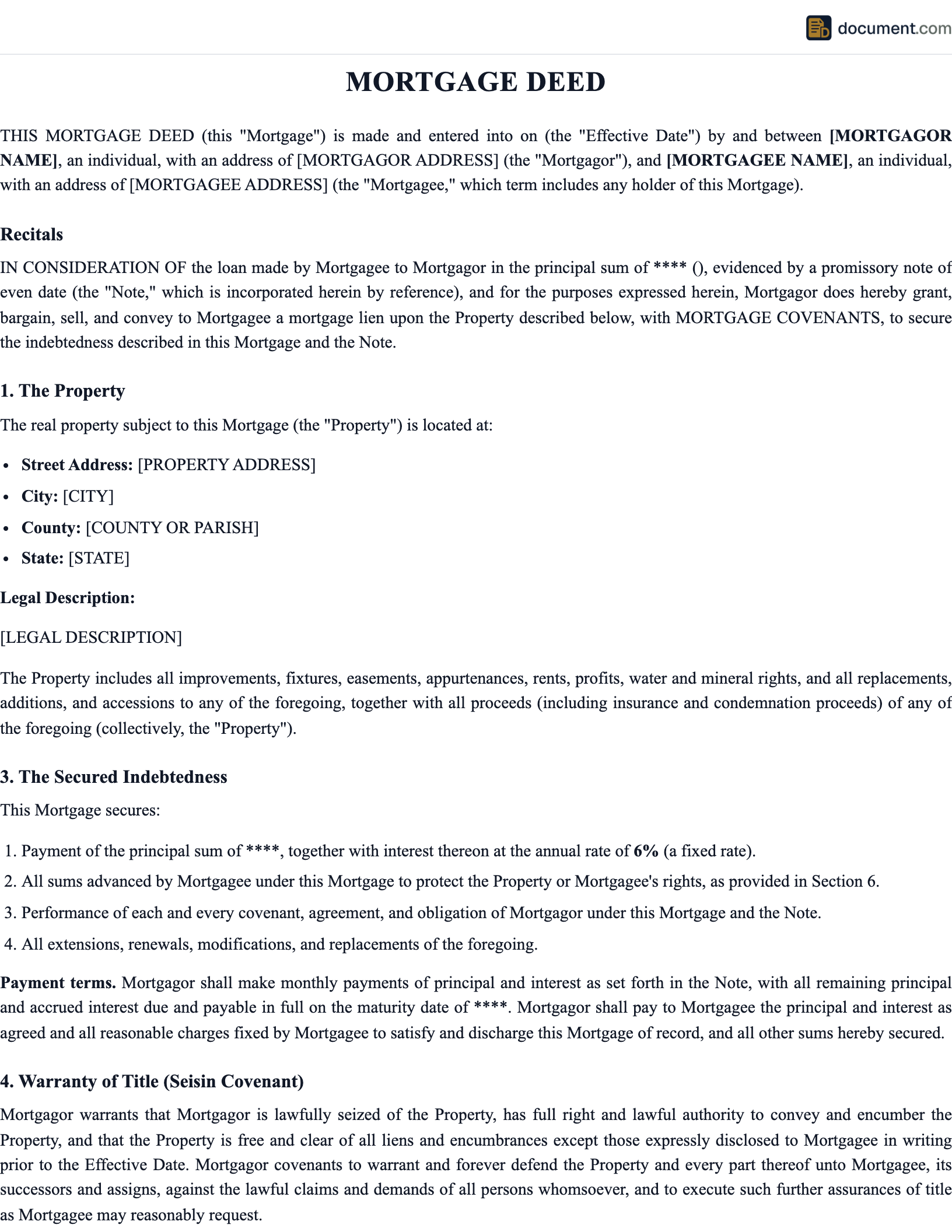
Sample Florida Mortgage Deed
Preview of our Florida-specific template. Your document will include all fields required for recording in any Florida county.
MORTGAGE DEED
STATE OF FLORIDA
Legal Document
PARTY INFORMATION
Name: [Full Legal Name]
Address: [Florida Address]
County: [County]
PROPERTY DESCRIPTION
County: [County] State: Florida
Legal Description: [Per Recorded Plat]
Parcel No.: [APN]
Florida Mortgage Deed FAQ
Common questions about filing in Florida, including requirements, fees, and tax implications.
Official Florida Resources
Official state resources for verifying requirements and finding your local recording office.
Important Considerations
Florida's two-witness requirement is the most common source of execution errors on mortgage deeds in this state. Both witnesses must be present at the same time as the notary and the mortgagor. Witnesses who sign separately after the fact, or who sign based on a phone or video confirmation rather than physical presence, create an execution defect that can jeopardize the mortgage's enforceability in a foreclosure proceeding. Plan the signing appointment carefully.
Florida's homestead protections under Article X of the Florida Constitution are among the strongest in the country. A homestead cannot be alienated without the joinder of the spouse, if the owner is married, even if title is held in only one spouse's name. This means a Florida mortgage on a homestead property must be signed by both spouses, regardless of how title is vested, or the lender's lien is unenforceable against that homestead interest. This is not a technicality that can be corrected after the fact.
Florida's judicial foreclosure timeline is one of the longer ones in the country. While the process has improved since the peak of the foreclosure crisis in the late 2000s and early 2010s, lenders should realistically budget eighteen months or more from filing to completion in contested cases. A well-drafted mortgage with clear default provisions, accurate legal descriptions, and proper execution is the lender's best protection against procedural challenges during that process.
Florida Attorney Note
Florida real estate attorneys routinely handle mortgage documentation in both institutional and private lending contexts. Given the state's homestead protections, two-witness requirement, documentary stamp and intangible taxes, and judicial foreclosure process, Florida is a state where a one-hour attorney review before signing is money well spent. Many Florida real estate attorneys offer flat-fee document review services that are affordable relative to the loan amounts involved.
Related Documents
Depending on your situation, you may need additional documents alongside this one. Below are commonly related documents that are frequently used together in real estate transactions.
Important Considerations
Before proceeding with your document, there are several important factors to consider. Each real estate transaction is unique, and understanding the specific requirements and implications of your situation will help ensure a smooth and legally compliant process.
Real estate laws and regulations are subject to change, and local requirements may differ from state-level rules. It is always advisable to verify current requirements with your local recording office before submitting any documents for recording.
If your transaction involves complex circumstances such as multiple parties, commercial properties, trusts, estates, or interstate elements, consulting with a licensed real estate attorney is strongly recommended. An attorney can provide guidance specific to your situation and help you avoid potential legal issues.
Keep copies of all documents related to your real estate transaction in a safe place. Recorded documents become part of the public record, but having your own copies ensures you can reference the terms and conditions at any time. Digital copies stored securely are also recommended as a backup.
Professional Recommendation
While our templates are designed to be comprehensive and legally compliant, we recommend having your completed document reviewed by a licensed attorney before recording, especially for high-value transactions or complex situations. Many attorneys offer flat-fee document review services that provide peace of mind at a reasonable cost.
Related Documents
Depending on your situation, you may need additional documents alongside this one. Below are commonly related documents that are frequently used together in real estate transactions.
Create your Florida Mortgage Deed in under 5 minutes.
Answer a few questions and download a Florida-compliant document, ready for the state agency.