



Delaware Mortgage Deed Overview
Delaware is a mortgage state, meaning the borrower retains title to the property while granting the lender a lien through the mortgage deed. Foreclosure in Delaware is a judicial process handled by the Court of Chancery, which is Delaware's specialized equity court. The Court of Chancery is nationally known for its expertise in corporate and business law, but it also has jurisdiction over mortgage foreclosures. Chancery foreclosures follow a structured process and typically move faster than foreclosures in many other judicial states.
Delaware has only three counties, and each has its own recorder of deeds office responsible for maintaining land records. New Castle County covers the northern part of the state including Wilmington and Newark. Kent County covers the middle region including Dover, the state capital. Sussex County covers the southernmost portion, including Delaware's popular coastal resort areas and a substantial amount of agricultural land. Recording fees and processing times vary slightly by county, though all three follow the same state-level statutory requirements for document formatting and execution.
$33
Recording fee
4% split
Transfer tax
Required
Notarization
0
Witnesses required
Delaware Requirements
All three Delaware recorder of deeds offices follow the same statutory requirements for recorded documents, but each county may have specific formatting preferences for margins, font sizes, and cover sheet requirements. Submitting a document that fails formatting requirements means it gets returned unrecorded and your lien priority is not established until resubmission. Checking with the specific county office before your first submission avoids this delay.
Delaware Specific Note
Delaware's transfer tax of 4% is one of the higher rates in the region and applies to deeds conveying ownership, not to the mortgage deed itself. Foreclosure goes through the Court of Chancery rather than the county courts, which is Delaware-specific. Sussex County properties, particularly coastal and agricultural parcels, often have complex legal descriptions that require careful verification against the recorder of deeds records before drafting the mortgage.
Document Requirements
- Notarization: Must be notarized by a Delaware notary public or authorized notary
- Witnesses: Delaware requires 0 additional witness(es)
- Legal Description: Complete legal description as it appears on the current deed of record
- Parcel Number: Assessor's parcel number or tax ID
- Return Address: Mailing address for returning the recorded document
- Formatting: Standard formatting with adequate margins, black ink, minimum 10-point font
How to File in Delaware
Recording a mortgage deed in Delaware is handled through one of the state's three county recorder of deeds offices. Delaware's small size means most transactions are within a short drive of the appropriate office, and all three counties offer e-recording for added convenience.
Draft the Document
Include all required elements: the complete legal description from the current deed of record, full legal names of the mortgagor and mortgagee, the loan amount, repayment terms and maturity date, the property tax parcel number, and a return mailing address. The preparer's name and address should also appear on the document.
Notarize the Document
The mortgagor must sign before a Delaware notary public. No additional witnesses are required beyond the notary. The notary acknowledgment must include the county where the acknowledgment is taken and the notary's commission expiration date. Delaware permits remote online notarization if an in-person appointment is not feasible.
Identify Your County Recorder of Deeds
Determine which of Delaware's three counties the property is in: New Castle (Wilmington), Kent (Dover), or Sussex (Georgetown). Contact that county's recorder of deeds to confirm current recording fees, accepted payment methods, and e-recording availability.
Submit and Pay Recording Fees
Submit the notarized original in person, by mail, or via e-recording. Pay the applicable recording fee. The transfer tax applies to the deed of conveyance, not to the mortgage, so the mortgage recording fee is the main cost at this step. Confirm the specific amount with the recorder before submitting.
Retain the Recorded Original
Once recorded, the document will be returned to the address listed on the filing. Keep the recorded original in a secure location. Both the borrower and the lender should maintain copies. If you are also recording a related promissory note or other security agreements, ensure all documents are cross-referenced for a complete record.
Delaware Fees & Costs
Typical costs for filing in Delaware. Actual fees may vary by county.
| Fee / Tax | Amount |
|---|---|
| Recording Fee | $33 |
| Transfer Tax | 4% split |
| Notarization | $5 - $25 per signature |
| Certified Copy | $1 - $10 per page |
| Attorney Review (optional) | $150 - $500 |
Delaware Tax Implications
Delaware's realty transfer tax is 4% of the purchase price, split between the state (2.5%) and the county (1.5%), with the cost typically shared equally between buyer and seller by custom. This tax applies to the deed of conveyance, not to the mortgage deed itself. Accordingly, the main cost of recording a mortgage deed in Delaware is the per-page recording fee, which is significantly less than the transfer tax applicable to a property purchase.
Delaware does not impose a separate mortgage recording tax, which keeps the cost of creating and recording a mortgage deed relatively modest. If you are a private lender recording a mortgage on Delaware real property, your main tax consideration is the federal and Delaware income tax on interest income you receive. Delaware does have a state income tax, and interest income from private lending is taxable at the ordinary income rate.
For buyers who financed a purchase, property tax is an ongoing obligation. Delaware's property tax rates vary by county and municipality, and Sussex County in particular has seen significant reassessment activity as coastal property values have climbed. Reassessment timelines and exemption programs for primary residences differ by county. Check with the relevant county's assessment office for current rates and any available exemptions that may apply to your property.
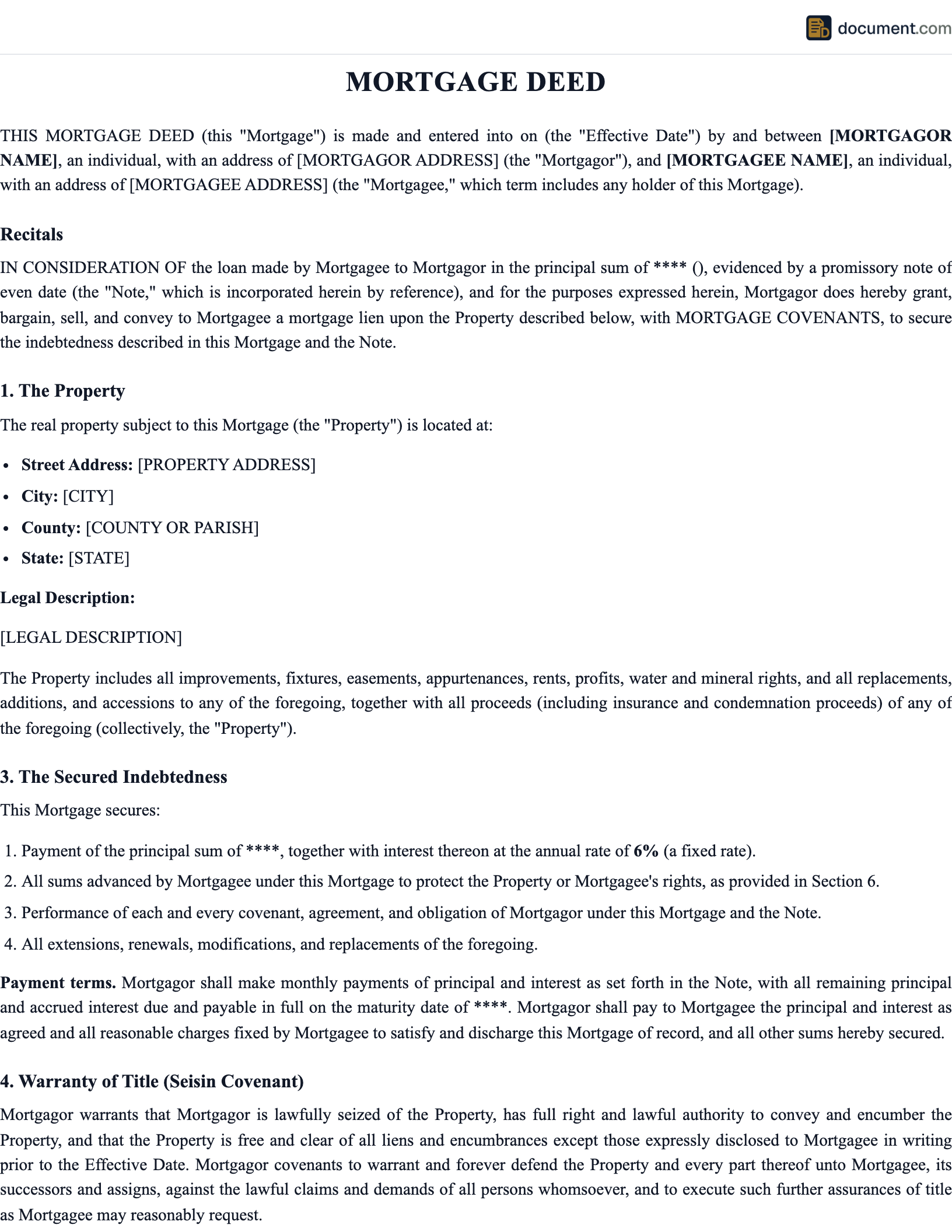
Sample Delaware Mortgage Deed
Preview of our Delaware-specific template. Your document will include all fields required for recording in any Delaware county.
MORTGAGE DEED
STATE OF DELAWARE
Legal Document
PARTY INFORMATION
Name: [Full Legal Name]
Address: [Delaware Address]
County: [County]
PROPERTY DESCRIPTION
County: [County] State: Delaware
Legal Description: [Per Recorded Plat]
Parcel No.: [APN]
Delaware Mortgage Deed FAQ
Common questions about filing in Delaware, including requirements, fees, and tax implications.
Official Delaware Resources
Official state resources for verifying requirements and finding your local recording office.
Important Considerations
Delaware's Court of Chancery handles mortgage foreclosure proceedings. This court applies equitable principles and has a long history of resolving complex real property disputes. While the Court of Chancery is world-renowned for corporate law, its jurisdiction over mortgage foreclosures is equally rigorous. Lenders filing a foreclosure action in Chancery must demonstrate proper documentation from the origination of the loan through to the default. A well-drafted mortgage deed is the foundation of that case.
Sussex County deserves particular attention. Delaware's southern county includes both popular beach communities like Rehoboth Beach and Bethany Beach and substantial agricultural land inland. Coastal properties can come with riparian rights, wetland restrictions, and easements from state and federal conservation programs. Agricultural properties may have farmland preservation easements recorded separately from the primary deed. Any mortgage on Sussex County property should be checked against these types of encumbrances before finalizing the loan terms.
Delaware's three-county structure keeps the recording system manageable but also means the recorder of deeds offices are smaller operations than those in large-state counties. If you are dealing with a time-sensitive closing, confirming e-recording availability and processing times with the specific county before submission day is worth a quick phone call.
Delaware Attorney Note
Delaware's Court of Chancery and its role in mortgage foreclosure makes the state's real estate law genuinely distinctive. If you are a private lender making a loan secured by Delaware real property, having a Delaware attorney review the mortgage deed and the promissory note before recording gives you a more reliable enforcement position if the borrower ever defaults. Delaware attorneys familiar with Chancery Court practice can also advise on any specific drafting language that strengthens your position in that forum.
Related Documents
Depending on your situation, you may need additional documents alongside this one. Below are commonly related documents that are frequently used together in real estate transactions.
Important Considerations
Before proceeding with your document, there are several important factors to consider. Each real estate transaction is unique, and understanding the specific requirements and implications of your situation will help ensure a smooth and legally compliant process.
Real estate laws and regulations are subject to change, and local requirements may differ from state-level rules. It is always advisable to verify current requirements with your local recording office before submitting any documents for recording.
If your transaction involves complex circumstances such as multiple parties, commercial properties, trusts, estates, or interstate elements, consulting with a licensed real estate attorney is strongly recommended. An attorney can provide guidance specific to your situation and help you avoid potential legal issues.
Keep copies of all documents related to your real estate transaction in a safe place. Recorded documents become part of the public record, but having your own copies ensures you can reference the terms and conditions at any time. Digital copies stored securely are also recommended as a backup.
Professional Recommendation
While our templates are designed to be comprehensive and legally compliant, we recommend having your completed document reviewed by a licensed attorney before recording, especially for high-value transactions or complex situations. Many attorneys offer flat-fee document review services that provide peace of mind at a reasonable cost.
Related Documents
Depending on your situation, you may need additional documents alongside this one. Below are commonly related documents that are frequently used together in real estate transactions.
Create your Delaware Mortgage Deed in under 5 minutes.
Answer a few questions and download a Delaware-compliant document, ready for the state agency.