



Connecticut Mortgage Deed Overview
Connecticut is a mortgage state that uses a judicial foreclosure process, and the way foreclosure works here is unlike virtually anywhere else in the country. Connecticut's "strict foreclosure" procedure allows a court to give the lender outright title to the property without conducting an auction. The court sets a law day, and if the borrower does not pay off the debt by that date, title passes directly to the lender. This process eliminates the redemption period common in other states and can result in a faster resolution for the mortgagee, though it still requires court involvement.
Land records in Connecticut are maintained at the town level by the town clerk, not at a county recording office. Connecticut abolished functional county government decades ago, so when you need to record a mortgage deed, you go to the town clerk for the municipality where the property sits. The state requires two witnesses plus a notary for execution, which is a higher bar than many states. Connecticut's conveyance tax applies to transfers of property interests and is calculated in tiers based on the consideration amount.
$60
Recording fee
0.75% - 2.25%
Transfer tax
Required
Notarization
2
Witnesses required
Connecticut Requirements
Connecticut town clerks follow standards established under the Connecticut General Statutes, but each of the 169 towns administers its own land records. Because recording is at the municipal level, requirements, fees, and processing times can differ from one town to the next. Calling the relevant town clerk before submission is always a good idea, particularly for unusual documents or properties that span multiple towns.
Connecticut Specific Note
Connecticut requires two witnesses plus a notary acknowledgment on mortgage deeds. Recording is handled by the town clerk, not a county office. Connecticut's strict foreclosure process is unique nationally and means the lender can receive title directly through court order without a public auction. Make sure the mortgage clearly identifies the property using the complete legal description from the town land records, not an abbreviated description from a tax bill.
Document Requirements
- Notarization: Must be notarized by a Connecticut notary public or authorized notary
- Witnesses: Connecticut requires 2 additional witness(es)
- Legal Description: Complete legal description as it appears on the current deed of record
- Parcel Number: Assessor's parcel number or tax ID
- Return Address: Mailing address for returning the recorded document
- Formatting: Standard formatting with adequate margins, black ink, minimum 10-point font
How to File in Connecticut
Recording in Connecticut goes through the town clerk's office for the town where the property is located. Unlike states with county recorders, you need to identify the correct municipality first. A property in Glastonbury records in Glastonbury's town hall, not at a regional or county office.
Draft the Document Carefully
Complete all required fields including the full legal description from the town land records, the names of both the mortgagor and mortgagee, the loan amount and repayment terms, and the return mailing address. Include the grantor's mailing address as required under Connecticut statute.
Arrange Signing with Two Witnesses and a Notary
Connecticut requires the mortgagor to sign in the presence of two witnesses who are not parties to the transaction, plus a notary public who acknowledges the signature. Coordinate everyone's schedule in advance. The witnesses must be physically present at the signing, not just signing separately at a later time.
Locate the Correct Town Clerk
Identify the town where the property is located and contact that town's clerk to confirm their hours, accepted payment methods, and whether they participate in e-recording. Connecticut has 169 separate town land record offices, and some are only open limited hours each week.
Submit and Pay the Recording Fee
Present the notarized original to the town clerk and pay the applicable recording fee. Connecticut recording fees are set by statute but verify the current rate, as the per-page fee for mortgages can differ from the rate for other recorded documents.
Retrieve the Recorded Original
The town clerk will stamp the document with the recording information and return the original to the address listed on the document. Keep the recorded original in a secure location. Both lender and borrower should retain copies of the fully executed and recorded mortgage deed.
Connecticut Fees & Costs
Typical costs for filing in Connecticut. Actual fees may vary by county.
| Fee / Tax | Amount |
|---|---|
| Recording Fee | $60 |
| Transfer Tax | 0.75% - 2.25% |
| Notarization | $5 - $25 per signature |
| Certified Copy | $1 - $10 per page |
| Attorney Review (optional) | $150 - $500 |
Connecticut Tax Implications
Connecticut's real estate conveyance tax applies to transfers of property interests and is a significant cost to factor into any purchase transaction. The state conveyance tax is 0.75% on the first $800,000 of consideration, and 1.25% on amounts above that threshold. Municipalities can add a local conveyance tax of up to 0.25%. These taxes are due at closing and are typically paid by the seller, though the parties can negotiate who bears this cost.
A mortgage deed is a security instrument, not a conveyance of ownership, so recording a mortgage deed does not itself trigger the conveyance tax. If the mortgage is part of a purchase transaction, the conveyance tax will apply to the underlying warranty deed or other deed transferring title. If you are refinancing, the conveyance tax does not apply because ownership is not changing hands.
Connecticut does not have a separate mortgage recording tax, unlike some neighboring states. However, Connecticut's overall property tax burden is among the highest in the country, and municipalities reassess properties periodically. A sale can trigger a reassessment to the sale price depending on the timing relative to the town's revaluation cycle. Connecticut has both state and local income taxes, and any interest income from a private mortgage is taxable at both levels for the lender.
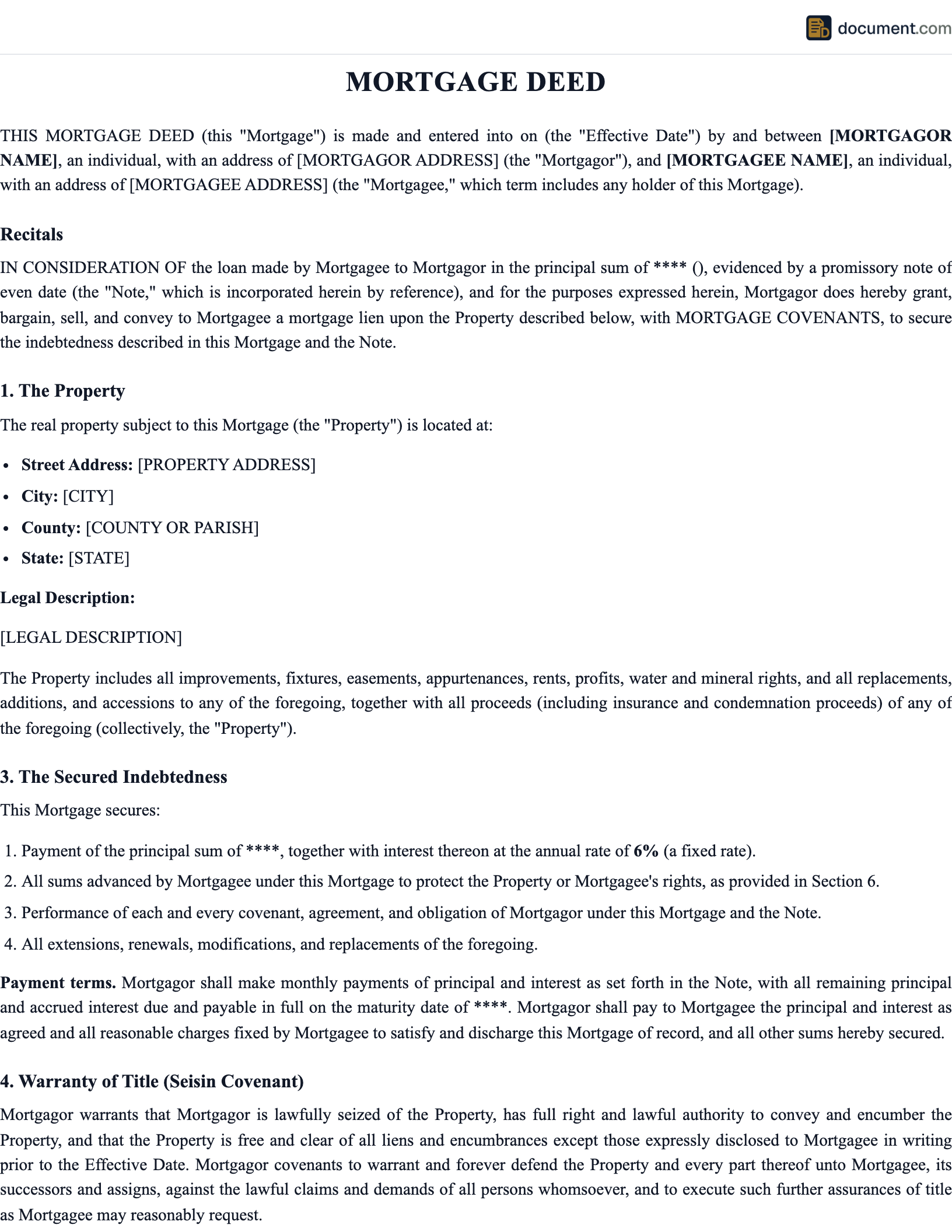
Sample Connecticut Mortgage Deed
Preview of our Connecticut-specific template. Your document will include all fields required for recording in any Connecticut county.
MORTGAGE DEED
STATE OF CONNECTICUT
Legal Document
PARTY INFORMATION
Name: [Full Legal Name]
Address: [Connecticut Address]
County: [County]
PROPERTY DESCRIPTION
County: [County] State: Connecticut
Legal Description: [Per Recorded Plat]
Parcel No.: [APN]
Connecticut Mortgage Deed FAQ
Common questions about filing in Connecticut, including requirements, fees, and tax implications.
Official Connecticut Resources
Official state resources for verifying requirements and finding your local recording office.
Important Considerations
Connecticut's strict foreclosure process is the single most important thing to understand when using a mortgage deed in this state. Unlike the power-of-sale foreclosure available in many states, or even the auction-based foreclosure common elsewhere, Connecticut's judicial strict foreclosure allows the court to set a "law day." If the borrower does not redeem the mortgage by paying off the full debt on or before that date, title transfers directly to the lender without any auction. This process typically takes a year or more from filing to resolution.
Because foreclosure is a court proceeding in Connecticut, the mortgage deed needs to be precisely drafted. Courts have rejected foreclosure actions based on technical deficiencies in the underlying mortgage document. The legal description must match exactly what appears in the town's land records. Both party names must appear consistently throughout the document. Any ambiguity in the default or acceleration provisions can complicate a foreclosure filing.
Connecticut's 169-town land records system can be confusing for out-of-state parties. If a property straddles a town line, both town clerks may need to receive the recording. Title insurance is especially valuable in Connecticut given the decentralized record-keeping and the volume of older properties in the state with complex title histories.
Connecticut Attorney Note
Connecticut attorneys are not required for real estate closings by statute, but the complexity of the state's foreclosure process and the strict witness requirements for mortgage execution make attorney involvement genuinely valuable here. Many Connecticut closings are handled by attorneys rather than title companies alone. If you are a private lender making a loan secured by Connecticut real property, having a Connecticut real estate attorney draft or review the mortgage deed is a reasonable precaution.
Related Documents
Depending on your situation, you may need additional documents alongside this one. Below are commonly related documents that are frequently used together in real estate transactions.
Important Considerations
Before proceeding with your document, there are several important factors to consider. Each real estate transaction is unique, and understanding the specific requirements and implications of your situation will help ensure a smooth and legally compliant process.
Real estate laws and regulations are subject to change, and local requirements may differ from state-level rules. It is always advisable to verify current requirements with your local recording office before submitting any documents for recording.
If your transaction involves complex circumstances such as multiple parties, commercial properties, trusts, estates, or interstate elements, consulting with a licensed real estate attorney is strongly recommended. An attorney can provide guidance specific to your situation and help you avoid potential legal issues.
Keep copies of all documents related to your real estate transaction in a safe place. Recorded documents become part of the public record, but having your own copies ensures you can reference the terms and conditions at any time. Digital copies stored securely are also recommended as a backup.
Professional Recommendation
While our templates are designed to be comprehensive and legally compliant, we recommend having your completed document reviewed by a licensed attorney before recording, especially for high-value transactions or complex situations. Many attorneys offer flat-fee document review services that provide peace of mind at a reasonable cost.
Related Documents
Depending on your situation, you may need additional documents alongside this one. Below are commonly related documents that are frequently used together in real estate transactions.
Create your Connecticut Mortgage Deed in under 5 minutes.
Answer a few questions and download a Connecticut-compliant document, ready for the state agency.