



Colorado Mortgage Deed Overview
Colorado sits in an interesting position among states when it comes to real property security instruments. Most Colorado lenders use a deed of trust rather than a traditional mortgage deed because the deed of trust allows non-judicial foreclosure through the state's public trustee system. However, mortgage deeds are fully valid under Colorado law and are used in a range of transactions, particularly in owner-financed deals and certain commercial arrangements where the parties prefer the mortgage structure.
When a mortgage deed is used in Colorado, it is recorded with the county clerk and recorder in the county where the property is located. Colorado does not impose a mortgage recording tax, which keeps upfront costs lower than in states like Florida or Georgia. The document must be notarized, though no additional witnesses are required beyond the notary. Colorado's race-notice recording system means that the recorded date determines priority, so prompt recording after execution is important.
$13
Recording fee
$0.01 per $100
Transfer tax
Required
Notarization
0
Witnesses required
Colorado Requirements
Colorado county clerk and recorder offices have uniform statutory requirements for recording real property documents, but each county may have its own supplemental formatting preferences. Documents that fail to meet technical requirements will be returned unrecorded, which can delay the transaction and create priority issues. Reviewing requirements with the specific county before submitting is always worthwhile.
Colorado Specific Note
Colorado does not have a mortgage recording tax, but the county clerk and recorder charges a per-page recording fee. Because Colorado is primarily a deed of trust state, a mortgage deed may be less familiar to local title companies and lenders. If you are using a mortgage deed rather than a deed of trust, confirm with your lender or title company that they will work with that instrument. The document must include the preparer's name and address under C.R.S. 38-35-109.
Document Requirements
- Notarization: Must be notarized by a Colorado notary public or authorized notary
- Witnesses: Colorado requires 0 additional witness(es)
- Legal Description: Complete legal description as it appears on the current deed of record
- Parcel Number: Assessor's parcel number or tax ID
- Return Address: Mailing address for returning the recorded document
- Formatting: Standard formatting with adequate margins, black ink, minimum 10-point font
How to File in Colorado
Recording a mortgage deed in Colorado is handled through the county clerk and recorder in the county where the property sits. The process is straightforward, but the details matter. A rejected document does not hold your place in the recording queue, so getting it right on the first submission saves time and protects your lien priority.
Prepare the Document
Complete all required fields including the legal description pulled from the current vesting deed, both parties' full legal names, the loan amount and terms, and the preparer's name and address as required by Colorado statute. Leave adequate top margin for the county's recording stamp.
Execute Before a Notary
The mortgagor must sign in front of a Colorado notary public or a notary authorized to act in Colorado. No additional witnesses are required. Colorado permits remote online notarization, so you are not limited to an in-person appointment if scheduling is an issue.
Submit to the County Clerk and Recorder
Bring the notarized original to the county clerk and recorder in the county where the property is located. Most Colorado counties accept e-recording through services like Simplifile or similar platforms, which can reduce turnaround time significantly compared to mail-in submissions.
Pay the Recording Fee
Colorado charges a per-page recording fee set by statute. There is no separate mortgage tax. Payment methods vary by county, so confirm accepted forms of payment before appearing in person. Keep your receipt and the returned recorded original for your files.
Confirm Recording and Distribute Copies
Once recorded, the county will return the original with a recording stamp showing the reception number, book, and page. Provide a copy to both the mortgagor and mortgagee. If the property has a homeowners association, notify them of the new lien as well.
Colorado Fees & Costs
Typical costs for filing in Colorado. Actual fees may vary by county.
| Fee / Tax | Amount |
|---|---|
| Recording Fee | $13 |
| Transfer Tax | $0.01 per $100 |
| Notarization | $5 - $25 per signature |
| Certified Copy | $1 - $10 per page |
| Attorney Review (optional) | $150 - $500 |
Colorado Tax Implications
Colorado does not impose a mortgage recording tax or a documentary stamp tax on mortgage instruments. This is a meaningful distinction from states like Florida, which charge both a doc stamp tax and an intangible tax on new mortgages. The absence of a mortgage tax in Colorado keeps closing costs down for owner-financed transactions and private lender deals.
Colorado does have a real property transfer tax at the state level, but it applies to the deed conveying ownership, not to the mortgage itself. Some Colorado municipalities impose a local transfer tax in addition to the state tax, so buyers and sellers in cities like Telluride or Aspen should factor that in. The mortgage deed is not subject to these transfer taxes since it is a lien, not a conveyance of title.
For owner-financed deals where the seller takes back a mortgage, the interest income received by the seller is taxable as ordinary income for federal and Colorado state purposes. The borrower may be able to deduct qualified mortgage interest on their federal return, but Colorado's income tax conforms closely to the federal treatment. Borrowers and sellers in these arrangements should each consult a tax advisor to understand how the deal will be reported.
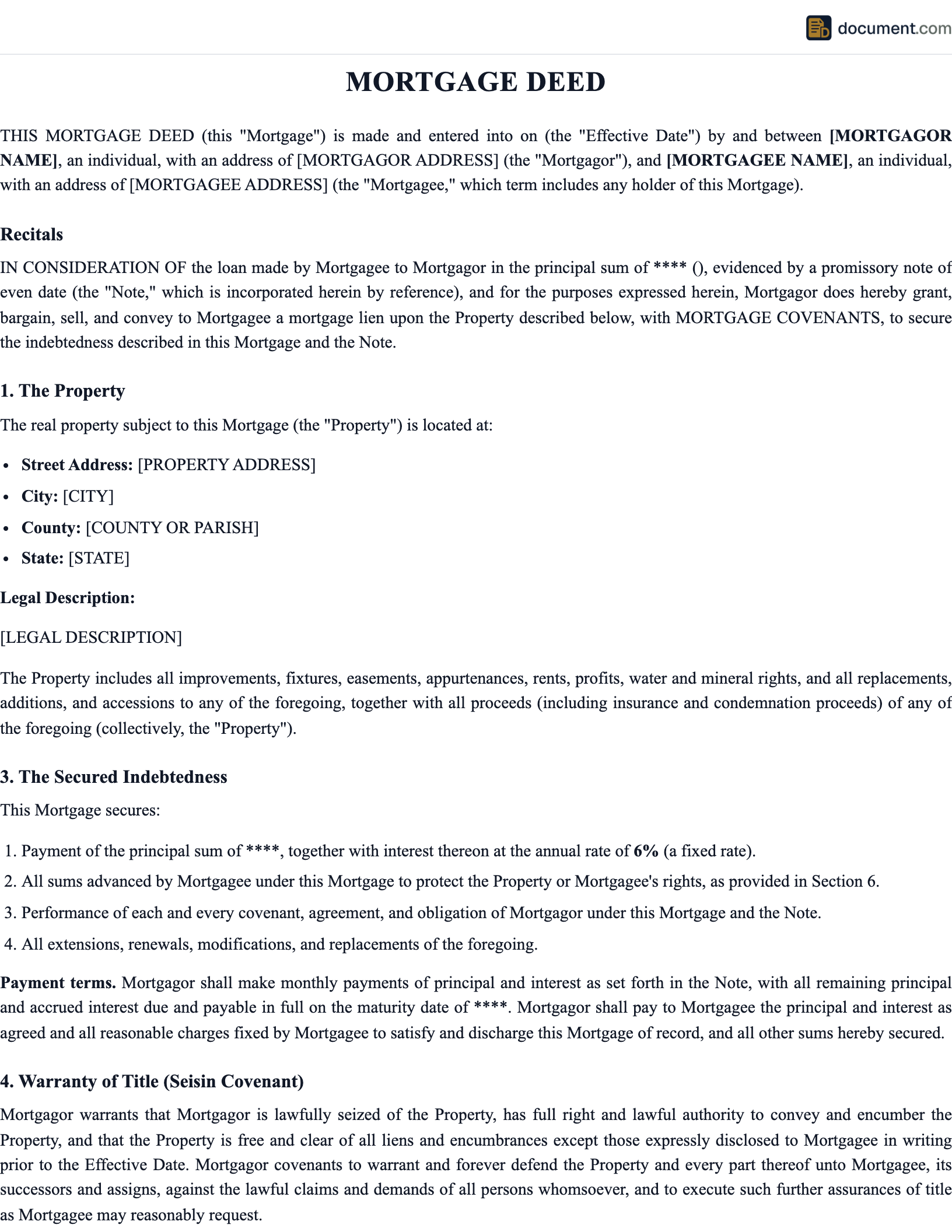
Sample Colorado Mortgage Deed
Preview of our Colorado-specific template. Your document will include all fields required for recording in any Colorado county.
MORTGAGE DEED
STATE OF COLORADO
Legal Document
PARTY INFORMATION
Name: [Full Legal Name]
Address: [Colorado Address]
County: [County]
PROPERTY DESCRIPTION
County: [County] State: Colorado
Legal Description: [Per Recorded Plat]
Parcel No.: [APN]
Colorado Mortgage Deed FAQ
Common questions about filing in Colorado, including requirements, fees, and tax implications.
Official Colorado Resources
Official state resources for verifying requirements and finding your local recording office.
Important Considerations
Because Colorado lenders typically use deeds of trust, a mortgage deed is less common in standard residential lending here. If you are using a mortgage deed rather than a deed of trust, make sure your lender is prepared to work with that instrument and that your title insurance company will insure the lien. Some Colorado lenders may insist on a deed of trust to preserve non-judicial foreclosure rights through the public trustee system.
Colorado's public trustee system is unique in the country. Each county has a public trustee, an elected or appointed official who handles the non-judicial foreclosure process for deeds of trust. Mortgage deeds do not benefit from this system. Foreclosing on a mortgage deed in Colorado requires going through the district court, which adds time and expense. This is a practical reason why most lenders prefer the deed of trust, and it is worth understanding before choosing your instrument.
If you are financing a property purchase with a private lender or structuring an owner-financed sale, the mortgage deed can be a simpler instrument to explain to the parties. Just make sure the underlying promissory note clearly sets out the loan amount, interest rate, payment schedule, and default provisions. The mortgage deed secures the note against the property, but the note is the heart of the obligation.
Colorado Attorney Note
Colorado real estate attorneys familiar with private lending and owner financing can help you decide whether a mortgage deed or deed of trust makes more sense for your transaction. Given the foreclosure differences between the two instruments, this is a decision worth making with professional input rather than defaulting to one or the other without understanding the implications.
Related Documents
Depending on your situation, you may need additional documents alongside this one. Below are commonly related documents that are frequently used together in real estate transactions.
Important Considerations
Before proceeding with your document, there are several important factors to consider. Each real estate transaction is unique, and understanding the specific requirements and implications of your situation will help ensure a smooth and legally compliant process.
Real estate laws and regulations are subject to change, and local requirements may differ from state-level rules. It is always advisable to verify current requirements with your local recording office before submitting any documents for recording.
If your transaction involves complex circumstances such as multiple parties, commercial properties, trusts, estates, or interstate elements, consulting with a licensed real estate attorney is strongly recommended. An attorney can provide guidance specific to your situation and help you avoid potential legal issues.
Keep copies of all documents related to your real estate transaction in a safe place. Recorded documents become part of the public record, but having your own copies ensures you can reference the terms and conditions at any time. Digital copies stored securely are also recommended as a backup.
Professional Recommendation
While our templates are designed to be comprehensive and legally compliant, we recommend having your completed document reviewed by a licensed attorney before recording, especially for high-value transactions or complex situations. Many attorneys offer flat-fee document review services that provide peace of mind at a reasonable cost.
Related Documents
Depending on your situation, you may need additional documents alongside this one. Below are commonly related documents that are frequently used together in real estate transactions.
Create your Colorado Mortgage Deed in under 5 minutes.
Answer a few questions and download a Colorado-compliant document, ready for the state agency.