



California Mortgage Deed Overview
California is one of the most heavily deed-of-trust-dependent states in the country. For practical purposes, mortgage deeds are not used in standard California real estate transactions. The deed of trust, not the mortgage deed, is the instrument that secures virtually every home purchase loan, refinance, home equity line of credit, and commercial real property loan in the state. California's non-judicial foreclosure framework under Civil Code Sections 2924 through 2924k gives lenders using deeds of trust a faster and less expensive enforcement path than the judicial foreclosure process required for mortgage deeds.
If a California mortgage deed were used, it would be recorded at the county recorder's office in the property's county. California has 58 counties with separate recording offices. Recording fees start around $15 for the first page. California imposes a documentary transfer tax of $1.10 per $1,000 on conveyances of real property, though this tax generally applies to deeds transferring ownership rather than mortgage instruments. Some California cities and counties impose substantial additional local transfer taxes. Notarization is required; no witnesses beyond the notary are needed. As a community property state, California requires both spouses to sign a mortgage on community property.
$15
Recording fee
$1.10 per $1,000
Transfer tax
Required
Notarization
0
Witnesses required
California Requirements
California recording requirements are set by the California Government Code. A mortgage deed must be signed by the mortgagor and acknowledged before a California notary public before it can be recorded. California has detailed notary regulations; the notary must complete a journal entry for each notarization and include the notary seal, signature, and commission expiration date on the acknowledgment. California also permits remote online notarization for certain documents under California Civil Code 1633.10, though real property instruments have specific requirements that should be verified before using remote notarization.
California Specific Note
California is a deed-of-trust state. Mortgage deeds are legally valid but rarely used by institutional lenders because they require judicial foreclosure rather than the non-judicial trustee sale available under a deed of trust. If you are drafting a California mortgage deed for a private transaction, be aware that California law provides the borrower with additional protections after judicial foreclosure, including in some circumstances the right to a deficiency judgment credit. Also note that some California cities and counties impose local documentary transfer taxes that can significantly exceed the state rate of $1.10 per $1,000. Confirm local tax rates before closing.
Document Requirements
- Notarization: Must be notarized by a California notary public or authorized notary
- Witnesses: California requires 0 additional witness(es)
- Legal Description: Complete legal description as it appears on the current deed of record
- Parcel Number: Assessor's parcel number or tax ID
- Return Address: Mailing address for returning the recorded document
- Formatting: Standard formatting with adequate margins, black ink, minimum 10-point font
How to File in California
Because mortgage deeds are uncommon in California, parties using one should work with a California real estate attorney who understands the judicial foreclosure process and the applicable anti-deficiency rules before proceeding.
Prepare the Document
Complete the mortgage deed with the full legal names and addresses of the mortgagor and mortgagee, the complete legal description from the current deed of record, the Assessor's Parcel Number, the county name, the amount of the secured obligation, and a return address. If the property is community property, include signature lines for both spouses.
Get the Document Notarized
All required signers must appear before a California-commissioned notary public. California notary law requires the notary to keep a journal entry for each acknowledgment. The notary must affix their seal, sign, and note their commission expiration date. Thumbprints are required for certain California real property instruments. No witnesses beyond the notary are required.
Submit to the County Recorder
File the executed mortgage deed with the county recorder in the California county where the property is located. California's 58 county recorders accept walk-in, mail-in, and e-recording. Large counties like Los Angeles and Santa Clara offer robust e-recording through approved vendors. Smaller counties may have more limited submission options.
Pay Recording Fees and Applicable Taxes
California recording fees start around $15 for the first page with per-page charges beyond that. The state documentary transfer tax of $1.10 per $1,000 generally applies to conveyances of ownership, not to mortgage instruments. However, some California cities and counties impose separate local transfer taxes. Confirm whether any local tax applies and at what rate before filing.
Retain the Recorded Original
The county recorder stamps the document with the recording number and date and returns it. Store the recorded mortgage deed with the promissory note and all related loan documents. When the loan is paid off, require the lender to record a full reconveyance or satisfaction of mortgage with the same county recorder. California imposes deadlines on lenders for releasing paid-off security instruments; follow up if the release is delayed.
California Fees & Costs
Typical costs for filing in California. Actual fees may vary by county.
| Fee / Tax | Amount |
|---|---|
| Recording Fee | $15 |
| Transfer Tax | $1.10 per $1,000 |
| Notarization | $5 - $25 per signature |
| Certified Copy | $1 - $10 per page |
| Attorney Review (optional) | $150 - $500 |
California Tax Implications
California imposes a statewide documentary transfer tax of $1.10 per $1,000 of consideration on transfers of real property. This tax applies to deeds conveying ownership and is collected by the county recorder at the time of recording. It does not apply to mortgage deeds, which create a lien rather than transfer title. However, several California cities and counties impose their own additional transfer taxes that can be substantially higher than the state rate. San Francisco imposes a tiered transfer tax that reaches $30 per $1,000 on high-value properties. Los Angeles, Oakland, and other jurisdictions have adopted city-level taxes as well. For any California transaction, confirm the local tax rate based on the property's specific location.
California property taxes are governed by Proposition 13, which limits property tax to 1% of assessed value and caps annual reassessment increases at 2% for properties that have not been sold or significantly improved. A mortgage transaction by itself does not trigger a Proposition 13 reassessment because title does not change hands. Reassessment occurs when the property is sold. Lenders escrow property taxes as part of the monthly payment to ensure the annual tax bill is paid to the county tax collector.
California's community property rules have significant federal income tax implications. Property held as community property in California receives a full stepped-up basis on both halves at the death of either spouse, which is more favorable than the rules in common-law states. This basis benefit applies regardless of which spouse owns the property on paper. Parties structuring a California real property transaction, including any mortgage, should consider the community property implications with a California tax professional.
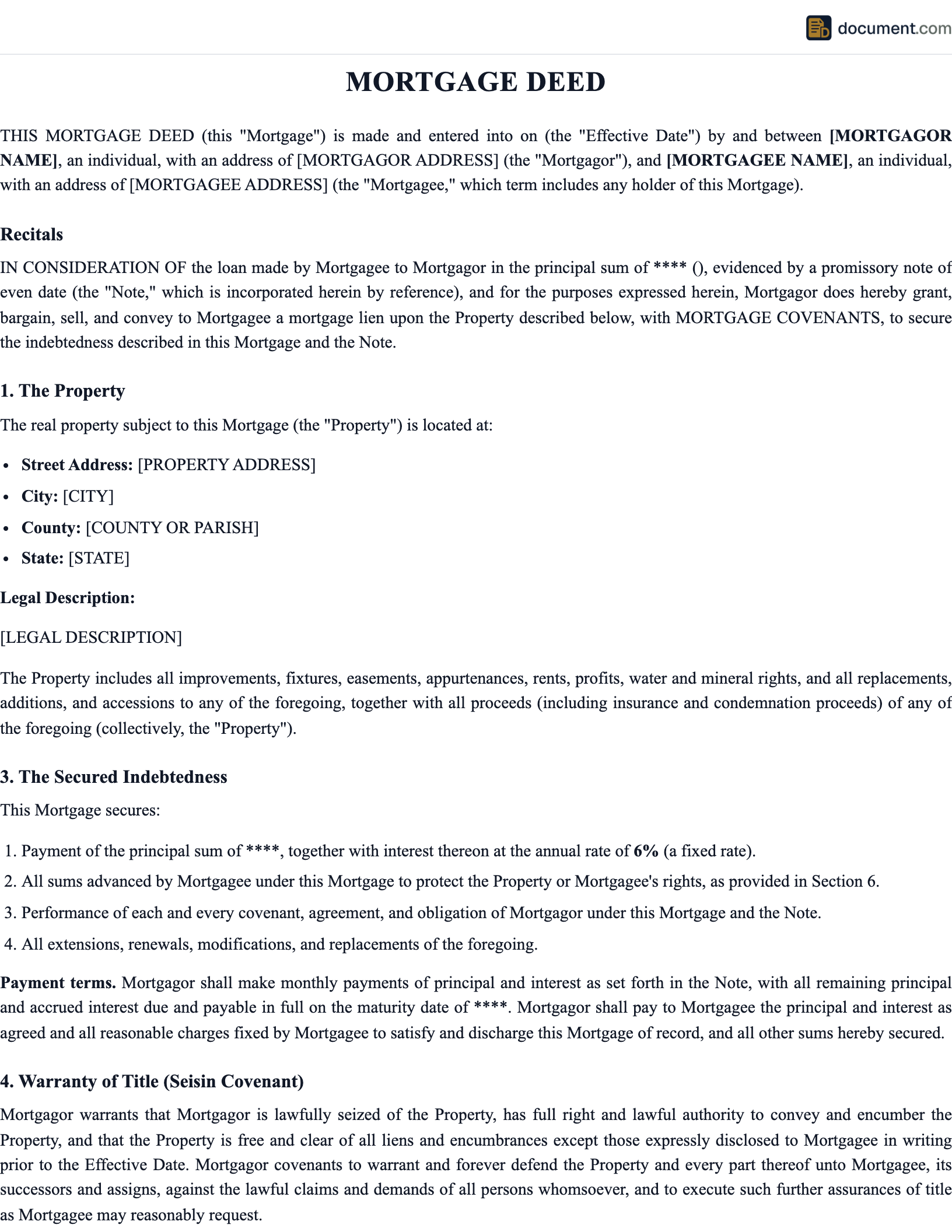
Sample California Mortgage Deed
Preview of our California-specific template. Your document will include all fields required for recording in any California county.
MORTGAGE DEED
STATE OF CALIFORNIA
Legal Document
PARTY INFORMATION
Name: [Full Legal Name]
Address: [California Address]
County: [County]
PROPERTY DESCRIPTION
County: [County] State: California
Legal Description: [Per Recorded Plat]
Parcel No.: [APN]
California Mortgage Deed FAQ
Common questions about filing in California, including requirements, fees, and tax implications.
Official California Resources
Official state resources for verifying requirements and finding your local recording office.
Important Considerations for California Mortgage Deeds
California's near-exclusive use of deeds of trust is not arbitrary. The deed-of-trust structure gives California lenders access to a non-judicial foreclosure process under Civil Code 2924 that is fundamentally faster and less expensive than judicial foreclosure. A lender using a mortgage deed in California gives up that non-judicial option entirely. If the borrower defaults, the lender must file a lawsuit in California Superior Court, obtain a judgment, and proceed through a court-supervised sale, which in California can take well over a year from first default to completed sale.
The anti-deficiency rules under California Code of Civil Procedure Sections 580b and 580d add another layer of complexity. Under CCP 580d, a lender who forecloses non-judicially through a trustee sale cannot seek a deficiency judgment against the borrower. By contrast, a lender who pursues judicial foreclosure under a mortgage deed may in some circumstances preserve the right to a deficiency judgment, depending on the loan type and property. This is the primary reason some private lenders deliberately choose a mortgage deed in California when they want to preserve that remedy.
California's community property rules require both spouses to sign a mortgage on community real property. California also requires a thumbprint of the signer in the notary's journal for any real property instrument being notarized, which is a more stringent requirement than most other states impose. Parties using a California notary for a real property mortgage deed should be prepared to provide a thumbprint at the time of notarization.
Deed of Trust vs. Mortgage Deed in California
For the vast majority of California real property financing, a deed of trust is the appropriate instrument. A California mortgage deed is a specialized tool with a narrow appropriate use case. If you are considering a California mortgage deed for a private lending transaction, consult a California real estate attorney before drafting the document. The attorney can advise on the foreclosure consequences, anti-deficiency rules, community property requirements, and whether the transaction is better structured as a deed of trust with a judicial foreclosure waiver or as a mortgage deed.
Related Documents
Depending on your situation, you may need additional documents alongside this one. Below are commonly related documents that are frequently used together in real estate transactions.
Important Considerations
California is fundamentally a deed-of-trust state, and nearly all real estate professionals in the state work exclusively with deeds of trust. A California mortgage deed is a legally valid but unusual instrument. Anyone using one should understand clearly that it requires judicial foreclosure through the California Superior Court if the borrower defaults, which is slower, more expensive, and more uncertain than the non-judicial trustee sale process.
California's anti-deficiency rules are among the most complex and consumer-protective in the country. CCP 580b bars deficiency judgments after foreclosure on a purchase money mortgage or deed of trust on owner-occupied residential property. CCP 580d bars deficiency judgments after any non-judicial trustee sale. The interaction of these rules with a judicial foreclosure under a California mortgage deed is an area where legal advice is particularly important.
California notary law is stricter than in most states. The notary must record a journal entry and take a thumbprint for real property instruments. Out-of-state notarization is permitted if the notary is commissioned in the state where the acknowledgment is taken, but California has specific acknowledgment certificate forms that should be used.
Community property is the default ownership form for property acquired by married persons in California. Both spouses must sign any mortgage on community property. When the loan is paid off, the lender must record a satisfaction of mortgage or full reconveyance with the county recorder. California law imposes specific deadlines on lenders for releasing paid security interests after payoff. are also recommended as a backup.
Professional Recommendation
While our templates are designed to be comprehensive and legally compliant, we recommend having your completed document reviewed by a licensed attorney before recording, especially for high-value transactions or complex situations. Many attorneys offer flat-fee document review services that provide peace of mind at a reasonable cost.
Related Documents
Depending on your situation, you may need additional documents alongside this one. Below are commonly related documents that are frequently used together in real estate transactions.
Create your California Mortgage Deed in under 5 minutes.
Answer a few questions and download a California-compliant document, ready for the state agency.