
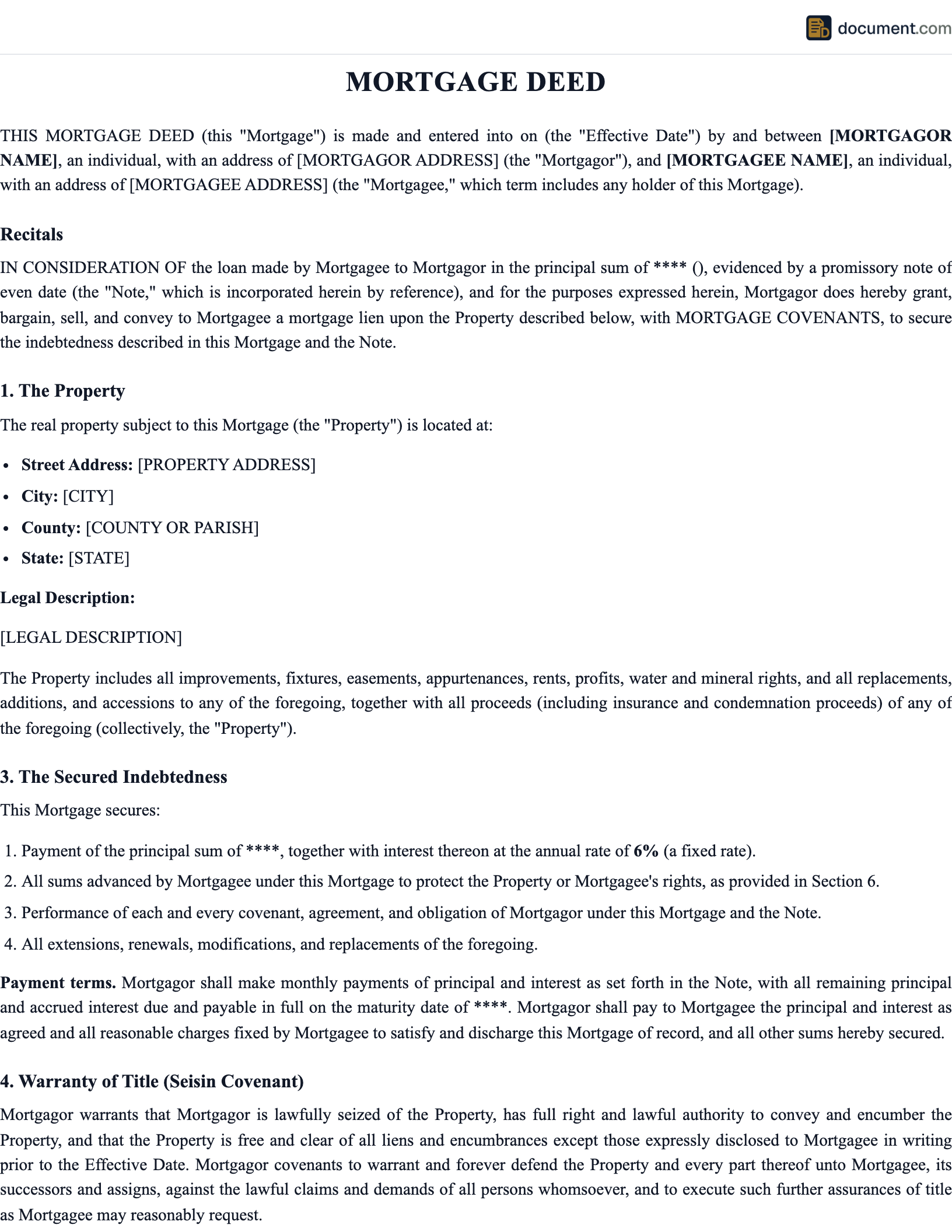



Arkansas Mortgage Deed Overview
Arkansas occupies an interesting middle position in the national landscape: it permits both mortgage deeds and deeds of trust, and both instruments see real-world use. Historically a mortgage state, Arkansas made non-judicial foreclosure available to lenders using deeds of trust after the Arkansas Statutory Foreclosure Act was adopted, and many institutional lenders moved toward deeds of trust to take advantage of the faster enforcement timeline. Mortgage deeds remain widely used for seller financing, agricultural land loans, and some smaller private lending arrangements.
Mortgage deeds in Arkansas are recorded with the circuit clerk in the county where the property is located. Each of Arkansas's 75 counties has a circuit clerk who maintains official real property records. Recording fees start around $15 per document. Arkansas imposes a real estate transfer tax of $3.30 per $1,000 of consideration, though this tax applies to transfers of ownership rather than to mortgage instruments directly. Notarization is required; no witnesses beyond the notary are needed. The homestead spousal consent rule is particularly important in Arkansas and is constitutionally rooted.
$15
Recording fee
$3.30 per $1,000
Transfer tax
Required
Notarization
0
Witnesses required
Arkansas Requirements
Arkansas recording requirements are governed by Title 18 of the Arkansas Code. A mortgage deed must be signed by the mortgagor and acknowledged before a notary public before it can be recorded. Because Arkansas follows a judicial foreclosure process for mortgage deeds, a properly recorded mortgage is the starting point for any enforcement action, and errors in the legal description or missing signatures can significantly complicate matters if the loan ever goes into default.
Arkansas Specific Note
Arkansas's constitutional homestead protection requires spousal consent for any mortgage on a homestead property, regardless of whose name is on the title. This is a constitutionally grounded rule that cannot be waived by contract. Arkansas also charges a $3.30 per $1,000 real estate transfer tax on conveyances, though this typically does not apply to mortgage instruments. Base recording fees start around $15; confirm per-page charges with the specific county circuit clerk before filing.
Document Requirements
- Notarization: Must be notarized by an Arkansas notary public or authorized notary
- Witnesses: Arkansas requires 0 additional witness(es)
- Legal Description: Complete legal description as it appears on the current deed of record
- Parcel Number: Assessor's parcel number or tax ID
- Return Address: Mailing address for returning the recorded document
- Formatting: Standard formatting with adequate margins, black ink, minimum 10-point font
How to File in Arkansas
Arkansas routes real property recording through the county circuit clerk rather than a separate recorder of deeds. Recording at the circuit clerk's office is how constructive notice is established for mortgage deeds in Arkansas, making timely filing critical from the lender's perspective.
Prepare the Document
Complete the mortgage deed with the full legal names and addresses of all parties, the complete legal description from the current deed on file with the circuit clerk, the amount of the secured debt, and repayment terms. Determine whether the property is a homestead and, if so, include a signature line for the mortgagor's spouse.
Get the Document Notarized
All required signers, including a spouse on homestead property, must sign before a notary public. Arkansas permits out-of-state notarization for parties signing outside Arkansas, provided the notary is duly commissioned in the state where the acknowledgment is taken. No witnesses beyond the notary are required.
File With the County Circuit Clerk
Bring the original notarized mortgage deed to the circuit clerk's office in the Arkansas county where the property is located. Arkansas has 75 counties, each with its own clerk. Smaller rural offices may have limited hours; call ahead before visiting. E-recording is available in some counties through approved electronic submitters.
Pay Recording and Transfer Fees
The base recording fee starts around $15 for the first page with additional per-page charges. Arkansas imposes a $3.30 per $1,000 real estate transfer tax on deeds conveying ownership, though this tax typically does not apply to mortgage instruments. Confirm the applicable fees and payment methods with the specific county circuit clerk before filing.
Retain the Stamped Original
The circuit clerk's office will stamp and return the recorded mortgage deed with the book and page reference from the official record. Keep this document in your permanent files. When the loan is paid off, the lender must record a release of mortgage or a satisfaction with the same circuit clerk. A lender who fails to timely record the release may be subject to penalties under Arkansas law.
Arkansas Fees & Costs
Typical costs for filing in Arkansas. Actual fees may vary by county.
| Fee / Tax | Amount |
|---|---|
| Recording Fee | $15 |
| Transfer Tax | $3.30 per $1,000 |
| Notarization | $5 - $25 per signature |
| Certified Copy | $1 - $10 per page |
| Attorney Review (optional) | $150 - $500 |
Arkansas Tax Implications
Arkansas imposes a real estate transfer tax of $3.30 per $1,000 of the property's consideration on deeds and conveyances. This tax is collected when a warranty deed, quitclaim deed, or similar transfer instrument is recorded. Mortgage deeds generally do not trigger the transfer tax because they create a lien rather than transferring ownership, but it is prudent to confirm the tax treatment with the circuit clerk or an Arkansas attorney, particularly for transactions where the line between a conveyance and a security instrument may be blurred.
Arkansas property taxes are assessed at the county level by each county's assessor. Property is assessed at 20% of its appraised market value for tax purposes. The annual tax rate is then applied to the assessed value. Arkansas requires that property be assessed annually, and both real and personal property are subject to tax. Lenders typically escrow property taxes as part of the monthly mortgage payment to ensure the taxes are paid and the property does not fall into a tax sale.
Arkansas does not impose a state mortgage recording tax or intangible tax on the loan amount. This keeps recording costs lower than in states like Florida or Georgia that charge taxes based on the mortgage principal. However, borrowers should account for the potential transfer tax liability on any deed associated with the same transaction.
Sample Arkansas Mortgage Deed
Preview of our Arkansas-specific template. Your document will include all fields required for recording in any Arkansas county.
MORTGAGE DEED
STATE OF ARKANSAS
Legal Document
PARTY INFORMATION
Name: [Full Legal Name]
Address: [Arkansas Address]
County: [County]
PROPERTY DESCRIPTION
County: [County] State: Arkansas
Legal Description: [Per Recorded Plat]
Parcel No.: [APN]
Arkansas Mortgage Deed FAQ
Common questions about filing in Arkansas, including requirements, fees, and tax implications.
Official Arkansas Resources
Official state resources for verifying requirements and finding your local recording office.
Important Considerations for Arkansas Mortgage Deeds
Arkansas gives lenders a meaningful choice between mortgage deeds and deeds of trust, and the choice has real consequences for how quickly and cheaply a lender can enforce the security interest. Mortgage deeds require judicial foreclosure through Arkansas circuit court, a process that includes filing, service, litigation, and a court-supervised sale. Deeds of trust under the Arkansas Statutory Foreclosure Act can proceed to trustee sale much more quickly after proper notice. Private lenders and sellers using mortgage deeds should factor the longer enforcement timeline into their credit decision.
Arkansas's constitutional homestead protection is one of the strongest in the South. The homestead of a family with a resident spouse cannot be alienated or encumbered without the consent of both spouses. This rule applies even if only one spouse is on the deed. In Arkansas, failing to obtain the spousal signature on a homestead mortgage is not merely a technical defect; it goes to the enforceability of the instrument and has been the subject of litigation in Arkansas courts.
Title searches in Arkansas are typically conducted through an abstract and opinion system. An abstractor prepares a chain of title going back to the original patent or grant, and a licensed Arkansas attorney then renders a title opinion based on the abstract. This is a different system from the title insurance commitment process used in many other states, and buyers should confirm whether their lender requires a title insurance policy, an attorney's title opinion, or both.
Mortgage Deed vs. Deed of Trust in Arkansas
If you are structuring a private loan in Arkansas, the choice between a mortgage deed and a deed of trust is worth discussing with an Arkansas real estate attorney. The deed of trust offers a faster non-judicial foreclosure path. The mortgage deed may provide more flexibility in some private lending contexts. An attorney can also confirm the homestead spousal consent requirements and review the legal description against the circuit clerk's records.
Related Documents
Depending on your situation, you may need additional documents alongside this one. Below are commonly related documents that are frequently used together in real estate transactions.
Important Considerations
Arkansas gives lenders a genuine choice between mortgage deeds and deeds of trust, and that choice affects the speed of enforcement. Mortgage deeds require judicial foreclosure; deeds of trust allow non-judicial trustee sales under the Arkansas Statutory Foreclosure Act. Both instruments are legally valid. The mortgage deed is typically the better choice when the parties want court oversight of any future enforcement, and the deed of trust is more attractive when the lender prioritizes a faster remedy.
The homestead spousal consent requirement in Arkansas is constitutionally grounded and not subject to waiver by agreement. If the mortgaged property is the borrower's homestead and the borrower has a resident spouse, that spouse must sign. Circuit clerks in Arkansas will often not flag missing spousal signatures at the time of recording, which means the defect can go undetected until the lender tries to foreclose.
Arkansas uses an abstract-and-opinion system for title examination in many parts of the state. A licensed abstractor prepares the chain of title, and an Arkansas attorney provides the title opinion. In some counties, title insurance is common; in others, an attorney's opinion is the primary form of title assurance. Buyers and lenders should clarify which form of title evidence their transaction requires.
Retain the recorded mortgage deed along with the promissory note and all other loan documents in a secure location. When the loan is paid off, follow up with the lender to confirm that a release of mortgage or satisfaction has been recorded with the circuit clerk. An unresolved lien on the circuit clerk's records will complicate any future sale or refinancing of the property. are also recommended as a backup.
Professional Recommendation
While our templates are designed to be comprehensive and legally compliant, we recommend having your completed document reviewed by a licensed attorney before recording, especially for high-value transactions or complex situations. Many attorneys offer flat-fee document review services that provide peace of mind at a reasonable cost.
Related Documents
Depending on your situation, you may need additional documents alongside this one. Below are commonly related documents that are frequently used together in real estate transactions.
Create your Arkansas Mortgage Deed in under 5 minutes.
Answer a few questions and download a Arkansas-compliant document, ready for the state agency.