
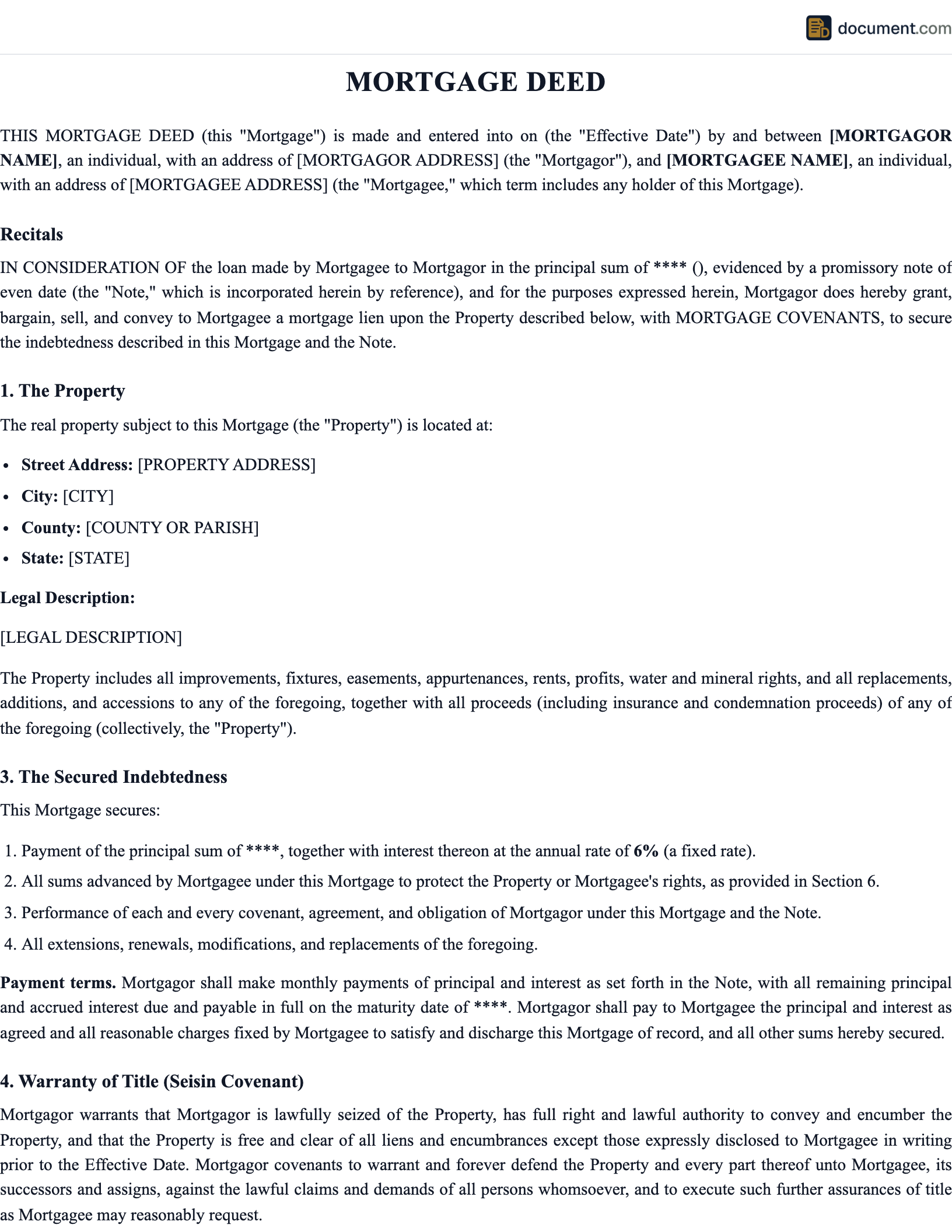



Arizona Mortgage Deed Overview
Arizona is a deed-of-trust state, meaning that the vast majority of residential and commercial real property loans in Arizona are secured by deeds of trust rather than mortgage deeds. The deed of trust structure is preferred by lenders because it enables non-judicial foreclosure under A.R.S. Section 33-807, allowing a trustee to sell the property through a public auction process without a court judgment. Mortgage deeds are legally valid in Arizona but impose a judicial foreclosure requirement that most institutional lenders find impractical.
Mortgage deeds in Arizona are recorded at the county recorder's office in the county where the property sits. Arizona has 15 county recorders, and recording fees start around $30 per document. Arizona charges no state real estate transfer tax and no mortgage tax on the instrument. Arizona is also a community property state, which means that if the property is community property, both spouses must sign the mortgage regardless of how title is held. Notarization is required; no additional witnesses are needed.
$30
Recording fee
None
Transfer tax
Required
Notarization
0
Witnesses required
Arizona Requirements
Arizona recording requirements are set by Title 33 of the Arizona Revised Statutes. A mortgage deed must be signed by the mortgagor and acknowledged before a notary public before it can be recorded. Arizona has authorized remote online notarization, which is a practical option when parties are not in the same location. Documents must include the Assessor's Parcel Number and a return address for the recorder to mail back the stamped original.
Arizona Specific Note
Arizona is a community property state. If the property being mortgaged is community property, both spouses must sign the mortgage deed even if only one spouse is on the title. Omitting a required spousal signature can allow the non-signing spouse to challenge the mortgage. Arizona has no state transfer tax or mortgage excise tax, but per-document recording fees apply. Fees vary slightly by county recorder.
Document Requirements
- Notarization: Must be notarized by an Arizona notary public or authorized notary
- Witnesses: Arizona requires 0 additional witness(es)
- Legal Description: Complete legal description as it appears on the current deed of record
- Parcel Number: Assessor's parcel number or tax ID
- Return Address: Mailing address for returning the recorded document
- Formatting: Standard formatting with adequate margins, black ink, minimum 10-point font
How to File in Arizona
Because most Arizona real estate professionals are more familiar with deeds of trust, parties using a mortgage deed should be especially careful about execution and recording to ensure the document functions as intended.
Prepare the Document
Complete the mortgage deed with the full legal names and mailing addresses for the mortgagor and mortgagee, the complete legal description from the current deed, the Assessor's Parcel Number, the secured obligation amount and terms, and a return address for the recorded document. If the property is community property, include signature lines for both spouses.
Get the Document Notarized
All required signers must appear before a notary public. Arizona authorizes remote online notarization, which allows parties to sign through a secure video platform if in-person notarization is inconvenient. The notary must complete the acknowledgment block with their seal and commission expiration date. No witnesses beyond the notary are required.
Submit to the County Recorder
File the executed mortgage deed with the recorder in the Arizona county where the property is located. Most Arizona county recorders accept e-recording through approved electronic submitters, which is the fastest option. Walk-in, mail-in, and drop-box submission are also available at most offices.
Pay Recording Fees
Arizona recording fees run approximately $30 per document. There is no state transfer tax and no mortgage excise tax. Some county recorders may have slightly different fee structures; verify before filing. E-recording submitters may add a convenience fee on top of the county's recording charge.
Retain the Recorded Original
The county recorder returns the document stamped with the docket and page or sequence number. Store the recorded mortgage deed with the rest of your loan documents. When the obligation is satisfied, require the lender to record a release of mortgage with the same county recorder. An unresolved lien on title will surface in any future title search and must be cleared before the property can be sold or refinanced.
Arizona Fees & Costs
Typical costs for filing in Arizona. Actual fees may vary by county.
| Fee / Tax | Amount |
|---|---|
| Recording Fee | $30 |
| Transfer Tax | None |
| Notarization | $5 - $25 per signature |
| Certified Copy | $1 - $10 per page |
| Attorney Review (optional) | $150 - $500 |
Arizona Tax Implications
Arizona is one of a handful of states that has affirmatively prohibited real estate transfer taxes by statute. A.R.S. Section 11-1134 bars counties from imposing any fee, stamp tax, or excise tax based on the sale price or transfer of real property. Cities and towns are similarly restricted. This means the only costs at recording are the recorder's per-document fee, which is among the lowest transactional tax burdens for real property in the country.
Arizona does impose property taxes administered at the county level by the county assessor and treasurer. Residential property is assessed at a statutory assessment ratio that determines the taxable value used to calculate the annual tax bill. Arizona law limits increases in a property's assessed value to no more than 5% per year for owner-occupied residential property, which provides some protection against rapid tax increases in rising markets. Mortgaged properties remain taxable, and lenders typically escrow property taxes as part of the monthly payment.
Arizona's community property rules carry significant tax implications at the federal level. When community property passes at death, both halves of the community receive a stepped-up basis equal to the fair market value at the date of death. This is more favorable than the rule in common-law states, where only the decedent's half receives a step-up. Married borrowers in Arizona should discuss the community property implications of any real estate transaction with a tax advisor.
Sample Arizona Mortgage Deed
Preview of our Arizona-specific template. Your document will include all fields required for recording in any Arizona county.
MORTGAGE DEED
STATE OF ARIZONA
Legal Document
PARTY INFORMATION
Name: [Full Legal Name]
Address: [Arizona Address]
County: [County]
PROPERTY DESCRIPTION
County: [County] State: Arizona
Legal Description: [Per Recorded Plat]
Parcel No.: [APN]
Arizona Mortgage Deed FAQ
Common questions about filing in Arizona, including requirements, fees, and tax implications.
Official Arizona Resources
Official state resources for verifying requirements and finding your local recording office.
Important Considerations for Arizona Mortgage Deeds
Arizona is a deed-of-trust state by practice and preference. If you are choosing between a mortgage deed and a deed of trust for a private transaction, the deed of trust gives the lender a non-judicial foreclosure remedy that is dramatically faster and cheaper to pursue than a court proceeding. A mortgage deed is appropriate in some contexts, but both parties should understand the enforcement difference before committing to that structure.
The community property rule is the most consequential Arizona-specific requirement for mortgage deeds. Any real property owned by a married couple as community property requires both spouses to sign the mortgage deed, regardless of whether both spouses are named on the title or the loan. Failure to obtain the required spousal signature gives the non-signing spouse grounds to contest the mortgage. Title companies in Arizona are familiar with this requirement and will raise it during the title review process.
Arizona prohibits deficiency judgments after a trustee sale under a deed of trust for purchase money mortgages on single-family residential property. The anti-deficiency rules under A.R.S. Sections 33-729 and 33-814 are complex and depend on the type of loan, the type of property, and the foreclosure method. Borrowers considering a mortgage deed versus a deed of trust should ask an Arizona attorney how the anti-deficiency rules apply to their specific transaction.
Community Property and Spousal Signature Compliance
Arizona's community property framework is the single issue that most frequently creates problems in residential mortgage transactions. An Arizona real estate attorney can confirm whether the property is community property, whether a spousal consent or signature is required, and how to structure the acknowledgment block correctly. Many Arizona attorneys provide fixed-fee document review for straightforward residential mortgage deeds.
Related Documents
Depending on your situation, you may need additional documents alongside this one. Below are commonly related documents that are frequently used together in real estate transactions.
Important Considerations
Arizona's deed-of-trust preference means most real estate attorneys, title companies, and escrow officers work primarily with deed-of-trust documents. Parties using a mortgage deed in an Arizona transaction should verify that all professionals involved are aware of the document type and understand the enforcement differences.
Community property status affects more than the signature requirement. It determines how ownership is characterized for tax purposes, what happens to the property at death, and how it is treated in a divorce. Married borrowers in Arizona who are uncertain about the community property status of a specific parcel should consult an Arizona family law or real estate attorney before executing any mortgage deed.
Arizona's anti-deficiency statutes provide borrowers with meaningful protection after certain types of foreclosures. However, these protections are not absolute and do not apply to all loan types or foreclosure methods. Borrowers who are considering whether a mortgage deed or deed of trust better serves their interests should ask specifically how Arizona's anti-deficiency rules would apply to their loan before signing.
After the loan is paid off, the lender must record a release of lien or satisfaction of mortgage with the county recorder. Follow up if this is not done within a few weeks of payoff; an unreleased mortgage stays on the public record and will need to be cleared before any future sale or refinance. are also recommended as a backup.
Professional Recommendation
While our templates are designed to be comprehensive and legally compliant, we recommend having your completed document reviewed by a licensed attorney before recording, especially for high-value transactions or complex situations. Many attorneys offer flat-fee document review services that provide peace of mind at a reasonable cost.
Related Documents
Depending on your situation, you may need additional documents alongside this one. Below are commonly related documents that are frequently used together in real estate transactions.
Create your Arizona Mortgage Deed in under 5 minutes.
Answer a few questions and download a Arizona-compliant document, ready for the state agency.