



Alaska Mortgage Deed Overview
Alaska primarily uses deeds of trust rather than mortgage deeds for real property financing, largely because deeds of trust allow non-judicial foreclosure through a power-of-sale clause. That said, mortgage deeds are legally valid in Alaska and are still used in some transactions, particularly those involving private lenders, seller financing, and certain government loan programs. If you are using a mortgage deed rather than a deed of trust, it is worth understanding how that choice affects the lender's remedies if the loan goes into default.
Unlike most states, Alaska does not have counties. Real property recording is handled by Alaska Recording District offices under the Alaska Department of Natural Resources. The recording district is based on property location, not a political subdivision. Recording fees start around $25 for the first page with per-page charges after that. Alaska charges no state real estate transfer tax and no mortgage excise or intangible tax. Notarization by an authorized notary is required; remote online notarization is now permitted under state statute.
$25
Recording fee
None
Transfer tax
Required
Notarization
0
Witnesses required
Alaska Requirements
Alaska recording requirements are governed by Alaska Statute Title 40. A mortgage deed must be signed by the mortgagor and acknowledged before a notary public before it can be recorded. The document is then filed with the recording district office that covers the property's location. Because Alaska lacks counties, finding the correct recording district is the first step that out-of-state parties sometimes get wrong.
Alaska Specific Note
Certain lands in Alaska held by Alaska Native Corporations or as federal Native allotments carry federal restrictions on encumbrance. A standard mortgage deed cannot be placed on restricted allotment land without Bureau of Indian Affairs approval. Confirm that the property's title history does not involve restricted land before proceeding. For all other Alaska properties, recording fees start around $25 with no state transfer tax on the instrument.
Document Requirements
- Notarization: Must be notarized by an Alaska notary public or authorized notary
- Witnesses: Alaska requires 0 additional witness(es)
- Legal Description: Complete legal description as it appears on the current deed of record
- Parcel Number: Assessor's parcel number or tax ID
- Return Address: Mailing address for returning the recorded document
- Formatting: Standard formatting with adequate margins, black ink, minimum 10-point font
How to File in Alaska
Alaska uses recording districts rather than county recorder offices. Identifying the correct recording district for the property before you begin is essential, since filing in the wrong district will not provide constructive notice and may leave the mortgage unenforceable against third parties.
Prepare the Document
Complete the mortgage deed with full legal names and addresses for all parties, the complete legal description referencing the recording district, the loan amount and repayment terms, and any default and acceleration provisions. Confirm the property is not restricted Alaska Native land before proceeding.
Get the Document Notarized
The mortgagor must sign before an Alaska-commissioned notary or a notary in the state where signing occurs. Alaska allows remote online notarization under AS 44.50.075, which is useful for rural areas and remote locations given the state's geography. No additional witnesses are required.
File With the Alaska Recording District Office
Submit the notarized mortgage deed to the recording district office that covers the property's location. The Alaska Division of Mining, Land and Water maintains offices in Anchorage, Fairbanks, Juneau, Kenai, Kodiak, Palmer, and other locations. E-recording is available through approved vendors for most districts.
Pay Recording Fees
Recording fees start around $25 for the first page, with per-page charges for longer documents. Alaska charges no state transfer tax on mortgage deeds and no intangible tax on the loan amount. Accepted payment methods vary by office; confirm before filing.
Retain the Recorded Document
The recording office will return the document stamped with the recording number and date. Keep this in your permanent records. When the loan is satisfied, the lender must record a release of mortgage in the same recording district. Follow up with the lender if the release is not recorded within a reasonable time after payoff.
Alaska Fees & Costs
Typical costs for filing in Alaska. Actual fees may vary by county.
| Fee / Tax | Amount |
|---|---|
| Recording Fee | $25 |
| Transfer Tax | None |
| Notarization | $5 - $25 per signature |
| Certified Copy | $1 - $10 per page |
| Attorney Review (optional) | $150 - $500 |
Alaska Tax Implications
Alaska stands out among states for having no state income tax and no state sales tax, and the same taxpayer-friendly posture extends to real property transactions. Alaska levies no state real estate transfer tax and no mortgage excise or intangible tax on the loan amount. This makes recording costs in Alaska among the lowest in the country for equivalent transactions.
Property taxes in Alaska are administered at the borough or municipality level. Alaska has no statewide property tax. Most organized boroughs levy property taxes; however, communities in the Unorganized Borough typically do not have local property tax unless they have separately established a service area that levies one. This wide variation matters particularly for rural Alaskan properties where tax obligations may differ significantly from what buyers expect based on experience in other states.
The Alaska Permanent Fund Dividend, while not a property tax issue, reflects the state's overall fiscal structure. For mortgage purposes, lenders underwriting Alaska loans should be aware that property tax obligations vary considerably by location and that some rural properties have minimal or no annual property tax. Escrow calculations for remote properties should be verified against the applicable borough or municipality records, not assumed based on population density.
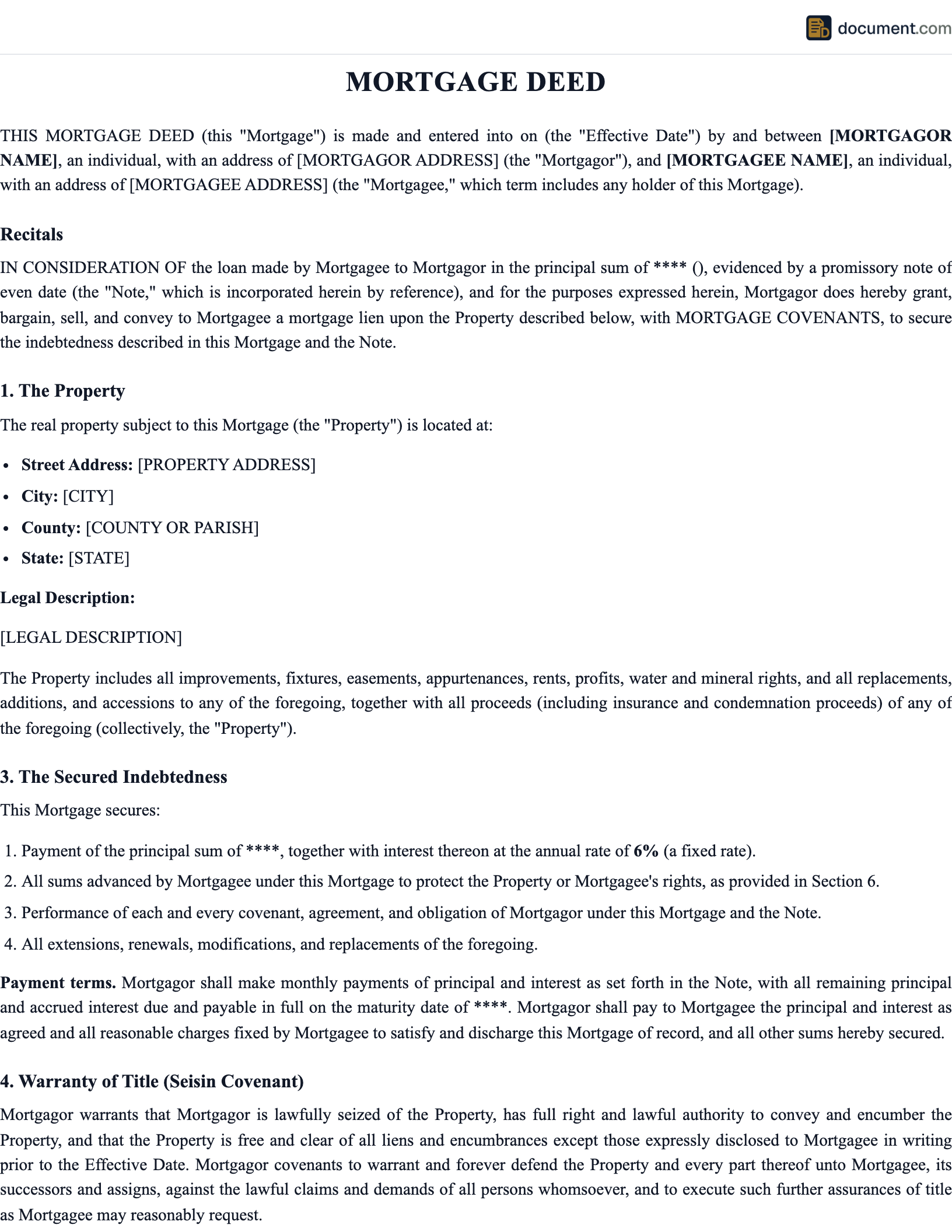
Sample Alaska Mortgage Deed
Preview of our Alaska-specific template. Your document will include all fields required for recording in any Alaska county.
MORTGAGE DEED
STATE OF ALASKA
Legal Document
PARTY INFORMATION
Name: [Full Legal Name]
Address: [Alaska Address]
County: [County]
PROPERTY DESCRIPTION
County: [County] State: Alaska
Legal Description: [Per Recorded Plat]
Parcel No.: [APN]
Alaska Mortgage Deed FAQ
Common questions about filing in Alaska, including requirements, fees, and tax implications.
Official Alaska Resources
Official state resources for verifying requirements and finding your local recording office.
Important Considerations for Alaska Mortgage Deeds
The choice between a mortgage deed and a deed of trust is more consequential in Alaska than in many states. Most institutional lenders in Alaska use deeds of trust specifically to preserve the non-judicial foreclosure option under AS 34.20.070. If you are using a mortgage deed for a private loan or seller-financing arrangement, the lender should understand that enforcement will require a judicial proceeding through the Alaska Superior Court if the borrower defaults.
Alaska's geography creates practical challenges for mortgage transactions. Remote properties may be in recording districts whose offices are hundreds of miles away. Mail-in and e-recording options exist but not universally. Title searches for rural Alaska properties can be complex due to the history of federal land conveyances, ANCSA corporation land selections, Native allotments, and state land disposals, all of which have overlapping and sometimes incomplete recording histories.
Subsurface mineral rights in Alaska are frequently separated from surface ownership, and a mortgage deed on the surface estate generally does not automatically include mineral rights unless specifically stated. For properties where mineral rights may have value, the mortgage document should address whether the lien covers only the surface or both estates.
Alaska Recording District Verification
Filing in the wrong Alaska recording district is a real risk for parties unfamiliar with the state's geographic organization. The Alaska DNR provides an online search tool to confirm the recording district for any property. Verify the district before drafting the mortgage deed, since the district name should appear in the document and must match where you file. An Alaska real estate attorney can confirm the district and review the legal description against the DNR records.
Related Documents
Depending on your situation, you may need additional documents alongside this one. Below are commonly related documents that are frequently used together in real estate transactions.
Important Considerations
The choice between a mortgage deed and a deed of trust matters more in Alaska than in most states because of the foreclosure consequences. Most institutional lenders use deeds of trust to preserve non-judicial foreclosure rights. If you are using a mortgage deed for a private or seller-financed transaction, make sure both parties understand that judicial foreclosure through the Alaska Superior Court is the available remedy in the event of default.
Alaska's lack of counties means finding the correct recording district is the first step that trips up out-of-state parties. The Alaska DNR provides an online tool to confirm the recording district for any property parcel. The district designation should appear in both the legal description and the filing instructions on the mortgage deed.
Native allotment and ANCSA corporation land restrictions create complications that standard mortgage deed forms cannot address on their own. If there is any question about the land status of the property, a title commitment from an Alaska-licensed title company will disclose these issues before closing. Do not proceed with recording a mortgage on restricted land without legal guidance.
Keep the recorded mortgage deed in a secure location alongside the loan documents. The Alaska recording system assigns each instrument a unique recording number that can be used to retrieve a copy from the recording district office if the original is lost. When the loan is paid off, verify that the lender has recorded a release or satisfaction of mortgage in the same district. are also recommended as a backup.
Professional Recommendation
While our templates are designed to be comprehensive and legally compliant, we recommend having your completed document reviewed by a licensed attorney before recording, especially for high-value transactions or complex situations. Many attorneys offer flat-fee document review services that provide peace of mind at a reasonable cost.
Related Documents
Depending on your situation, you may need additional documents alongside this one. Below are commonly related documents that are frequently used together in real estate transactions.
Create your Alaska Mortgage Deed in under 5 minutes.
Answer a few questions and download a Alaska-compliant document, ready for the state agency.