
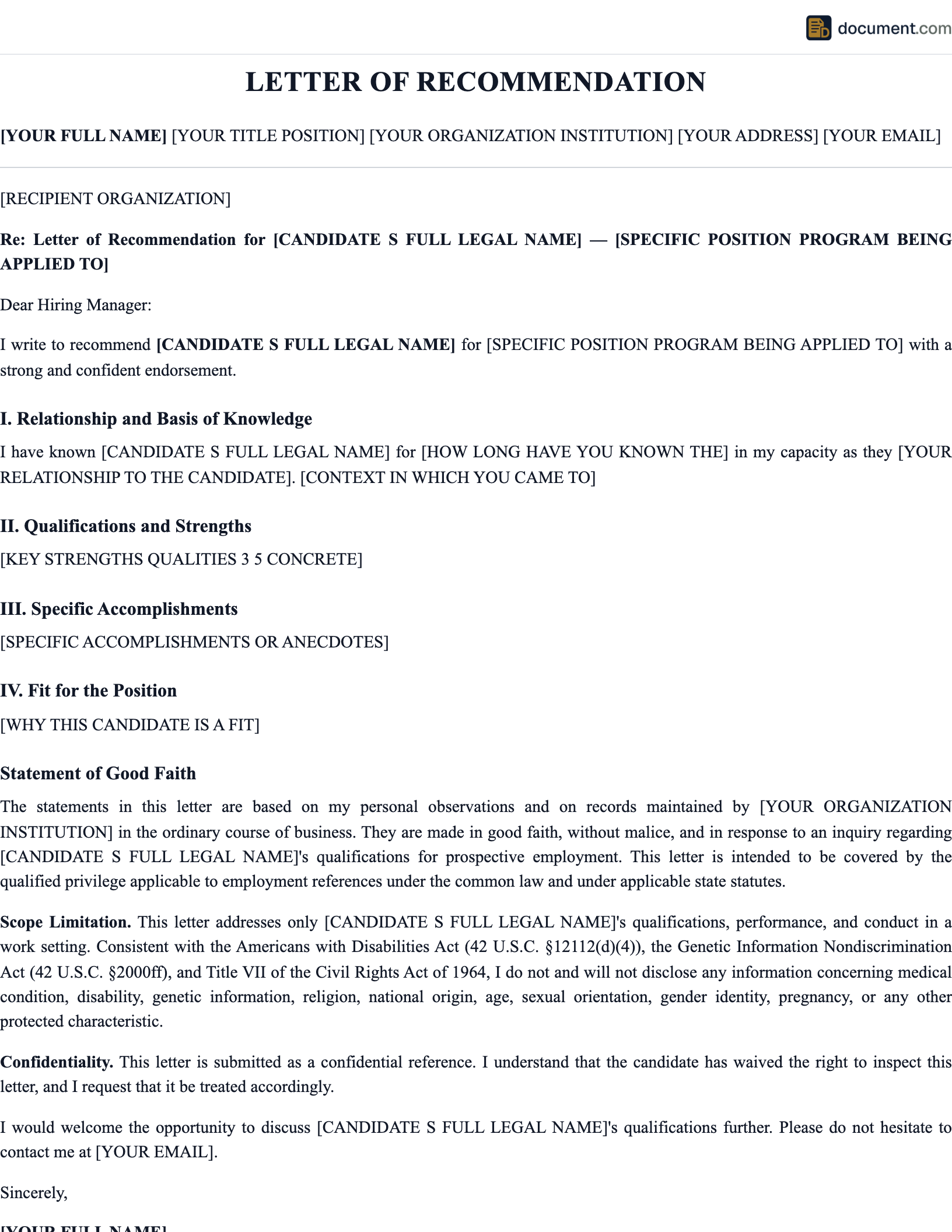



What Is a Residency Letter of Recommendation?
A residency letter of recommendation is a detailed clinical evaluation written by an attending physician, department chair, or program director who has directly supervised a medical student during clinical rotations. Submitted through the Electronic Residency Application Service (ERAS) as part of the National Resident Matching Program (NRMP) application cycle, the residency LOR provides program directors with an expert assessment of the applicant's clinical competence, medical knowledge, procedural skills, professionalism, and readiness for the demands of graduate medical education. It is one of the most heavily weighted components of the residency application, frequently cited by program directors as a decisive factor in interview invitations and rank list placement.
What distinguishes a residency LOR from other recommendation letters is its clinical depth and specificity. Program directors expect these letters to function as peer-level clinical evaluations — an attending physician who supervised the applicant on the wards, in the operating room, or in the clinic is uniquely positioned to assess whether the applicant can handle the transition from medical student to resident physician. The letter should demonstrate that the recommender observed the applicant managing patients independently, making clinical decisions under pressure, interacting with multidisciplinary teams, and responding constructively to feedback. Generic praise without clinical context is immediately recognizable to experienced readers and significantly undermines the letter's impact.
The residency application landscape has become increasingly competitive across specialties. NRMP data shows that the number of applicants per position has risen steadily, particularly in specialties like dermatology, orthopedic surgery, plastic surgery, and interventional radiology. In this environment, strong recommendation letters function as differentiators among applicants with similar USMLE scores, research productivity, and clinical grades. A letter that places the applicant in the top percentage of medical students the recommender has supervised, provides vivid clinical examples, and offers a candid assessment of the applicant's strengths and growth areas carries substantially more influence than formulaic letters that could describe any competent medical student.
Clinical Assessment
Expert evaluation of patient care skills, diagnostic reasoning, and procedural competence.
Comparative Ranking
Positions the applicant relative to peers who have rotated through the same service.
Match-Ready Format
Structured for ERAS submission and reviewed by residency program directors.
Residency LOR Form Preview
Letter of Recommendation
Residency Program Application — ERAS
ATTENDING PHYSICIAN INFORMATION
Name: Specialty:
Institution:
CLINICAL ROTATION DETAILS
I supervised during their rotation from to .
COMPARATIVE ASSESSMENT
I rank this applicant in the top % of medical students I have supervised over the past years.
ATTENDING SIGNATURE
DATE
Key Components
A residency letter of recommendation must address these core areas to provide program directors with the clinical evidence they need during applicant evaluation:
| Component | Purpose | Key Details |
|---|---|---|
| Attending Credentials | Establishes evaluator authority | Board certification, academic rank, specialty, years of practice, teaching experience |
| Clinical Context | Defines observation setting | Rotation type, duration, patient volume, case complexity, supervision level |
| Medical Knowledge | Assesses clinical fund of knowledge | Differential diagnosis, evidence-based practice, pathophysiology understanding |
| Patient Care Skills | Evaluates bedside performance | History-taking, physical exam, treatment planning, patient communication, follow-up |
| Professionalism | Addresses conduct and ethics | Reliability, integrity, accountability, response to feedback, ethical reasoning |
| Comparative Ranking | Contextualizes against peers | Percentile ranking, comparison to prior students, overall recommendation level |
| Specialty Fit | Demonstrates residency readiness | Specialty-specific skills, research alignment, career goals, growth trajectory |
How to Write a Residency Letter of Recommendation
Establish Your Credentials and Clinical Context
Begin with your name, specialty, board certification, academic title, and institutional affiliation. Describe the clinical setting in which you supervised the applicant — inpatient service, outpatient clinic, operating room, or intensive care unit — and the duration of the rotation. Specify the patient population and case complexity to help program directors understand the clinical environment in which you observed the applicant. Your credentials establish the authority of your assessment, and the clinical context frames the specific skills you are evaluating.
Provide Specific Clinical Anecdotes
Describe two to three clinical scenarios where the applicant demonstrated exceptional competence, initiative, or growth. Detail how the applicant managed a complex patient case, identified a subtle clinical finding, handled a difficult family conversation, or performed under pressure in an emergency. Use enough clinical detail that a program director in the same specialty can visualize the scenario, but maintain patient confidentiality. These anecdotes are the most important part of the letter — they transform your assessment from opinion into evidence.
Assess Core Competencies Systematically
Address the six ACGME core competencies: patient care, medical knowledge, practice-based learning, interpersonal and communication skills, professionalism, and systems-based practice. You do not need to label each competency explicitly, but your letter should cover enough of these domains that program directors can assess the applicant's readiness across the full spectrum of residency expectations. Discuss how the applicant sought feedback and incorporated it into practice, how they communicated with nurses, pharmacists, and consulting services, and whether they demonstrated awareness of healthcare systems and resource utilization.
Include a Meaningful Comparative Ranking
Program directors consistently identify the comparative ranking as one of the most useful elements of a residency LOR. Place the applicant in a specific percentile among medical students you have supervised: top five percent, top ten percent, or top quartile. Specify the total number of students this ranking encompasses and the timeframe of your comparison. A statement that the applicant ranks in the top ten percent of the approximately two hundred medical students you have supervised over fifteen years of academic practice provides a concrete, credible benchmark that generic superlatives cannot match.
Address Specialty Fit and Growth Potential
Explain why the applicant is well-suited for their chosen specialty based on the clinical traits and aptitudes you observed. For surgical specialties, discuss hand skills, spatial reasoning, and stamina. For internal medicine, discuss diagnostic reasoning and systems thinking. For pediatrics, discuss rapport with children and family-centered communication. If the applicant demonstrated growth during the rotation — improving in an area that was initially weak — describing that trajectory shows maturity and self-awareness that program directors value.
Close with an Unambiguous Endorsement
End with a clear, categorical statement of recommendation: whether you recommend the applicant enthusiastically and without reservation, strongly, or with some qualification. Program directors have developed a lexicon for reading recommendation letters, and the closing endorsement is where they look for the letter's bottom line. If you can honestly write that you would want this applicant as your own resident or would trust them to care for your family, include that statement — it is one of the strongest endorsements available in a residency LOR.
ERAS and the Match Process
The Electronic Residency Application Service (ERAS) is the centralized platform through which virtually all residency application materials — including letters of recommendation — are submitted to programs participating in the National Resident Matching Program (NRMP). Understanding how letters flow through this system helps both applicants and recommenders manage the process effectively and avoid common pitfalls that can delay or undermine an application.
Recommenders upload letters through the ERAS Letter of Recommendation Portal (LoRP) using the unique letter ID assigned by the applicant. Once uploaded, the letter is available for the applicant to assign to specific programs — applicants can selectively route letters, sending specialty- specific letters to relevant programs while withholding them from others. This routing flexibility means applicants applying to multiple specialties or programs with different letter requirements can customize their application strategically. However, it also means recommenders should write letters that are broadly applicable unless the applicant specifically requests a letter targeted to a particular program.
ERAS Timeline Alert
ERAS applications are typically transmitted to programs in late September. Letters uploaded after this date may arrive after programs have already begun reviewing applications, potentially putting the applicant at a disadvantage. Recommenders should aim to upload letters by mid-September at the latest. Late letters are one of the most common preventable problems in residency applications and can result in incomplete applications being screened out before review.
Frequently Asked Questions
Official Resources
Authoritative resources on residency applications, recommendation letter guidelines, and the Match process.
AAMC - ERAS Overview
Official ERAS documentation including letter of recommendation upload procedures, timelines, and program requirements.
NRMP - National Resident Matching Program
The Match organization with data reports, applicant statistics, and program participation information.
ACGME - Accreditation Council for GME
Residency program accreditation body with core competency frameworks and milestones used in evaluation.
AMA - Graduate Medical Education Resources
American Medical Association resources on residency training, GME policy, and medical education advocacy.
AAMC - Applying to Residencies
Comprehensive guide for medical students navigating the residency application process including letter requirements.
ECFMG - Educational Commission for Foreign Medical Graduates
Certification body for international medical graduates applying to U.S. residency programs.
Create Your Residency Recommendation Letter
Draft a detailed clinical evaluation that highlights patient care skills, procedural competence, and specialty readiness for the ERAS application and Match process.
Create DocumentNo account required. Free to create and preview.