
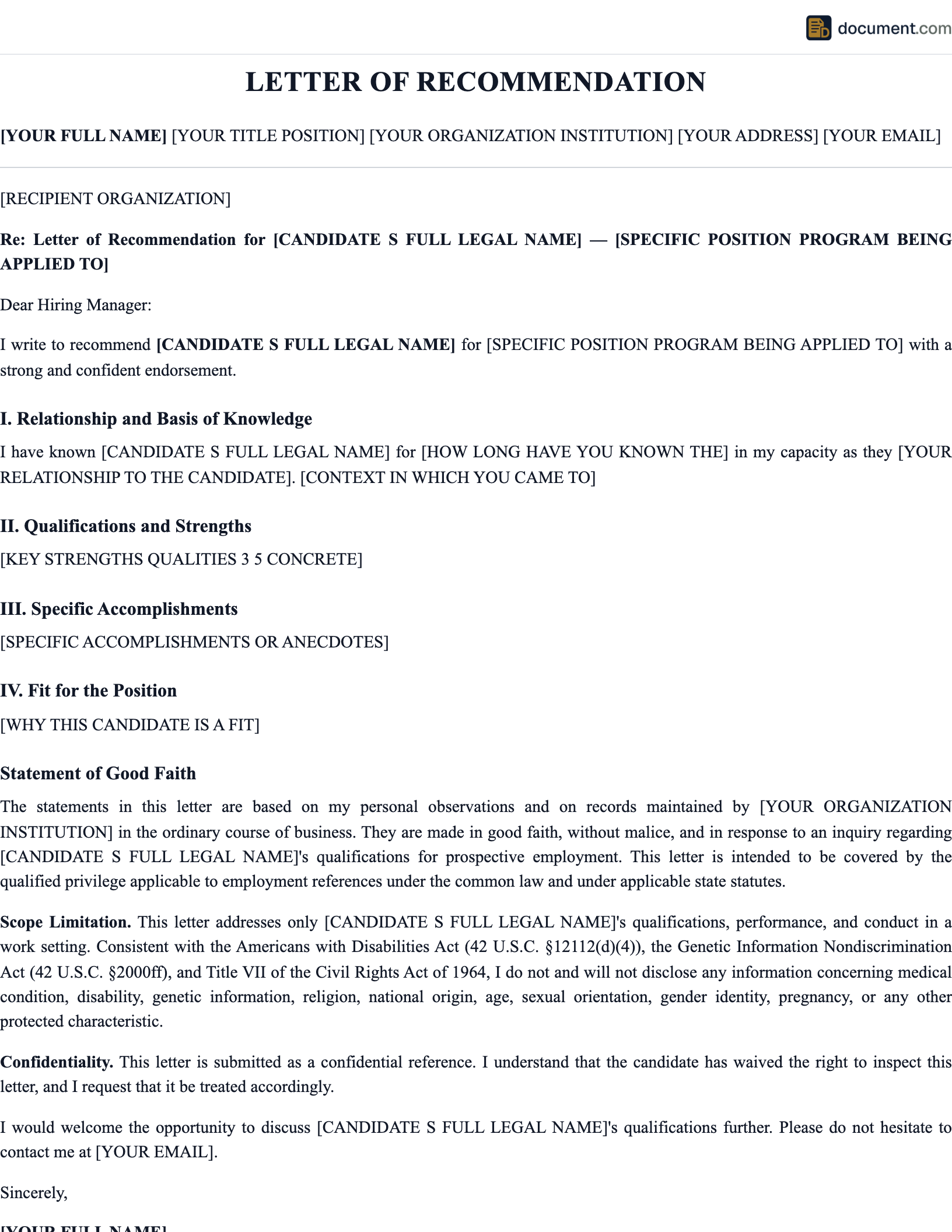



What Is a PA School Letter of Recommendation?
A PA school letter of recommendation is a formal written endorsement submitted as part of a physician assistant program application through the Central Application Service for Physician Assistants (CASPA) or directly to individual programs. Unlike generic academic references, a PA school LOR must speak to the applicant's specific readiness for the physician assistant profession — a healthcare role that demands clinical competence, diagnostic reasoning, empathetic patient communication, and the ability to function as part of a collaborative medical team. The letter serves as third-party validation that the applicant possesses the combination of intellectual ability, clinical awareness, and interpersonal maturity that PA programs require of their incoming students.
PA admissions committees use recommendation letters to triangulate information from other application components — GPA, GRE scores, personal statements, and healthcare experience hours. A strong LOR adds dimensionality to an application by providing an external perspective on how the applicant performs in real clinical or academic settings, how they handle pressure, and whether they demonstrate the professional behaviors expected of a healthcare provider. Programs consistently report that specific, evidence-based letters from clinical supervisors carry the most weight in admissions decisions, often differentiating competitive applicants who appear similar on paper.
The physician assistant profession occupies a unique space in healthcare — PAs practice medicine under physician supervision but with significant autonomy, performing physical examinations, ordering diagnostic tests, developing treatment plans, and prescribing medications across virtually every medical specialty. Because the profession demands both breadth and adaptability, PA programs look for recommendation letters that demonstrate the applicant can thrive in a fast-paced, generalist medical education model rather than a narrow specialty track. Recommenders who understand this distinction write the most effective letters.
Clinical Readiness
Validates hands-on patient care skills and clinical judgment in healthcare settings.
Team Collaboration
Demonstrates ability to work within interdisciplinary healthcare teams effectively.
Academic Foundation
Confirms the applicant's intellectual capacity for rigorous PA program coursework.
PA School LOR Form Preview
Letter of Recommendation
Physician Assistant Program Application
RECOMMENDER INFORMATION
Name: Title:
Institution/Practice:
APPLICANT ASSESSMENT
I have known for in the capacity of .
CLINICAL COMPETENCY EVALUATION
Based on my direct observation, I rate this applicant's clinical aptitude as compared to peers at a similar stage.
RECOMMENDER SIGNATURE
DATE
Key Components
An effective PA school recommendation letter must address these essential areas to provide admissions committees with the evidence they need to evaluate an applicant:
| Component | Purpose | Key Details |
|---|---|---|
| Relationship Context | Establishes credibility of assessment | How the recommender knows the applicant, duration, supervisory capacity, clinical or academic setting |
| Clinical Competence | Demonstrates healthcare readiness | Patient interaction, clinical reasoning, procedural skills, medical terminology, charting ability |
| Interpersonal Skills | Shows patient rapport ability | Empathy, communication, cultural sensitivity, patient education, bedside manner |
| Academic Aptitude | Confirms intellectual readiness | Analytical thinking, scientific reasoning, study habits, academic performance in prerequisites |
| Professional Behaviors | Indicates professional maturity | Reliability, punctuality, ethical conduct, HIPAA awareness, professional demeanor |
| Comparative Assessment | Contextualizes the applicant | Ranking among peers, comparison to successful PA students, specific strengths relative to cohort |
| Specific Anecdotes | Provides concrete evidence | Clinical scenarios, patient care examples, problem- solving instances, teamwork demonstrations |
How to Write a PA School Letter of Recommendation
Establish Your Relationship and Credibility
Open the letter by introducing yourself, your professional credentials, and your relationship to the applicant. State your title, the institution or practice where you supervised the applicant, and the duration and context of your interaction. Admissions committees weigh letters more heavily when the recommender has directly observed the applicant in a clinical or academic setting over an extended period, so be specific about the number of hours or months you worked together.
Describe Clinical Exposure and Skills
Detail the applicant's clinical experiences under your supervision, including the types of patients seen, procedures observed or assisted with, and the clinical environment (emergency department, primary care clinic, surgical setting, etc.). Describe specific instances where the applicant demonstrated clinical reasoning, asked insightful questions about differential diagnoses, or showed initiative in learning new clinical skills. PA programs want to see that the applicant has meaningful exposure to patient care, not just passive observation hours.
Assess Interpersonal and Communication Skills
Provide examples of how the applicant interacts with patients, families, and members of the healthcare team. Describe their bedside manner, ability to explain medical information at an appropriate level, comfort with diverse patient populations, and capacity for empathetic listening. Since PAs spend significant time counseling patients and coordinating care with physicians, nurses, and other providers, evidence of strong communication skills is particularly compelling for admissions reviewers.
Evaluate Academic and Intellectual Readiness
Comment on the applicant's intellectual curiosity, analytical abilities, and capacity for the demanding academic workload of a PA program. If you supervised them in an academic setting, discuss their performance in relevant coursework, their approach to studying complex medical concepts, or their ability to synthesize clinical information. If your relationship is primarily clinical, you can still address their scientific knowledge, willingness to research unfamiliar conditions, and capacity for evidence-based thinking.
Provide a Comparative Assessment
Contextualize the applicant's abilities by comparing them to other pre-PA students, medical assistants, scribes, or healthcare professionals you have supervised. Statements like ranking the applicant in the top percentage of aspiring PAs you have mentored over your career provide concrete benchmarks that help admissions committees calibrate the strength of the recommendation. Avoid superlatives without context — saying someone is the best candidate ever is less credible than providing a specific, honest ranking.
Close with a Strong Endorsement
Conclude the letter with an unambiguous statement of recommendation, specifying whether you recommend the applicant highly, without reservation, or with some qualification. Offer to provide additional information if the admissions committee has questions, and include your contact information. A strong closing paragraph that ties together the applicant's clinical skills, personal qualities, and professional potential creates a memorable final impression that reinforces the letter's core message.
Who Should Write the Letter
The identity and professional background of your recommender significantly influences how admissions committees perceive your application. PA programs prioritize letters from individuals who have directly supervised you in a healthcare capacity and can provide specific, credible testimony about your clinical readiness. The ideal recommendation portfolio balances clinical and academic perspectives to present a complete picture of your qualifications.
Practicing physician assistants are among the most valued recommenders because they understand the PA profession from the inside — the scope of practice, the daily demands, the collaborative relationship with supervising physicians, and the specific qualities that predict success in PA education and practice. A PA who has supervised your clinical hours can credibly assess whether you possess the temperament, clinical curiosity, and professional maturity that PA programs seek. Physicians, nurse practitioners, and other healthcare professionals who have directly supervised your patient care activities are also strong choices, particularly if they can speak to your clinical skills in detail.
Academic recommenders — science professors, anatomy instructors, or research advisors — provide a complementary perspective on your intellectual abilities and scholarly discipline. These letters are especially valuable when they include specific examples of academic achievement, research contributions, or exceptional performance in prerequisite coursework that directly relates to PA program curriculum. Combining a clinical letter with an academic letter gives admissions committees a three-dimensional view of your candidacy that neither perspective alone can provide.
Frequently Asked Questions
Official Resources
Authoritative resources for PA school applications, recommendation letter guidelines, and the physician assistant profession.
CASPA - Central Application Service for PAs
Official PA program application portal with guidelines on recommendation letter submission, requirements, and deadlines.
AAPA - American Academy of PAs
National professional organization providing resources on the PA profession, education requirements, and career development.
ARC-PA - Accreditation Review Commission
Accrediting body for PA programs with a directory of accredited programs and accreditation standards.
PAEA - PA Education Association
Resources for PA educators and applicants including program data, applicant statistics, and admissions guidance.
NCCPA - National Commission on Certification of PAs
Certification body for physician assistants with information on PANCE examination and continuing education.
BLS - Physician Assistants Occupational Outlook
Bureau of Labor Statistics data on PA employment, salary, job outlook, and educational requirements.
Create Your PA School Recommendation Letter
Draft a compelling recommendation that highlights clinical readiness, patient care skills, and academic preparedness for physician assistant education.
Create DocumentNo account required. Free to create and preview.