



What Is a Nursing School Letter of Recommendation?
A nursing school letter of recommendation is a formal endorsement written by a professor, clinical supervisor, employer, or healthcare professional who can attest to an applicant's readiness for the demands of a nursing education program. Unlike general academic references that focus broadly on intellectual ability, nursing school recommendations must speak directly to qualities that predict success in clinical environments: empathy under pressure, attention to detail in patient care scenarios, the ability to collaborate with multidisciplinary teams, and the emotional resilience required to handle the physical and psychological demands of bedside nursing.
Nursing program admissions committees use recommendation letters as a critical screening tool because transcripts and standardized test scores reveal only part of an applicant's profile. A GPA demonstrates academic capability, but it cannot convey how an applicant responded when a patient became distressed during a clinical rotation, or how they took initiative to comfort a family member in a hospital waiting room. The recommendation letter fills these gaps by providing firsthand observations from someone who has seen the applicant operate in settings that approximate the nursing profession. Programs at all levels — from associate degree nursing to Doctor of Nursing Practice — rely on these letters to differentiate among academically qualified candidates.
The weight a recommendation letter carries depends on the specificity of the endorsement and the credibility of the recommender. A letter from a registered nurse who supervised the applicant during a hundred hours of clinical volunteering and can describe their patient communication style in detail is far more persuasive than a brief note from a professor who can only confirm the applicant earned an A in their course. Admissions reviewers read thousands of letters and can instantly distinguish between genuine advocacy based on personal knowledge and formulaic praise that could describe any applicant.
Patient Empathy
Demonstrates the applicant's compassion and bedside manner observed in clinical or caregiving settings.
Academic Readiness
Confirms the applicant's ability to handle rigorous science coursework and clinical training demands.
Team Collaboration
Highlights the applicant's ability to work effectively within healthcare teams and communicate with colleagues.
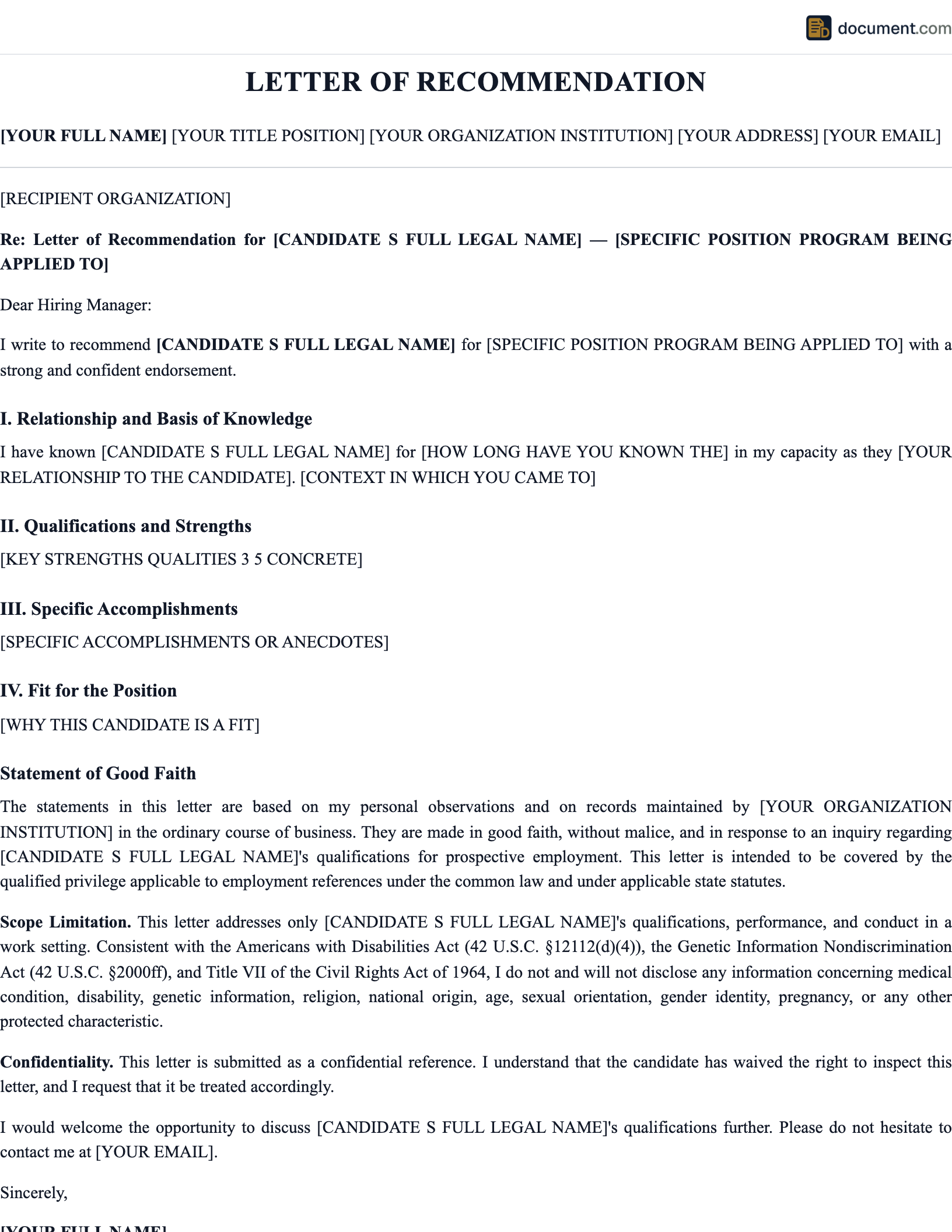
Nursing School Recommendation Letter Form Preview
Letter of Recommendation
For Nursing Program Admission
TO THE ADMISSIONS COMMITTEE
Dear Members of the Admissions Committee, I am writing to recommend for admission to your nursing program.
PROFESSIONAL RELATIONSHIP
I have known the applicant for years in my capacity as .
CLINICAL AND ACADEMIC ASSESSMENT
During our interaction, I have observed to demonstrate exceptional and a strong commitment to .
RESPECTFULLY SUBMITTED
Signature / Date
Key Components
An effective nursing school recommendation letter must include these essential elements to support the applicant's candidacy and satisfy admissions committee expectations:
| Component | Purpose | Key Details |
|---|---|---|
| Recommender Credentials | Establishes authority and credibility | Title, institution, nursing credentials, years of experience |
| Relationship Context | Shows basis for evaluation | Course taught, clinical supervised, duration of observation |
| Clinical Aptitude | Demonstrates healthcare readiness | Patient interaction skills, clinical judgment, technical ability |
| Academic Performance | Confirms intellectual preparation | Science coursework mastery, study habits, analytical thinking |
| Interpersonal Skills | Shows collaboration fitness | Teamwork, communication, empathy, cultural sensitivity |
| Specific Anecdotes | Provides memorable evidence | Concrete examples of initiative, problem-solving, patient care |
| Unequivocal Endorsement | Provides clear recommendation | Ranking among peers, enthusiasm level, confidence in success |
How to Write a Nursing School Letter of Recommendation
Open with Your Credentials and Context
Begin by identifying yourself — your professional title, nursing credentials (if applicable), institution, and how long you have worked in healthcare or academia. Establish why your evaluation should carry weight by describing your experience supervising students, mentoring aspiring nurses, or teaching prerequisite science courses. Clearly state the applicant's name and the specific program they are applying to, so the admissions committee knows this is a personalized letter rather than a generic template.
Describe Your Relationship with the Applicant
Explain how you know the applicant, in what capacity you have observed them, and over what timeframe. Whether you taught them in a challenging anatomy course, supervised their clinical hours as a CNA, or managed them in a hospital volunteer program, the admissions committee needs to understand the depth and context of your interactions. The more substantive the relationship, the more credible your observations will be.
Highlight Clinical and Patient Care Qualities
Nursing programs prioritize applicants who show natural aptitude for patient care. Describe specific instances where the applicant demonstrated empathy, maintained composure during stressful situations, or communicated effectively with patients and families. If you observed them in a clinical or volunteer setting, detail how they handled patient interactions, followed safety protocols, or showed initiative in providing comfort and care beyond what was required.
Address Academic Strengths and Work Ethic
Discuss the applicant's intellectual capabilities, particularly in science-heavy coursework like anatomy, physiology, chemistry, or microbiology. Describe their study habits, classroom participation, ability to grasp complex concepts, and performance on practical examinations. Nursing programs are academically demanding, and admissions committees want assurance that the applicant can handle the rigor without sacrificing the interpersonal aspects of nursing education.
Provide Specific, Memorable Anecdotes
Include two to three concrete stories that illustrate the qualities you are endorsing. An anecdote about the applicant staying late to help a struggling classmate prepare for a lab practical, or about their calm response when a patient experienced a medical emergency during a volunteer shift, is worth more than any number of adjectives. These stories make the applicant real to the admissions committee and distinguish them from hundreds of other qualified candidates.
Close with a Strong, Clear Endorsement
End the letter with an unambiguous statement of support. Many recommenders use a comparative ranking — 'among the top five students I have taught in fifteen years' — which gives the committee a concrete benchmark. Restate your confidence in the applicant's ability to succeed in the nursing program, offer to provide additional information if needed, and include your direct contact information. Sign the letter on institutional or professional letterhead to reinforce your credibility.
Who Should Write a Nursing School Recommendation Letter
Selecting the right recommender is one of the most important decisions in the nursing school application process. The ideal recommender has observed the applicant in a context that mirrors the demands of nursing education and practice — meaning they can speak credibly about clinical aptitude, academic rigor, and interpersonal skills rather than just general character. Science faculty members who taught the applicant in prerequisite courses like anatomy, physiology, microbiology, or pharmacology are excellent choices because they can address both intellectual ability and the work ethic required to succeed in a science-intensive curriculum.
Clinical supervisors and registered nurses who have directly observed the applicant providing patient care — whether through CNA employment, hospital volunteering, or community health work — offer a different but equally valuable perspective. They can speak to bedside manner, professional conduct, adherence to safety protocols, and the applicant's ability to handle the emotional weight of healthcare work. Employers in healthcare settings, academic advisors who guided the applicant through their pre-nursing coursework, and coordinators of health-related community programs also make strong recommenders when they can provide specific, firsthand observations rather than secondhand impressions.
Check Program-Specific Requirements
Many nursing programs specify exactly who should write recommendation letters — for example, requiring at least one letter from a science faculty member and one from a healthcare professional. Some programs prohibit letters from family members or personal friends. Always review the admissions requirements carefully before selecting your recommenders, as failing to follow these instructions can delay your application or result in automatic disqualification.
Frequently Asked Questions
Official Resources
Authoritative resources on nursing education standards, admissions requirements, and professional development for aspiring nurses.
American Association of Colleges of Nursing
National organization setting standards for nursing education including BSN, MSN, and DNP program accreditation and admissions guidelines.
National League for Nursing
Professional organization dedicated to excellence in nursing education with resources on program standards and faculty development.
NursingCAS - Centralized Application Service
Centralized application platform used by many nursing programs, including guidelines for recommendation letter submission.
National Council of State Boards of Nursing
Regulatory body providing information on nursing licensure, education requirements, and NCLEX examination standards.
BLS - Registered Nurses Occupational Outlook
Bureau of Labor Statistics data on nursing career prospects, education requirements, and state-by-state employment information.
American Association of Nurse Practitioners
Professional resources for advanced practice nursing including graduate program requirements and clinical training standards.
Create Your Nursing School Recommendation Letter
Draft a professional nursing school recommendation that highlights clinical aptitude, patient empathy, and academic readiness in a format admissions committees expect.
Create DocumentNo account required. Free to create and preview.