
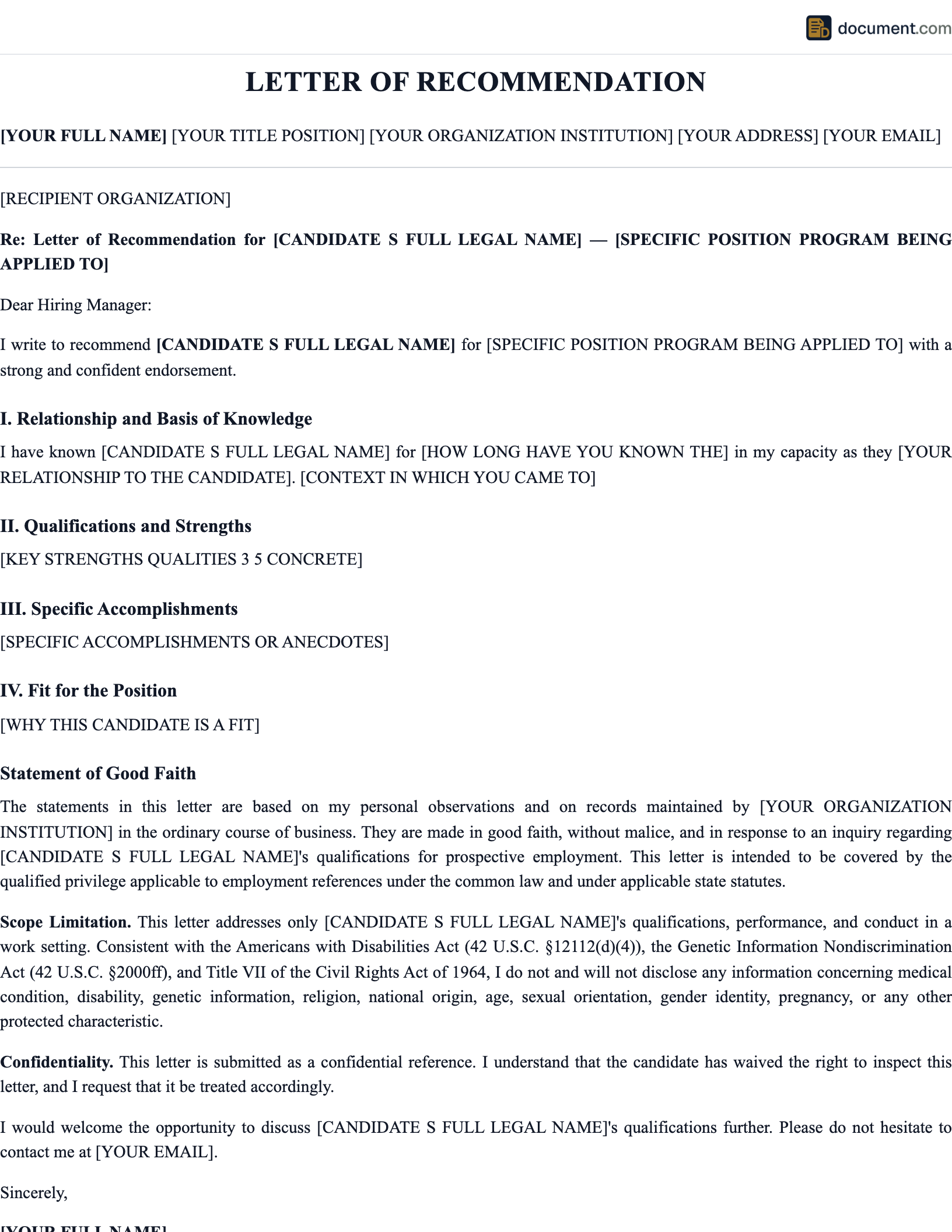



What Is a Law School Letter of Recommendation?
A law school letter of recommendation is a formal academic or professional endorsement submitted through LSAC's Credential Assembly Service as part of a JD program application. Unlike general academic recommendations, law school letters are evaluated by admissions committees specifically trained to identify the analytical, communicative, and character traits that predict success in the Socratic method classroom, legal writing coursework, and ultimately in legal practice. The letter provides the only narrative, third-party assessment of the applicant in an application package otherwise dominated by quantitative metrics — LSAT scores and undergraduate GPA — that increasingly converge among competitive applicants.
At top-ranked law schools where the median LSAT score exceeds the 95th percentile and median GPAs cluster above 3.8, the recommendation letter becomes a decisive factor in distinguishing otherwise statistically identical candidates. Admissions officers at these institutions report reading thousands of letters per cycle and developing a finely tuned ability to distinguish between genuine, detailed endorsements and formulaic praise. The recommender's ability to provide specific, vivid examples of the applicant's analytical prowess, writing quality, and intellectual character can shift an application from the waitlist to the admitted pile — particularly for applicants whose numerical credentials fall within the school's interquartile range.
The law school recommendation letter also serves as a credibility signal about the applicant's judgment and professional relationships. An applicant who secures detailed, enthusiastic letters from professors who clearly know them well demonstrates the interpersonal skills, initiative, and relationship-building ability that are essential in legal practice. Conversely, an applicant who submits generic letters from prominent figures who clearly do not know them personally reveals poor judgment about what admissions committees actually value — a concerning signal for someone seeking to enter a profession built on persuasion and credibility.
Analytical Reasoning
Demonstrates capacity for complex legal analysis and logical argumentation.
Writing Excellence
Validates the applicant's ability to construct clear, persuasive written arguments.
Socratic Readiness
Shows ability to engage in rigorous intellectual dialogue and think on one's feet.
Law School Recommendation Letter Form Preview
Letter of Recommendation
Law School Admissions — LSAC CAS
TO THE ADMISSIONS COMMITTEE
I am writing to provide my strongest recommendation for for admission to your Juris Doctor program.
ACADEMIC CONTEXT
I have known the applicant for as their professor in at .
ANALYTICAL AND WRITING ASSESSMENT
The applicant ranks in the top percent of students I have taught, demonstrating exceptional analytical reasoning and written advocacy.
RECOMMENDER
DATE
Key Components
A persuasive law school recommendation letter must address these specific elements that admissions committees evaluate:
| Component | Purpose | Key Details |
|---|---|---|
| Recommender Credentials | Establishes evaluative authority | Academic title, department, institution, courses taught, years of experience |
| Analytical Reasoning | Core predictor of law school success | Issue spotting, logical argumentation, case analysis, problem decomposition |
| Written Communication | Essential for legal writing courses | Thesis construction, evidence integration, persuasive technique, clarity |
| Verbal Engagement | Predicts Socratic method readiness | Class discussion quality, counterargument engagement, articulation under pressure |
| Intellectual Character | Shows depth beyond grades | Curiosity, nuanced thinking, willingness to revise positions, ethical reasoning |
| Comparative Assessment | Calibrates recommendation strength | Percentile ranking, comparison cohort size, years of teaching reference |
How to Write a Law School Letter of Recommendation
Establish Your Evaluative Context
Open with your academic credentials, the courses in which you taught the applicant, the size of those courses, and the nature of the assessments (exam-based, paper-based, participation-graded). Admissions committees need this context to calibrate your subsequent assessments — a recommender who taught the applicant in a 15-person seminar with weekly written responses has a fundamentally different evaluative vantage point than one who taught a 200-person lecture.
Demonstrate Analytical Reasoning Capacity
Provide specific examples of the applicant engaging in the kind of analytical reasoning law school demands. Describe how they dissected a complex argument in a paper, identified a logical flaw in a reading that other students missed, or synthesized competing perspectives into a coherent position. The best examples show the applicant's thought process, not just the conclusion — admissions committees want to understand how the applicant thinks, not just what they think.
Address Writing Quality with Evidence
Legal education is fundamentally a writing discipline, and law school recommendation letters must speak directly to the applicant's writing ability. Quote or paraphrase specific passages from the applicant's work that illustrate exceptional thesis construction, evidence integration, or persuasive technique. If the applicant improved their writing over the course of your class, describe that trajectory — growth narrative is compelling to admissions committees because law school requires rapid skill development.
Describe Classroom and Intellectual Engagement
Law school instruction relies heavily on the Socratic method, where professors call on students to analyze cases on the spot. Describe the applicant's verbal contributions — not just frequency, but quality. Did they engage thoughtfully with counterarguments? Did they articulate complex positions under pressure? Did they contribute to the intellectual environment by raising questions that advanced the entire class's understanding? These observations directly predict the applicant's readiness for the law school classroom.
Place the Applicant in Comparative Context
Provide an explicit comparative ranking: 'among the top 3% of students I have taught in twenty years' or 'one of the five most analytically gifted undergraduates in my department this decade.' This comparative framework gives admissions committees the evaluative anchor they need, because a single professor's 'excellent' may mean different things depending on their standards and the caliber of their institution's students. Specify your comparison cohort size and timeframe.
Close with Conviction and Availability
End with an unambiguous statement of recommendation that leaves no room for interpretation. Avoid qualifiers like 'I think' or 'I believe' — state your recommendation directly. Offer to discuss the applicant further by phone or email, and include your direct contact information. A strong closing transforms the letter from an administrative requirement into a personal advocacy document.
What Law School Admissions Committees Value
Law school admissions is a holistic process, but committees read recommendation letters through a specific evaluative lens shaped by the demands of legal education. The Socratic method classroom requires students who can think on their feet, engage with ambiguity, and construct arguments under pressure. Legal writing courses demand the ability to organize complex information, reason by analogy, and write with precision. Clinical programs and moot court require interpersonal skills, ethical judgment, and the ability to advocate for others effectively.
Admissions officers consistently report that the most valuable recommendation letters are those that reveal something the numbers cannot capture. A student with a 3.9 GPA who never spoke in class presents a very different candidacy than one with a 3.7 who regularly challenged the professor's arguments, visited office hours to debate assigned readings, and wrote a thesis that the professor described as the best undergraduate work they had supervised. The recommendation letter is the only component of the application that can convey this qualitative distinction, and the most effective letters do so through vivid, specific narrative rather than generalized superlatives.
LSAC Recommendation Guidelines
LSAC advises recommenders to address the applicant's intellectual ability, writing skills, oral communication, work ethic, maturity, and integrity. The CAS system processes letters centrally, so a single letter can serve all schools. However, applicants applying to schools with dramatically different profiles should consider whether a one-size-fits-all letter serves each application equally well, or whether school-specific letters would be more effective.
Frequently Asked Questions
Official Resources
Authoritative resources for law school applications and recommendation letter guidance.
LSAC - Requesting Letters of Recommendation
Official LSAC guidance on the CAS letter submission process, recommender instructions, and FERPA waiver requirements.
ABA Section of Legal Education
American Bar Association resources on ABA-accredited law school standards, admissions practices, and legal education requirements.
NALP - Legal Career Professionals
National Association for Law Placement data on law school employment outcomes and career planning resources.
AccessLex Institute
Nonprofit research and advocacy organization focused on law school access, affordability, and value for prospective students.
Cornell Law - Legal Information Institute
Comprehensive legal research resource providing free access to primary law sources relevant to understanding legal education context.
Education Data Initiative - Law School Statistics
Current data on law school enrollment, acceptance rates, costs, and employment outcomes to contextualize application competitiveness.
Create Your Law School Recommendation Letter
Build a compelling law school recommendation that highlights analytical reasoning, writing excellence, and the intellectual character traits admissions committees seek.
Create DocumentNo account required. Free to create and preview.