



Massachusetts Lease Termination Overview
Lease termination in Massachusetts is governed by Massachusetts General Laws (MGL) Chapter 186, which establishes the rights and obligations of landlords and tenants. Massachusetts is widely recognized as one of the most tenant-friendly states in the nation, with strict security deposit rules, strong anti-retaliation protections, comprehensive habitability requirements under the State Sanitary Code (105 CMR 410), and domestic violence early termination rights. The state's housing courts have developed substantial case law that further strengthens tenant protections.
Massachusetts distinguishes between "tenancies at will" (month-to-month arrangements) and "leases" (fixed-term agreements). Under MGL c.186 s.12, a tenancy at will can be terminated by either party with a notice equal to one full rental period or 30 days, whichever is longer. The quit date must coincide with a rent due date. This creates a slightly different calculation than most states — the notice effectively covers the next full rental period, meaning the actual notice is often closer to 60 days from when it's given.
Massachusetts's security deposit law (MGL c.186 s.15B) is notoriously strict and heavily penalizes non-compliance. Landlords must hold deposits in a separate interest-bearing account, provide detailed receipts, document pre-existing conditions, and pay annual interest. Any failure to follow these detailed requirements — even technical violations — can result in the tenant recovering three times the deposit amount (treble damages) plus attorney fees. This makes proper handling of security deposits during lease termination critically important for Massachusetts landlords.
30+ Days
Notice period
30 Days
Deposit return
Banned
Rent control
No
Just cause required
Massachusetts Notice Periods for Lease Termination
MGL c.186 s.12 establishes the notice period for tenancies at will as one full rental period or 30 days, whichever is longer. The notice must terminate the tenancy on a rent due date. For cause-based terminations, a 14-day notice applies to non-payment, and a 30-day notice applies to other violations.
| Tenancy Type | Notice Required | Authority |
|---|---|---|
| Tenancy at Will (Monthly) | Full rental period or 30 days (longer) | MGL c.186 § 12 |
| Fixed-Term Lease | Per lease terms (auto-expires) | Contract law |
| Non-Payment of Rent | 14 days to pay or vacate | MGL c.186 § 11 |
| Other Cause (Violation) | 30 days to cure or vacate | MGL c.186 § 11 |
| Domestic Violence | 30 days after landlord receives notice | MGL c.186 § 24 |
Massachusetts Quit Date Requirement
Massachusetts requires the termination date (quit date) to fall on a rent due date. This means if rent is due on the first of each month and you give notice on January 15, the earliest quit date is March 1 — not February 15. The notice must cover at least one full rental period. This effectively means that notice given after the rent due date will push termination to the end of the following month, creating a practical notice period that often exceeds 30 days.
Massachusetts Legal Requirements for Termination
A valid termination notice in Massachusetts must satisfy the requirements of MGL c.186. Massachusetts courts strictly enforce procedural requirements, and technical defects can invalidate a notice.
Required Elements of a Termination Notice
- Written form: All termination notices must be in writing under MGL c.186 s.12
- Property identification: Include the full street address and unit number of the rental property
- Quit date: The termination date must fall on a rent due date, covering at least one full rental period or 30 days (whichever is longer)
- Party identification: Include full legal names of the landlord and all tenants
- Move-out instructions: Specify key return, inspection date, and forwarding address for deposit return with interest
- Proper delivery: Personal delivery or sending by mail; courts generally accept certified mail with return receipt
Early Termination Grounds in Massachusetts
Massachusetts provides several grounds for early termination. Domestic violence, sexual assault, rape, and stalking victims may terminate under MGL c.186 s.24 with 30 days notice and documentation. Military service members may terminate under the SCRA. Tenants may terminate if the landlord fails to maintain the premises under the State Sanitary Code (105 CMR 410) after written notice. Landlords must mitigate damages under MGL c.186 s.15B(6)(e) when a tenant breaks a lease, making Massachusetts one of the most tenant-protective states for early termination scenarios.
How to Terminate a Lease in Massachusetts
Follow these steps to properly terminate a lease in Massachusetts.
Calculate the Quit Date
Determine the correct quit date. For a tenancy at will with rent due on the first, notice must be given on or before the first of a month, and the quit date is the first of the following month. Notice given after the rent due date pushes termination to the month after that. The quit date must always be a rent due date.
Draft a Written Notice to Quit
Prepare a written "notice to quit" identifying the property, stating the quit date, and listing move-out expectations. Include your forwarding address to trigger the 30-day deposit return with interest. Reference the tenancy at will and the quit date clearly.
Deliver the Notice
Deliver by personal service or certified mail. Keep copies and proof of delivery. Massachusetts does not mandate a specific delivery method for tenancy-at-will notices, but documentation is essential if the termination is later challenged in Housing Court.
Conduct a Move-Out Inspection
Document property condition carefully. Massachusetts's treble damage penalty for security deposit violations makes thorough documentation critical. Compare move-out condition against the condition statement required at move-in under MGL c.186 s.15B.
Return Deposit with Interest
The landlord must return the deposit with accrued interest within 30 days of vacating. Any deductions require an itemized list with sworn statements. Failure to comply triggers treble damages plus attorney fees. Tenants should provide a forwarding address and request a final accounting in writing.
Security Deposit After Lease Termination in Massachusetts
Massachusetts has the strictest security deposit law in the country under MGL c.186 s.15B. The deposit cannot exceed one month's rent. The landlord must hold the deposit in a separate interest-bearing Massachusetts bank account, provide the tenant with a receipt within 30 days of receiving it, provide a statement of property condition within 10 days of occupancy, and pay interest annually at the rate set by the Treasurer. After the tenant vacates, the deposit with interest must be returned within 30 days.
If the landlord deducts for damages, they must provide a sworn itemized statement of damages. Any violation of these detailed requirements — including failure to provide the initial receipt, failure to hold the deposit in a proper account, failure to pay annual interest, or failure to return the deposit within 30 days — entitles the tenant to recover three times the deposit amount (treble damages) plus court costs and reasonable attorney fees. This treble damage provision is the strongest in the nation and makes deposit handling a critical compliance issue during any Massachusetts lease termination.
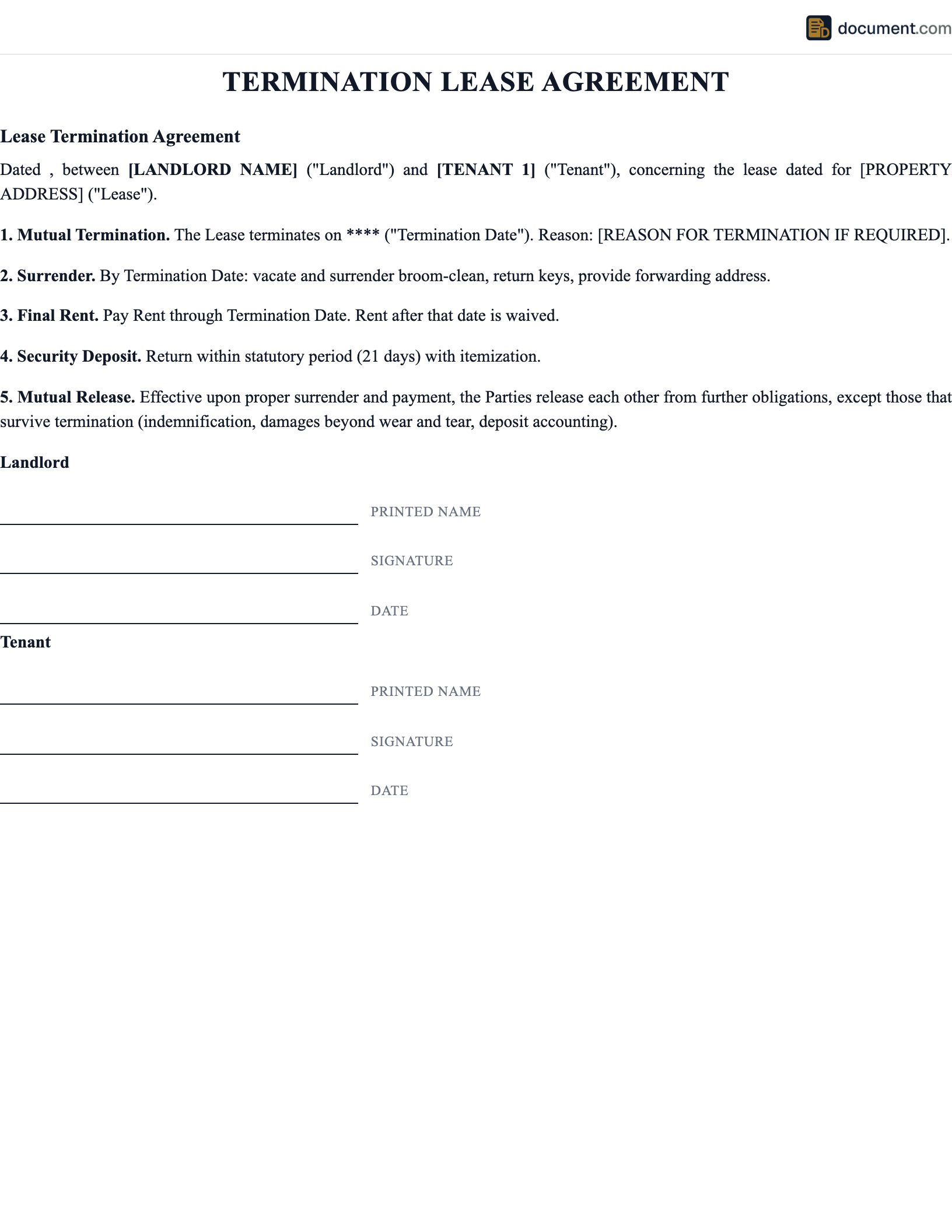
Sample Massachusetts Lease Termination Letter
Below is a preview of a lease termination letter customized for Massachusetts.
NOTICE TO QUIT
COMMONWEALTH OF MASSACHUSETTS
Pursuant to MGL c.186 § 12
FROM
Name: [Sender Full Name]
Role: [Landlord/Tenant]
Address: [Current Address]
Phone: [Contact]
TO
Name: [Recipient Full Name]
Role: [Landlord/Tenant]
Address: [Property/Mailing Address]
TERMINATION DETAILS
Property: [Rental Address & Unit]
Lease Date: [Original Lease/TAW Start Date]
Quit Date: [Last Day of Tenancy — must be rent due date]
Reason: [Non-Renewal / End of Term / Early Termination]
MOVE-OUT INSTRUCTIONS
Key Return: [Location/Method]
Inspection: [Date/Time]
Forwarding Address: [For Security Deposit + Interest Return]
Condition: [Move-Out Requirements per Lease]
Massachusetts Lease Termination FAQ
Common questions about ending a lease in Massachusetts.
Official Massachusetts Resources
Use these resources to verify Massachusetts landlord-tenant law and find legal assistance.
Related Massachusetts Documents
Depending on your situation, you may need additional documents alongside your Massachusetts lease termination letter.
Create your Massachusetts Termination Lease Agreement in under 5 minutes.
Answer a few questions and download a Massachusetts-compliant document, ready for the state agency.