



Maryland Lease Termination Overview
Lease termination in Maryland is governed by the Maryland Code, Real Property Title 8, which covers landlord-tenant relationships including lease termination, eviction procedures, and security deposits. Maryland does not have a comprehensive residential landlord-tenant act like the URLTA. Instead, the state relies on Title 8 of the Real Property Article combined with case law and local ordinances to regulate the landlord-tenant relationship. This creates a complex regulatory environment, especially in the jurisdictions surrounding Washington, D.C.
Maryland occupies a middle ground between landlord-friendly and tenant-friendly. The state provides meaningful protections including a two-month security deposit cap, a 45-day deposit return deadline, domestic violence termination rights, and anti-retaliation provisions. However, Maryland's unique failure-to-pay-rent process allows landlords to file directly in District Court without a preliminary notice, which is one of the fastest non-payment processes in the country. The state also does not impose a mandatory grace period for rent payments, though many leases include one.
Local ordinances play a significant role in Maryland landlord-tenant law. Montgomery County has enacted just-cause eviction protections and rent guidelines. Takoma Park has a rent stabilization ordinance. Baltimore City has considered various tenant protection measures. Prince George's County and Howard County also have tenant protection rules. Before issuing a termination notice, landlords should verify compliance with both state law and any applicable local ordinance for the jurisdiction where the rental property is located.
1 Month
Notice period
45 Days
Deposit return
Local
Rent control
Local
Just cause (varies)
Maryland Notice Periods for Lease Termination
Maryland Code, Real Property section 8-402 establishes the notice requirements for terminating periodic tenancies. The standard notice for month-to-month tenancies is one month. Maryland's failure-to-pay-rent process is unique in that no preliminary notice is required before filing in court.
| Tenancy Type | Notice Required | Authority |
|---|---|---|
| Month-to-Month | 1 month before end of rental period | RP § 8-402(b)(3) |
| Week-to-Week | 1 week | RP § 8-402(b)(4) |
| Year-to-Year | 3 months before end of year | RP § 8-402(b)(2) |
| Fixed-Term Lease | Per lease terms (auto-expires) | Contract law |
| Failure to Pay Rent | No pre-suit notice required | RP § 8-401 |
| Domestic Violence | 30 days after landlord receives notice | RP § 8-5A-02 |
Maryland's Failure-to-Pay-Rent Process
Maryland is unique in not requiring a preliminary notice before filing a failure-to-pay-rent action. Under RP section 8-401, the landlord can file directly in District Court once rent is overdue. The tenant is served through the court process and may pay the full amount owed plus court costs at or before the hearing to avoid eviction. This makes Maryland one of the fastest states for landlords to initiate non-payment proceedings, though the overall court process still takes several weeks.
Maryland Legal Requirements for Termination
A valid termination notice in Maryland must comply with Real Property Title 8 and any applicable local ordinances.
Required Elements of a Termination Notice
- Written form: Termination notices must be in writing under RP section 8-402
- Property identification: Include the full street address and unit number, including county or city
- Termination date: Specify the date the tenancy ends, at least one month from delivery and aligned with the rental period
- Party identification: Include full legal names of the landlord and all tenants on the lease
- Move-out instructions: Specify key return, inspection date, and forwarding address for deposit return
- Proper delivery: Personal delivery or certified mail recommended; keep proof of delivery
Early Termination Grounds in Maryland
Maryland provides several grounds for early termination. Domestic violence victims may terminate under RP section 8-5A-02 with 30 days notice and a protective order or police report. Military members may terminate under the SCRA. Tenants may terminate for habitability failures after written notice under the implied warranty of habitability recognized by Maryland courts. Landlords may terminate for non-payment (direct court filing), breach of lease, or holdover situations.
How to Terminate a Lease in Maryland
Follow these steps to properly terminate a lease in Maryland.
Determine Applicable Law
Identify whether local ordinances apply. Montgomery County has just-cause eviction; Takoma Park has rent stabilization; Baltimore City has additional notice requirements for long-term tenants. Check both state law and local rules before proceeding.
Review Your Lease and Draft Notice
Check the lease for termination clauses and early termination fees. Draft a written notice identifying the property, stating the termination date (one month from delivery, aligned with rental period end), and including move-out instructions and forwarding address.
Deliver the Notice
Deliver by personal service or certified mail with return receipt. Keep copies and proof of delivery. Do not accept rent payments after the termination date, as this may revive the tenancy under Maryland case law.
Conduct a Move-Out Inspection
Document property condition with photographs and a written checklist. Maryland caps deposits at two months' rent, and the 45-day return deadline requires landlords to act promptly. The landlord must provide receipts or good faith estimates for any claimed damages.
Return Keys and Provide Forwarding Address
Tenants should return all keys and provide a forwarding address. The landlord's 45-day deposit return deadline under RP section 8-203 begins when the tenant vacates. Failure to comply can result in treble damages (three times the amount wrongfully withheld).
Security Deposit After Lease Termination in Maryland
Maryland's security deposit rules are found in RP section 8-203. The maximum deposit is two months' rent. After the tenant vacates, the landlord has 45 days to return the deposit or provide an itemized list of damages with receipts or good faith estimates. The deposit must be held in a Maryland financial institution in a separate account, and the landlord must provide the tenant with a receipt identifying the institution within 30 days of receiving the deposit.
Maryland requires landlords to pay simple interest on security deposits held for more than six months at the rate of 3% per year. If the landlord fails to return the deposit or provide the itemized statement within 45 days, the tenant may recover up to three times the amount wrongfully withheld (treble damages) plus reasonable attorney fees. This is one of the strongest deposit penalty provisions in the country. Tenants should document property condition thoroughly and provide a forwarding address in writing.
Sample Maryland Lease Termination Letter
Below is a preview of a lease termination letter customized for Maryland.
LEASE TERMINATION LETTER
STATE OF MARYLAND
Pursuant to MD Code, RP § 8-402
FROM
Name: [Sender Full Name]
Role: [Landlord/Tenant]
Address: [Current Address]
Phone: [Contact]
TO
Name: [Recipient Full Name]
Role: [Landlord/Tenant]
Address: [Property/Mailing Address]
TERMINATION DETAILS
Property: [Rental Address, County/City & Unit]
Lease Date: [Original Lease Date]
Termination Date: [Last Day of Tenancy]
Reason: [Non-Renewal / End of Term / Early Termination]
MOVE-OUT INSTRUCTIONS
Key Return: [Location/Method]
Inspection: [Date/Time]
Forwarding Address: [For Security Deposit Return]
Condition: [Move-Out Requirements per Lease]
Maryland Lease Termination FAQ
Common questions about ending a lease in Maryland.
Official Maryland Resources
Use these resources to verify Maryland landlord-tenant law and find legal assistance.
Related Maryland Documents
Depending on your situation, you may need additional documents alongside your Maryland lease termination letter.
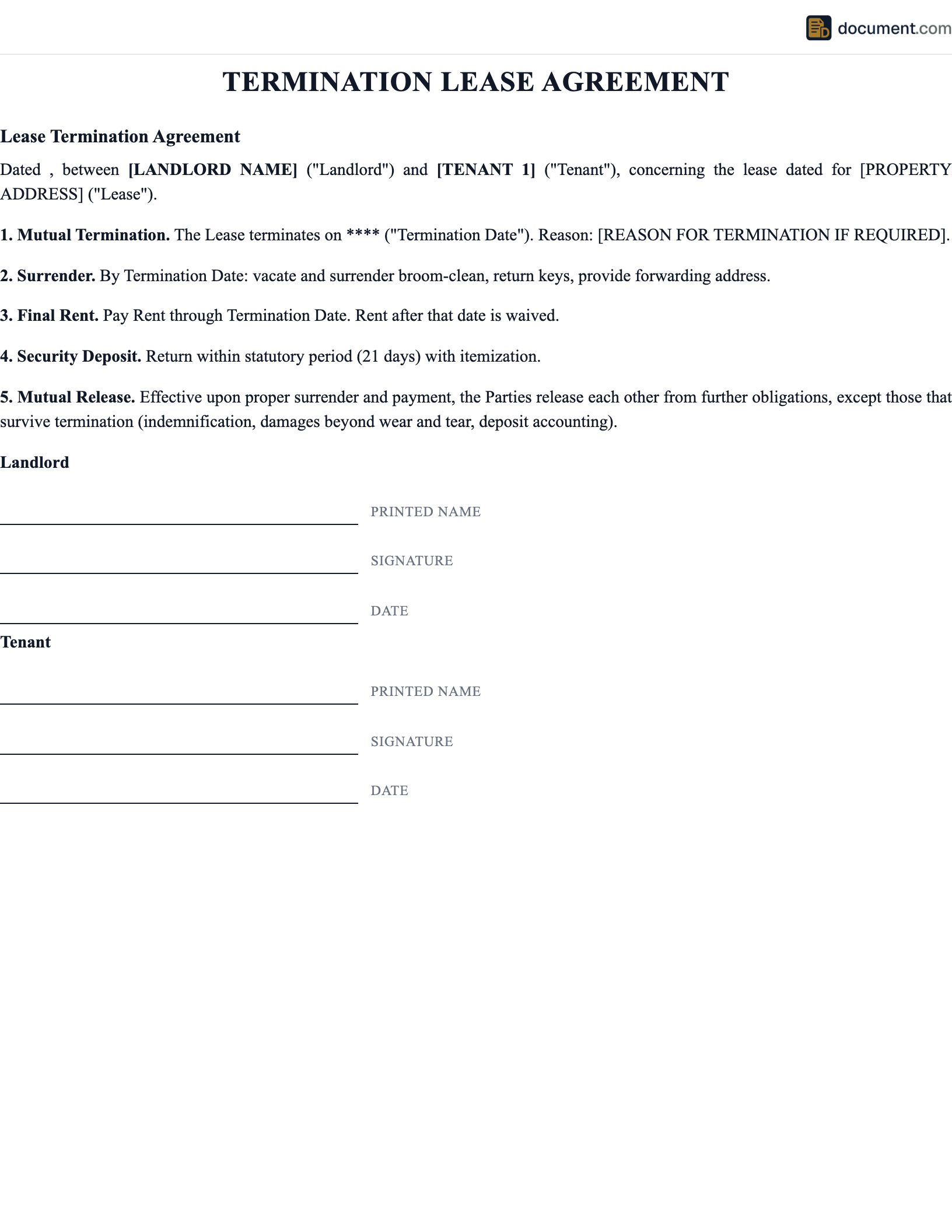
Create your Maryland Termination Lease Agreement in under 5 minutes.
Answer a few questions and download a Maryland-compliant document, ready for the state agency.