
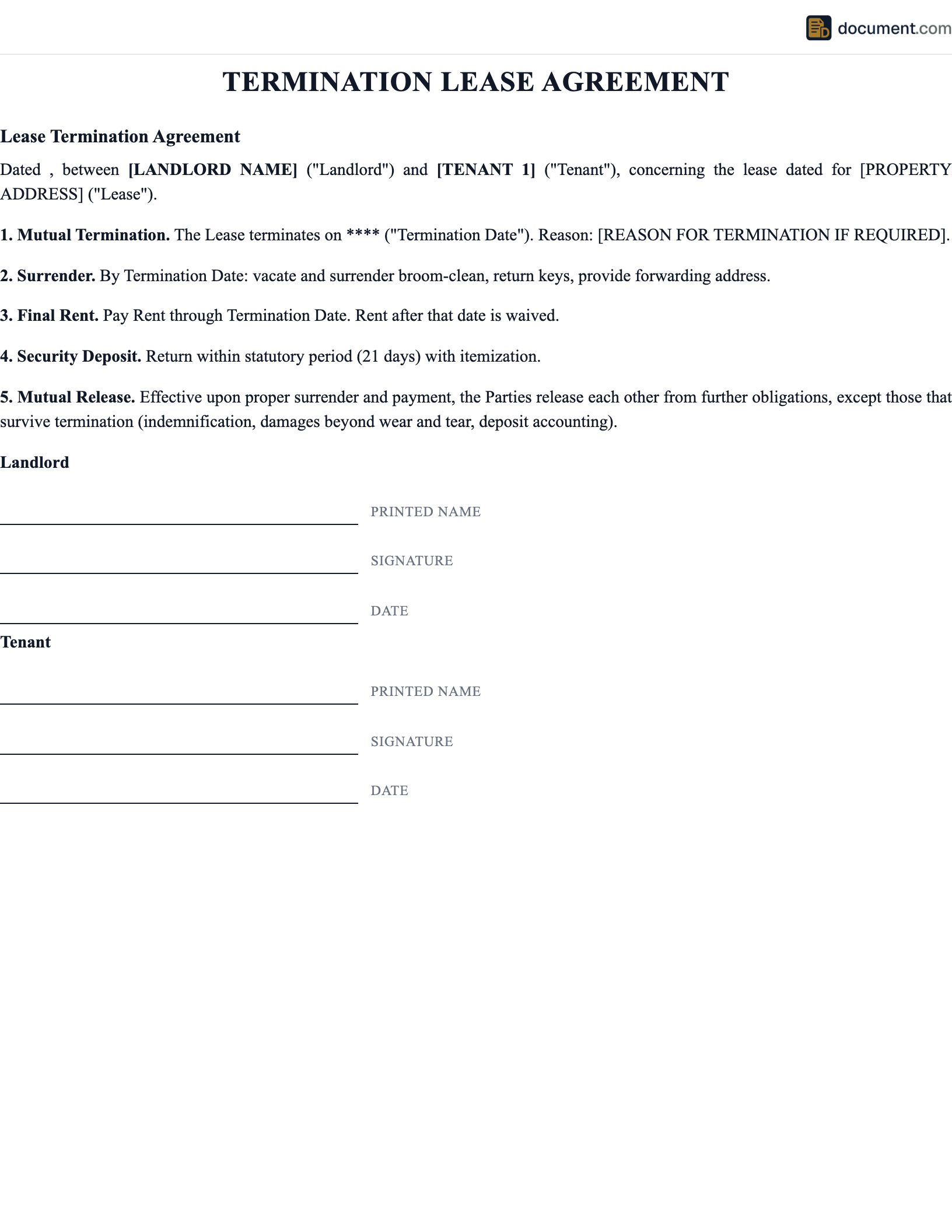



Kansas Lease Termination Overview
Lease termination in Kansas is governed by the Kansas Residential Landlord and Tenant Act (KRLTA), codified at K.S.A. 58-2540 through 58-2573. The KRLTA is based on the Uniform Residential Landlord and Tenant Act and provides a comprehensive statutory framework for residential rental relationships in Kansas. The Act covers security deposits, maintenance obligations, termination procedures, eviction processes, and remedies for both landlords and tenants. It applies to all residential rental agreements except for certain excluded properties such as transient lodging, institutional housing, and owner-occupied buildings with two or fewer units.
Kansas is generally considered a landlord-friendly state. There is no rent control, no just-cause eviction requirement, and the termination process for periodic tenancies is straightforward. However, the KRLTA provides balanced protections for both parties, including a 14-day cure period for lease violations, anti-retaliation protections for tenants, and reasonable security deposit caps. The 30-day notice period for month-to-month terminations applies equally to landlords and tenants.
Kansas does not have a domestic violence early termination statute, which distinguishes it from many other states that have enacted such protections. Military service members remain protected by the federal SCRA. Both landlords and tenants should be aware that the KRLTA includes a non-waivability provision (K.S.A. 58-2543) that prevents lease clauses from overriding tenant protections under the Act, including the 14-day cure period and the anti-retaliation provisions.
30 Days
Notice period
30 Days
Deposit return
None
Rent control
No
Just cause required
Kansas Notice Periods for Lease Termination
The KRLTA establishes specific notice periods for different types of lease termination. K.S.A. 58-2570 requires 30 days written notice for month-to-month tenancies. Cause-based terminations follow shorter timelines under sections 58-2564 and 58-2565.
| Tenancy Type | Notice Required | Authority |
|---|---|---|
| Month-to-Month | 30 days before end of rental period | K.S.A. § 58-2570 |
| Fixed-Term Lease | Per lease terms (auto-expires) | Contract law |
| Non-Payment of Rent | 3 days (10 days if first offense) | K.S.A. § 58-2564(b) |
| Lease Violation (Curable) | 14 days to cure | K.S.A. § 58-2564(a) |
| Repeat Violation (6 months) | 14 days, no right to cure | K.S.A. § 58-2564(a) |
Kansas Repeat Violation Rule
Under K.S.A. 58-2564(a), if a tenant commits the same or a substantially similar violation within 6 months of a prior curable violation, the landlord may serve a new 14-day notice that does not include a right to cure. The tenancy terminates automatically after 14 days regardless of whether the tenant attempts to correct the problem. This progressive discipline approach encourages tenants to address issues permanently while giving landlords recourse for persistent violations.
Kansas Legal Requirements for Termination
A valid termination notice in Kansas must satisfy the requirements of the KRLTA. Kansas courts will scrutinize the notice for proper content, timing, and delivery.
Required Elements of a Termination Notice
- Written form: Termination notices must be in writing under K.S.A. 58-2570
- Property identification: Include the full street address and unit number of the rental property
- Termination date: Specify the date the tenancy ends, at least 30 days from delivery and aligned with the rental period end
- Party identification: Include full legal names of the landlord and all tenants on the lease
- Move-out instructions: Specify key return, inspection date, and forwarding address for security deposit return
- Proper delivery: Personal delivery or mailing to last known address per K.S.A. 58-2557; certified mail recommended
Early Termination Grounds in Kansas
Kansas provides limited grounds for early lease termination. Military service members can terminate under the SCRA with 30 days notice and a copy of orders. Tenants may terminate if the landlord materially breaches the obligation to maintain the premises under K.S.A. 58-2559, after providing written notice and allowing 14 days to repair. Kansas does not have a state-level domestic violence early termination statute. Landlords may terminate early for non-payment (3 or 10 days), material violations (14 days), or if the tenant endangers the health or safety of others.
How to Terminate a Lease in Kansas
Follow these steps to properly terminate a lease under the KRLTA.
Review Your Lease Agreement
Check the lease for termination clauses, early termination fees, and automatic renewal provisions. Remember that under K.S.A. 58-2543, lease provisions that conflict with KRLTA tenant protections are void and unenforceable. The lease cannot waive the 14-day cure period or the anti-retaliation provisions.
Draft a Written Termination Notice
Prepare a written notice identifying the property, stating the termination date (at least 30 days and aligned with the rental period end), and listing move-out instructions. Include your forwarding address if you are the tenant to ensure timely deposit return within the 30-day deadline.
Deliver the Notice
Deliver by personal service or mail to the recipient's last known address under K.S.A. 58-2557. Certified mail with return receipt is recommended for documentation. Keep copies of the notice and all delivery records. Notice is effective when mailed or personally delivered.
Conduct a Move-Out Inspection
Schedule a walk-through to document property condition with photographs and a checklist. Kansas caps security deposits at one month's rent for unfurnished and 1.5 months for furnished units, and the landlord has only 30 days to return the deposit with an itemized statement.
Return Keys and Provide Forwarding Address
Tenants should return all keys on the termination date and provide a written forwarding address. The 30-day deposit return deadline under K.S.A. 58-2550 begins when the tenancy terminates and the tenant vacates. Landlords should document key receipt and begin the deposit accounting promptly.
Security Deposit After Lease Termination in Kansas
Kansas security deposit rules are codified at K.S.A. 58-2550. The maximum deposit is one month's rent for unfurnished units and one and a half months' rent for furnished units, plus an additional half month for pet deposits. After the tenancy terminates and the tenant vacates, the landlord must return the deposit or provide an itemized list of deductions within 30 days.
Permissible deductions include unpaid rent, damages beyond normal wear and tear, and lease-authorized charges. If the landlord fails to return the deposit or provide the itemized statement within 30 days, the tenant may recover 1.5 times the amount wrongfully withheld. Kansas does not require landlords to pay interest on security deposits or hold them in a separate account. However, the landlord must disclose to the tenant at the beginning of the tenancy where the deposit is held.
Sample Kansas Lease Termination Letter
Below is a preview of a lease termination letter customized for Kansas.
LEASE TERMINATION LETTER
STATE OF KANSAS
Pursuant to K.S.A. § 58-2570
FROM
Name: [Sender Full Name]
Role: [Landlord/Tenant]
Address: [Current Address]
Phone: [Contact]
TO
Name: [Recipient Full Name]
Role: [Landlord/Tenant]
Address: [Property/Mailing Address]
TERMINATION DETAILS
Property: [Rental Address & Unit]
Lease Date: [Original Lease Date]
Termination Date: [Last Day of Tenancy]
Reason: [Non-Renewal / End of Term / Early Termination]
MOVE-OUT INSTRUCTIONS
Key Return: [Location/Method]
Inspection: [Date/Time]
Forwarding Address: [For Security Deposit Return]
Condition: [Move-Out Requirements per Lease]
Kansas Lease Termination FAQ
Common questions about ending a lease in Kansas under the KRLTA.
Official Kansas Resources
Use these resources to verify Kansas landlord-tenant law and find legal assistance.
Related Kansas Documents
Depending on your situation, you may need additional documents alongside your Kansas lease termination letter.
Create your Kansas Termination Lease Agreement in under 5 minutes.
Answer a few questions and download a Kansas-compliant document, ready for the state agency.