
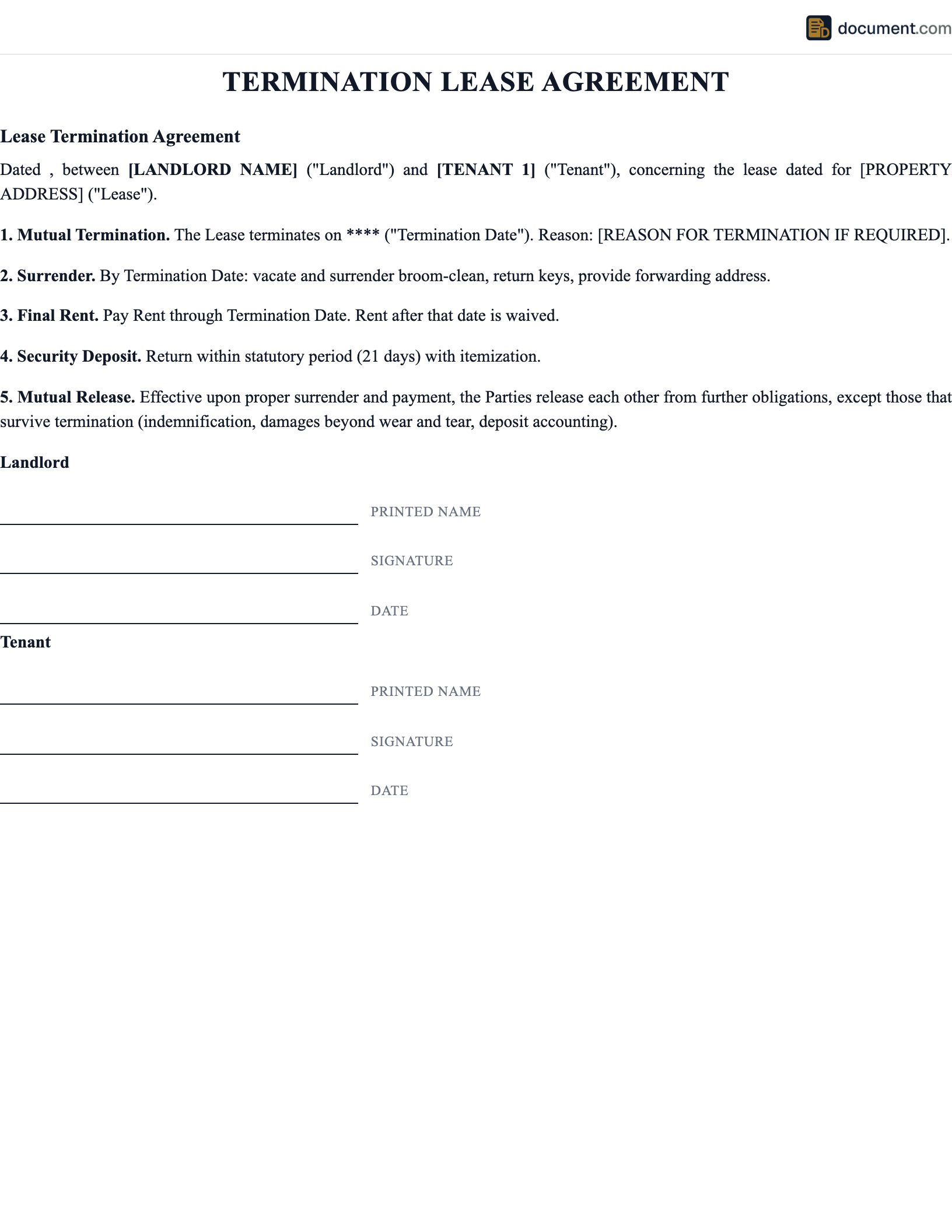



Illinois Lease Termination Overview
Lease termination in Illinois is governed by a combination of state statutes and local ordinances that create a complex regulatory landscape. At the state level, the Illinois Code of Civil Procedure (735 ILCS 5/9-207 through 9-211) establishes rules for terminating periodic tenancies and initiating forcible entry and detainer proceedings. The Security Deposit Return Act (765 ILCS 710) and the Safe Homes Act (765 ILCS 750) provide additional requirements and protections. Unlike many states, Illinois does not have a statewide residential landlord-tenant act, which means local municipalities play an outsized role in defining tenant protections.
The most significant local ordinance is the Chicago Residential Landlord and Tenant Ordinance (RLTO), which applies to most residential rental units within Chicago city limits. The RLTO imposes strict requirements for security deposit handling, notice provisions, lease disclosures, and termination procedures that go far beyond state law. Chicago also enacted a just-cause eviction ordinance effective in 2024 that requires landlords to have a legitimate reason to decline lease renewal. Cook County adopted a similar tenant protection ordinance covering unincorporated Cook County areas and some suburban municipalities that opted in.
Outside of Chicago and Cook County, Illinois landlord-tenant law is more landlord-friendly, with fewer restrictions on lease termination and non-renewal. However, all Illinois landlords must comply with the state Security Deposit Return Act, the Safe Homes Act for domestic violence victims, and federal fair housing law. Illinois's diverse regulatory environment means that a termination letter must be carefully tailored to the specific jurisdiction where the rental property is located.
30 Days
Notice period
30 Days
Deposit return
Evolving
Rent control
Chicago
Just cause (local)
Illinois Notice Periods for Lease Termination
Illinois requires 30 days written notice to terminate a month-to-month tenancy under 735 ILCS 5/9-207. The notice must be given before the beginning of the rental period in which the termination will take effect. For cause-based terminations, Illinois provides a 5-day notice for non-payment and a 10-day notice for other lease violations.
| Tenancy Type | Notice Required | Authority |
|---|---|---|
| Month-to-Month | 30 days before end of rental period | 735 ILCS 5/9-207 |
| Week-to-Week | 7 days | 735 ILCS 5/9-207 |
| Year-to-Year | 60 days before end of year | 735 ILCS 5/9-205 |
| Fixed-Term Lease | Per lease terms (auto-expires) | Contract law |
| Non-Payment of Rent | 5 days to pay or vacate | 735 ILCS 5/9-209 |
| Lease Violation | 10 days to cure or vacate | 735 ILCS 5/9-210 |
Chicago RLTO Rules
If the rental property is located in the City of Chicago, the Chicago RLTO imposes additional termination requirements. Chicago's just-cause eviction ordinance requires landlords to have a qualifying reason to decline lease renewal and provides tenants with a right to cure certain violations before termination. Landlords must also comply with strict security deposit rules under the RLTO. Failure to follow Chicago-specific requirements can result in penalties equal to two months rent plus attorney fees.
Illinois Legal Requirements for Termination
A valid termination notice in Illinois must satisfy both state and any applicable local requirements. Failure to include required elements or follow proper procedures can invalidate the termination and expose the sender to liability.
Required Elements of a Termination Notice
- Written form: All termination notices must be in writing; oral notices are not enforceable under Illinois law
- Property identification: Include the full street address and unit number of the rental property
- Termination date: State the specific date on which the tenancy will end, at least 30 days from delivery and aligned with the end of a rental period
- Party identification: Include the full names of the landlord and all tenants on the lease
- Move-out instructions: Specify key return procedures, move-out inspection, and forwarding address for deposit return
- Proper delivery: Deliver by personal service, certified mail, or the method specified in the lease; in Chicago, the RLTO requires first-class mail or personal delivery
Early Termination Grounds in Illinois
Illinois provides several pathways for early lease termination. The Safe Homes Act (765 ILCS 750) allows victims of domestic violence, sexual violence, or stalking to terminate with 30 days notice by providing a protective order or police report. Military service members may terminate under the federal SCRA. Tenants may also terminate when the landlord breaches the implied warranty of habitability by failing to maintain the premises in a safe and habitable condition after written notice under the Residential Tenants' Right to Repair Act (765 ILCS 742).
How to Terminate a Lease in Illinois
Follow these steps to properly terminate a lease in Illinois. Requirements may differ based on whether the property is in Chicago, Cook County, or elsewhere in the state.
Determine Which Laws Apply
Identify whether the property is in Chicago (RLTO applies), unincorporated Cook County (Cook County RTEP may apply), or elsewhere in Illinois (state law only). The applicable rules for notice, delivery, and permissible termination reasons differ significantly by jurisdiction.
Review Your Lease Agreement
Check the lease for any termination clause, early termination fee, automatic renewal provision, or required notice period. Illinois leases may include terms that exceed the statutory minimum. In Chicago, certain lease clauses that violate the RLTO may be void and unenforceable.
Draft a Written Termination Notice
Prepare a written notice that identifies the property, states the termination date (at least 30 days from delivery, aligned with a rental period end), and includes move-out instructions. In Chicago, include any required RLTO disclosures and state the reason for non-renewal if applicable under the just-cause ordinance.
Deliver the Notice Properly
Deliver by personal service or certified mail with return receipt requested. In Chicago, the RLTO allows first-class mail or personal delivery. Keep a copy of the notice and proof of delivery. If serving by mail, account for additional mailing time when calculating the notice period.
Handle Security Deposit and Move-Out
Conduct a move-out inspection and document conditions. The landlord has 30 days to return the deposit with an itemized statement under the Security Deposit Return Act. In Chicago, the landlord must also pay accrued interest on the deposit. Tenants should provide a forwarding address in writing to ensure timely return.
Security Deposit After Lease Termination in Illinois
The Illinois Security Deposit Return Act (765 ILCS 710) applies statewide. Landlords must return the full deposit within 30 days of the tenant vacating if no deductions are made. If the landlord intends to make deductions for damages or unpaid rent, they must provide an itemized statement of deductions and any remaining balance within 30 days. If a landlord fails to comply, the tenant may recover up to two times the deposit amount plus reasonable attorney fees.
In Chicago, the RLTO imposes additional requirements. Security deposits must be held in a federally insured interest-bearing account at a financial institution in Illinois. Landlords must pay interest to tenants annually and provide a receipt listing the institution name and rate. Violations of the Chicago deposit rules can result in penalties of two times the deposit amount plus attorney fees and costs. These strict rules make deposit handling a critical part of any Chicago lease termination.
Sample Illinois Lease Termination Letter
Below is a preview of a lease termination letter customized for Illinois. Your document will include provisions compliant with state law and, where applicable, Chicago RLTO requirements.
LEASE TERMINATION LETTER
STATE OF ILLINOIS
Pursuant to 735 ILCS 5/9-207
FROM
Name: [Sender Full Name]
Role: [Landlord/Tenant]
Address: [Current Address]
Phone: [Contact]
TO
Name: [Recipient Full Name]
Role: [Landlord/Tenant]
Address: [Property/Mailing Address]
TERMINATION DETAILS
Property: [Rental Address & Unit]
Lease Date: [Original Lease Date]
Termination Date: [Last Day of Tenancy]
Reason: [Non-Renewal / End of Term / Early Termination]
MOVE-OUT INSTRUCTIONS
Key Return: [Location/Method]
Inspection: [Date/Time]
Forwarding Address: [For Security Deposit Return]
Condition: [Move-Out Requirements per Lease]
Illinois Lease Termination FAQ
Common questions about ending a lease in Illinois, including state and Chicago RLTO requirements.
Official Illinois Resources
Use these resources to verify Illinois landlord-tenant law and find legal assistance.
Related Illinois Documents
Depending on your situation, you may need additional documents alongside your Illinois lease termination letter.
Create your Illinois Termination Lease Agreement in under 5 minutes.
Answer a few questions and download a Illinois-compliant document, ready for the state agency.