
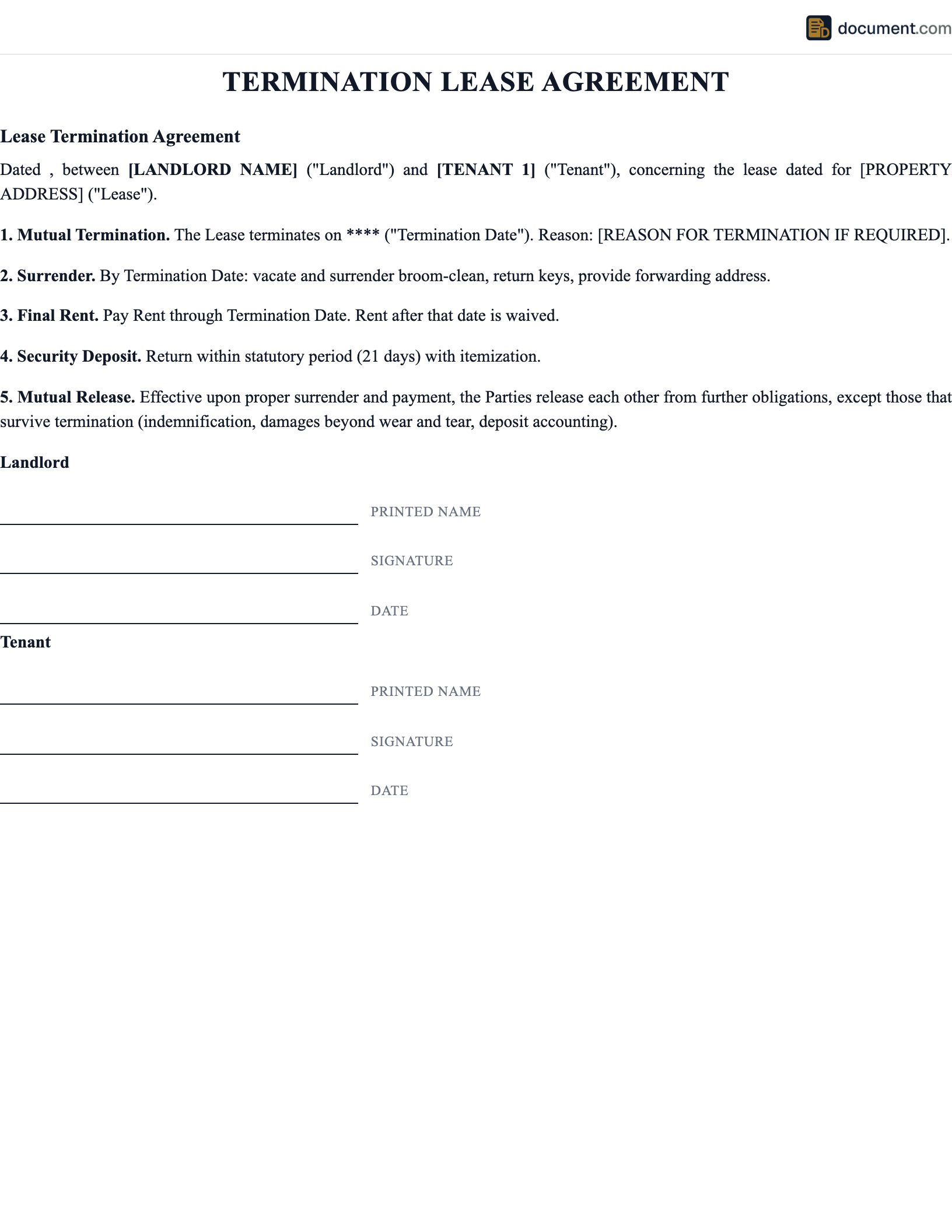



Connecticut Lease Termination Overview
Lease termination in Connecticut is governed by Connecticut General Statutes Chapter 830 (sections 47a-1 through 47a-74), which establishes a comprehensive framework for residential landlord-tenant relationships. Connecticut is a relatively tenant-protective state with strong anti-retaliation provisions, mandatory interest on security deposits, and a requirement that all evictions proceed through the Housing Court or housing session of the Superior Court.
Connecticut does not have a single statutory notice period for month-to-month terminations. Instead, under common law principles and Conn. Gen. Stat. 47a-23, notice equal to one rental period (typically 30 days for monthly tenancies) is generally required. However, the lease agreement may specify different notice requirements. For cause-based terminations, specific notice periods apply: non-payment of rent requires a 9-day Notice to Quit under praxis, while lease violations typically require a 15-day notice.
Connecticut stands out for requiring landlords to pay annual interest on security deposits under Conn. Gen. Stat. 47a-21(i), a provision that is uncommon nationwide. The state limits deposits to two months' rent and requires return within 30 days after the tenant vacates. Connecticut also provides early termination rights for victims of family violence and has strong protections against retaliatory eviction under Conn. Gen. Stat. 47a-20.
30 Days
Notice (typical)
30 Days
Deposit return
Some Cities
Rent control
Yes
Deposit interest
Connecticut Notice Periods for Lease Termination
Connecticut's notice requirements vary based on the type of tenancy and the reason for termination.
| Tenancy Type | Notice Required | Authority |
|---|---|---|
| Month-to-Month | One rental period (typically 30 days) | Common law / lease terms |
| Week-to-Week | One rental period (7 days) | Common law |
| Tenancy at Will | 3 days Notice to Quit | CGS 47a-23 |
| Fixed-Term | Per lease terms | Contract law |
| Non-Payment of Rent | 9-day Notice to Quit | CGS 47a-23 |
| Lease Violation | 15-day Notice to Quit | CGS 47a-15 |
| Family Violence | Written notice + court order | CGS 47a-11e |
Connecticut Housing Court Requirement
All evictions in Connecticut must go through the Housing Court or the housing session of the Superior Court. Landlords cannot use self-help measures such as changing locks, removing belongings, or shutting off utilities. The Summary Process eviction procedure has specific timing and service requirements that must be followed precisely.
Connecticut Legal Requirements for Termination
Connecticut has specific requirements for lease termination notices. The state's anti-retaliation statute (CGS 47a-20) prohibits landlords from terminating in response to a tenant's good-faith complaint about housing conditions.
Required Notice Contents
- Written form: Termination notices should be in writing for enforceability in Connecticut courts
- Property identification: Full address and unit number of the rental property
- Termination date: The specific date on which the tenancy will end
- Delivery method: Personal delivery, leaving at the unit with a witness, or certified mail
- Interest accounting: If the tenant has a deposit, address how accrued interest will be paid per CGS 47a-21(i)
Family Violence Early Termination
Under Conn. Gen. Stat. 47a-11e, a tenant who is a victim of family violence may terminate their lease by providing written notice along with a copy of a restraining order or protective order issued by a Connecticut court. The tenant is responsible for rent through the termination date or 30 days after providing notice, whichever is later. The landlord may not charge early termination fees or penalize the tenant.
How to Terminate a Lease in Connecticut
Follow these steps to ensure your Connecticut lease termination is legally effective.
Review Your Lease for Notice Requirements
Connecticut does not have a single statutory notice period for month-to-month terminations. Check your lease for specific provisions. If the lease is silent, provide notice equal to one rental period (typically 30 days).
Draft a Written Termination Notice
Include the property address, termination date, party names, and lease reference. Reference any accrued security deposit interest owed under CGS 47a-21(i).
Deliver the Notice Properly
Deliver by personal service, by leaving at the unit in the presence of a witness, or by certified mail. Keep proof of delivery for potential Housing Court proceedings.
Complete Move-Out and Request Deposit Plus Interest
Document property condition, return all keys, and provide a forwarding address. The landlord has 30 days to return the deposit plus any accrued interest with an itemized statement of deductions.
Security Deposit After Lease Termination in Connecticut
Connecticut's security deposit law (CGS 47a-21) is more tenant-protective than most states. The landlord must return the deposit within 30 days after the tenant vacates, or within 15 days after the tenant provides a forwarding address, whichever is later. The maximum deposit is two months' rent. Connecticut uniquely requires landlords to pay annual interest on deposits at a rate set by the state banking commissioner.
Permissible deductions include unpaid rent and damages beyond normal wear and tear. The landlord must provide a written itemized statement of deductions. If the landlord fails to return the deposit within the required timeframe, the tenant may recover double the deposit amount. The interest requirement is unique and landlords must track and pay or credit it annually — failure to pay interest does not forfeit the deposit but creates additional liability.
Sample Connecticut Lease Termination Letter
Below is a preview of a lease termination letter tailored for Connecticut.
LEASE TERMINATION LETTER
STATE OF CONNECTICUT
Pursuant to Conn. Gen. Stat. Chapter 830
FROM
Name: [Sender Full Name]
Role: [Landlord/Tenant]
Address: [Current Address]
Phone: [Contact]
TO
Name: [Recipient Full Name]
Role: [Landlord/Tenant]
Address: [Property/Mailing Address]
TERMINATION DETAILS
Property: [Rental Address & Unit]
Lease Date: [Original Lease Date]
Termination Date: [Last Day of Tenancy]
Reason: [Non-Renewal / End of Term / Early Termination]
MOVE-OUT INSTRUCTIONS
Key Return: [Location/Method]
Inspection: [Date/Time]
Forwarding Address: [For Deposit + Interest Return]
Condition: [Move-Out Requirements]
Connecticut Lease Termination FAQ
Common questions about ending a lease in Connecticut.
Official Connecticut Resources
Use these resources to verify Connecticut landlord-tenant law and find legal assistance.
Related Connecticut Documents
You may need these documents alongside your Connecticut lease termination letter.
Create your Connecticut Termination Lease Agreement in under 5 minutes.
Answer a few questions and download a Connecticut-compliant document, ready for the state agency.