
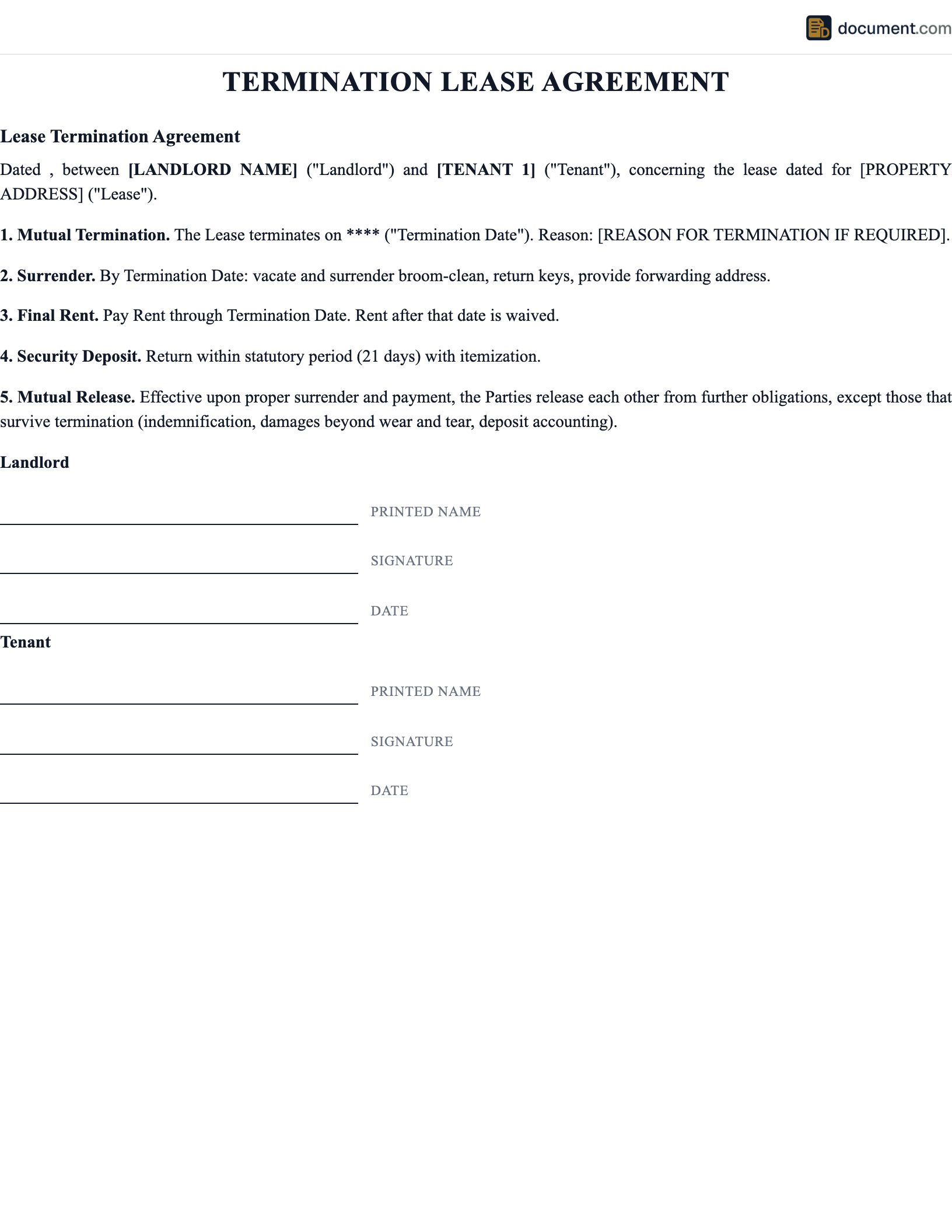



California Lease Termination Overview
Lease termination in California is governed by Civil Code sections 1940 through 1954.06, supplemented by the landmark Tenant Protection Act of 2019 (AB 1482, codified at Cal. Civ. Code 1946.2 and 1947.12). California has the most complex and tenant-protective landlord-tenant laws in the country. The notice period for terminating a month-to-month tenancy depends on how long the tenant has occupied the unit: 30 days if under one year, and 60 days if one year or more (Cal. Civ. Code 1946.1).
AB 1482 fundamentally changed California lease termination law by requiring just cause for eviction in most residential tenancies. Landlords of covered properties cannot terminate without an enumerated reason, divided into "at-fault" causes (non-payment, breach, nuisance, criminal activity) and "no-fault" causes (owner move-in, withdrawal from rental market under the Ellis Act, substantial renovation). For no-fault terminations, the landlord must provide relocation assistance equal to one month's rent or waive the final month's rent.
Many California cities have their own rent stabilization ordinances with even stricter rules. Los Angeles, San Francisco, Oakland, Berkeley, West Hollywood, Santa Monica, and San Jose all have local rent control with additional just-cause protections, enhanced relocation payments, and lower rent increase caps. Navigating California lease termination requires understanding whether AB 1482, a local ordinance, or both apply to the specific property.
30/60 Days
Notice period
21 Days
Deposit return
Statewide
Rent control
Yes
Just cause (AB 1482)
California Notice Periods for Lease Termination
California's notice periods vary based on occupancy duration and termination reason. AB 1482 adds additional requirements for covered properties.
| Tenancy Type | Notice Required | Authority |
|---|---|---|
| Month-to-Month (under 1 year) | 30 days | Cal. Civ. Code 1946.1 |
| Month-to-Month (1+ years) | 60 days | Cal. Civ. Code 1946.1 |
| Week-to-Week | 7 days | Cal. Civ. Code 1946 |
| Fixed-Term | Per lease terms | Contract law |
| Non-Payment of Rent | 3 days to pay or quit | Cal. CCP 1161(2) |
| No-Fault (AB 1482) | 60 days + relocation | Cal. Civ. Code 1946.2(d) |
California Just-Cause Eviction (AB 1482)
Under the Tenant Protection Act, landlords of covered properties cannot terminate a tenancy without just cause after 12 months of occupancy. No-fault terminations require 60 days notice plus relocation assistance equal to one month's rent. Many California cities have even stricter local ordinances. Violating these requirements can result in significant penalties including the tenant's actual damages and attorney fees.
California Legal Requirements for Termination
California has specific and detailed requirements for lease termination notices. Defective notices are the most common reason unlawful detainer cases are dismissed in California courts.
Required Notice Contents
- Written form: All termination notices must be in writing per Cal. Civ. Code 1946
- Notice period: 30 days if under 1 year occupancy, 60 days if 1 year or more per Cal. Civ. Code 1946.1
- Just cause (AB 1482): For covered properties, state the specific just-cause reason and relevant code section
- Relocation assistance: For no-fault terminations under AB 1482, offer one month's rent or waive final month
- Delivery method: Personal delivery, substituted service plus mail, or posting plus mail per CCP 1162
Early Termination Protections in California
California provides extensive early termination rights. Under Cal. Civ. Code 1946.7, victims of domestic violence, sexual assault, stalking, human trafficking, or elder abuse may terminate with 14 days written notice plus a protective order or police report. Military members can terminate under both the federal SCRA and California Military and Veterans Code 409.1. Tenants may terminate for habitability defects under Cal. Civ. Code 1942. If a landlord unlawfully locks out a tenant or shuts off utilities, the tenant may terminate and recover damages under Cal. Civ. Code 789.3.
How to Terminate a Lease in California
California lease termination involves more steps than most states due to AB 1482 and potential local ordinance requirements.
Determine Notice Period and AB 1482 Coverage
Calculate whether 30 or 60 days notice is needed based on occupancy duration. Determine whether AB 1482 applies and whether a local rent control ordinance adds additional requirements for the property.
Draft the Termination Notice with All Required Elements
Include property address, termination date, and all parties' names. If AB 1482 applies, state the specific just-cause reason and code section. For no-fault terminations, include the relocation assistance offer.
Serve the Notice Per CCP 1162
California allows personal delivery, substituted service (leaving with a competent adult plus mailing), or posting on the door plus mailing. Complete a proof of service form documenting when, how, and by whom the notice was served.
Handle Security Deposit and Move-Out
California gives landlords 21 calendar days to return the deposit with an itemized statement per Cal. Civ. Code 1950.5. Document property condition with photos and video at move-out. Request a pre-move-out inspection under Cal. Civ. Code 1950.5(f).
Security Deposit After Lease Termination in California
California Civil Code 1950.5 provides detailed rules for security deposits. The landlord must return the deposit or provide an itemized statement of deductions within 21 calendar days after the tenant vacates. Since January 1, 2024, AB 12 limits most deposits to one month's rent regardless of whether the unit is furnished (the previous limit was two months for unfurnished and three months for furnished).
Permissible deductions include unpaid rent, cleaning costs to restore the unit to move-in condition (less normal wear and tear), and repair of damages beyond normal wear. The landlord must provide receipts for deductions over $125. If the landlord fails to return the deposit within 21 days, the tenant may recover up to twice the deposit amount in bad faith cases, plus the actual deposit owed. California tenants may request a pre-move-out inspection, giving the landlord an opportunity to identify potential deductions and the tenant an opportunity to address them before vacating.
Sample California Lease Termination Letter
Below is a preview of a lease termination letter tailored for California, including AB 1482 compliance provisions.
LEASE TERMINATION LETTER
STATE OF CALIFORNIA
Pursuant to Cal. Civ. Code 1946.1 / AB 1482
FROM
Name: [Sender Full Name]
Role: [Landlord/Tenant]
Address: [Current Address]
Phone: [Contact]
TO
Name: [Recipient Full Name]
Role: [Landlord/Tenant]
Address: [Property/Mailing Address]
TERMINATION DETAILS
Property: [Rental Address & Unit]
Lease Date: [Original Lease Date]
Termination Date: [Last Day of Tenancy]
Reason: [Just Cause per AB 1482 / Non-Renewal / End of Term]
Relocation Assistance: [If applicable under AB 1482]
MOVE-OUT INSTRUCTIONS
Key Return: [Location/Method]
Pre-Move-Out Inspection: [Date/Time per CCC 1950.5(f)]
Forwarding Address: [For Deposit Return within 21 days]
Condition: [Move-Out Requirements]
California Lease Termination FAQ
Common questions about ending a lease in California under AB 1482 and state landlord-tenant law.
Official California Resources
Use these resources to verify California landlord-tenant law and find legal assistance.
Related California Documents
You may need these documents alongside your California lease termination letter.
Create your California Termination Lease Agreement in under 5 minutes.
Answer a few questions and download a California-compliant document, ready for the state agency.