



Virginia Venue Rental Agreement Overview
Virginia's event venue market is organized around three distinct regional centers: Northern Virginia's federal and technology-driven market along the Arlington-McLean-Tysons corridor, Richmond's growing creative and corporate market, and the Hampton Roads multi-city market serving Virginia Beach, Norfolk, Chesapeake, and Newport News. Virginia's wine country in the Blue Ridge foothills and Shenandoah Valley has also developed a substantial destination wedding and weekend retreat venue market over the past decade. The combination of proximity to Washington, DC, Colonial and Civil War historical sites, and Chesapeake Bay waterfront access makes Virginia one of the more diverse state venue markets in the mid-Atlantic region.
Virginia is an ABC control state where the Virginia Alcoholic Beverage Control Authority issues premises-specific licenses, which means the venue's ABC license governs all alcohol service at events. Virginia applies a 5.3% state sales tax on prepared food and taxable services. Northern Virginia localities add a 0.7% regional tax. Virginia ABC enforcement is active, and the specific license type held by a venue determines what event arrangements are permitted. Hampton Roads waterfront venues and Virginia wine country farm wineries each have additional regulatory contexts that should be addressed in the rental agreement.
$25
Recording fee
$0.25 per $100
Transfer tax
Required
Notarization
0
Witnesses required
Virginia Requirements
Virginia venue rental agreements need to address Virginia ABC premises-specific licensing, Virginia Department of Health food service requirements for catering, local noise ordinances that vary substantially between Northern Virginia, Richmond, and Hampton Roads, and the specific considerations for winery and waterfront venues. Northern Virginia venues near Washington, DC have the highest regulatory complexity due to the density of competing requirements across multiple jurisdictions.
Virginia ABC License Coverage Note
Virginia ABC licenses are premises-specific and cannot be transferred to event organizers or other locations. The venue's current ABC license determines what alcohol service is permitted and under what conditions. Virginia farm winery licenses, brewery licenses, and mixed beverage restaurant licenses each carry different event service permissions. Event planners need to confirm the venue's specific ABC license type and any event restrictions before finalizing alcohol service plans. Virginia ABC enforcement is active and penalties for service outside license scope apply to the venue.
Venue Agreement Requirements
- Virginia ABC License Terms: Specify the venue's ABC license type, authorized service arrangements, and any service hour or product restrictions
- VDH Food Service Requirements: Address outside caterer Virginia Department of Health permit requirements and food service responsibilities
- Local Noise Ordinance Compliance: Specify amplified sound cutoff times under Arlington County, Richmond City, Virginia Beach, or applicable jurisdiction ordinances
- Waterfront Venue Provisions: For Chesapeake Bay, Hampton Roads, or Eastern Shore venues, address tidal flooding risk, VMRC compliance, and waterfront access terms
- Insurance Requirements: Event liability and liquor liability insurance naming the venue as additional insured
- Winery and Brewery Venue Terms: For farm winery and craft brewery venues, specify what product service is authorized under the ABC license and any event-specific limitations
How to File in Virginia
Executing a Virginia venue rental agreement requires early attention to ABC license verification, particularly for winery and brewery venues where license type limitations can affect the planned event configuration. For Hampton Roads waterfront venues, confirming VMRC compliance and tidal flood risk provisions before signing is essential for outdoor waterfront events.
Confirm Virginia ABC License Type and Event Authorizations
Request documentation of the venue's ABC license and confirm what service arrangements it authorizes. For farm winery venues in the Blue Ridge or Shenandoah Valley, verify what non-wine alcohol is permitted under the license. Confirm any ABC-required service hour limitations that would affect the planned event schedule.
Inspect the Venue and Assess Market-Specific Conditions
Visit the venue to confirm capacity, load-in logistics, kitchen access, and outdoor space conditions. For Northern Virginia venues, assess parking and commuter access given the region's traffic patterns. For Hampton Roads waterfront venues, evaluate tidal flooding risk and dock or waterway access logistics. For Richmond industrial venues, confirm generator access, HVAC capacity, and ceiling height for production events.
Negotiate ABC Compliance Terms, Noise Provisions, and Outside Vendor Policies
Draft the agreement to specify Virginia ABC-compliant alcohol service terms, amplified sound cutoff times under the applicable local ordinance, outside caterer VDH permit requirements, and force majeure provisions addressing summer tropical weather and hurricane risk for Hampton Roads and coastal venues. Northern Virginia agreements should address the specific jurisdiction's noise ordinance because Arlington, Fairfax, and Alexandria all apply different standards.
Execute the Agreement and Obtain Event Insurance
Both parties sign the final agreement. Obtain event liability insurance naming the venue as additional insured with at least $1 million in per-occurrence coverage. For events with alcohol service, secure separate liquor liability coverage. Northern Virginia venues and larger Hampton Roads convention properties often require higher coverage minimums, so confirm insurance requirements before purchasing coverage.
Confirm Permits, Insurance Certificates, and Pre-Event Logistics
Verify that insurance certificates are delivered to the venue, outside caterers have confirmed VDH food service permits and their own liability insurance, and any ABC-required server certifications are in place. For Hampton Roads waterfront events, confirm VMRC dock use permissions and any waterfront access restrictions in advance. For Northern Virginia events, confirm parking and shuttle logistics given the region's commuter traffic patterns.
Virginia Fees & Costs
Virginia venue rental costs vary significantly across the state's three major market regions. Northern Virginia commands the highest rates driven by federal and technology sector demand. Richmond's competitive and growing market offers a range from boutique industrial spaces to premium hotel ballrooms. Hampton Roads waterfront and Virginia Beach resort venues occupy a seasonal premium market. The figures below reflect typical ranges across these distinct market segments.
| Fee / Cost | Typical Range |
|---|---|
| Northern Virginia Venue Rental | $1,500 - $15,000 per event |
| Richmond Venue Rental | $500 - $7,000 per event |
| Hampton Roads / Virginia Beach Waterfront Venue | $800 - $10,000 per event |
| Event Liability Insurance | $150 - $600 per event |
| Liquor Liability Coverage | $100 - $500 per event |
| Attorney Review | $250 - $700 |
Sample Virginia Venue Rental Agreement
Preview of our Virginia-specific template. Your document will include all fields required for recording in any Virginia county.
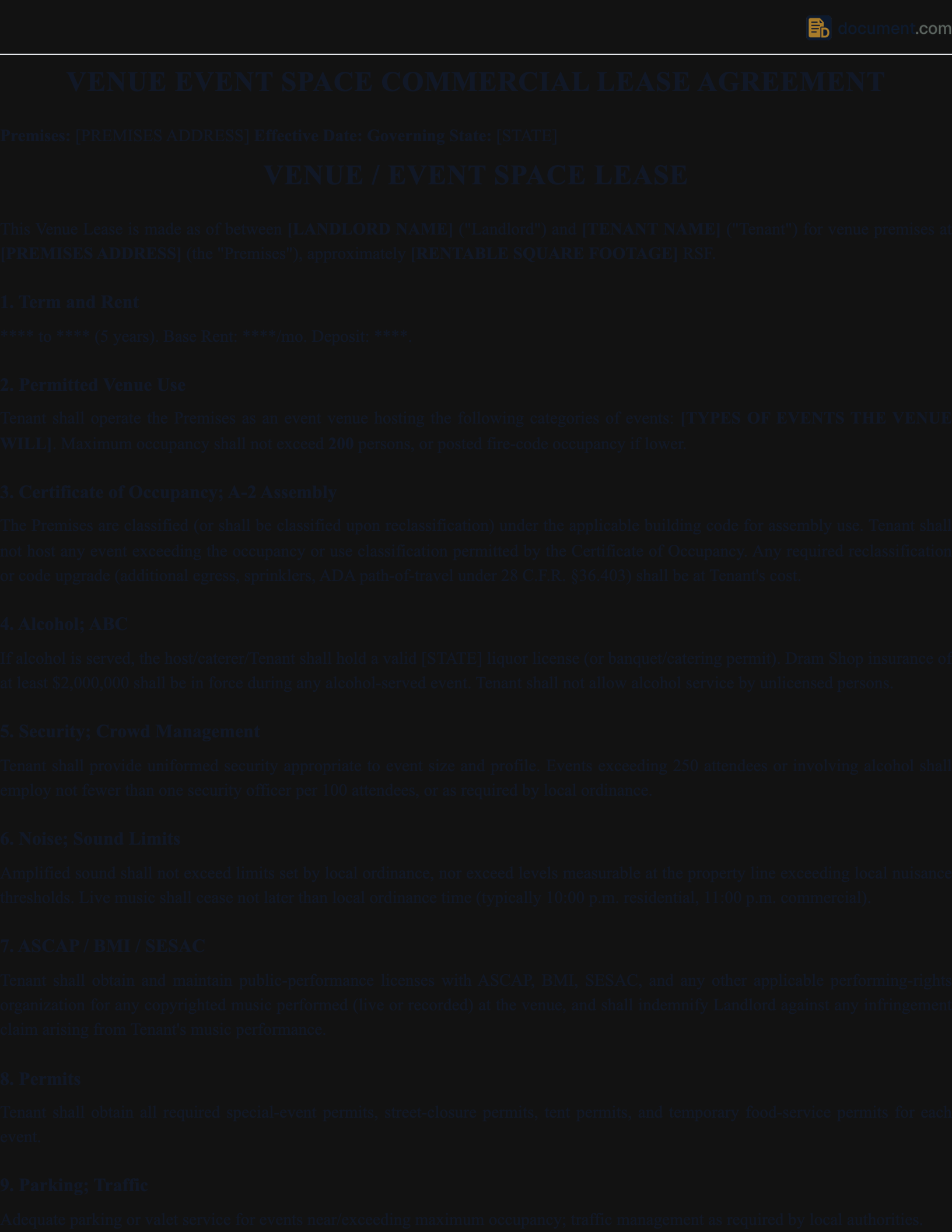
VENUE/EVENT SPACE RENTAL AGREEMENT
STATE OF VIRGINIA
Legal Document
PARTY INFORMATION
Name: [Full Legal Name]
Address: [Virginia Address]
County: [County]
PROPERTY DESCRIPTION
County: [County] State: Virginia
Legal Description: [Per Recorded Plat]
Parcel No.: [APN]
Virginia Venue Rental Agreement FAQ
Common questions about filing in Virginia, including requirements, fees, and tax implications.
Official Virginia Resources
Official state resources for verifying requirements and finding your local recording office.
Related Documents
Depending on your situation, you may need additional documents alongside this one. Below are commonly related documents that are frequently used together in real estate transactions.
Create your Virginia Commercial Venue Event Space Lease Agreement in under 5 minutes.
Answer a few questions and download a Virginia-compliant document, ready for the state agency.