
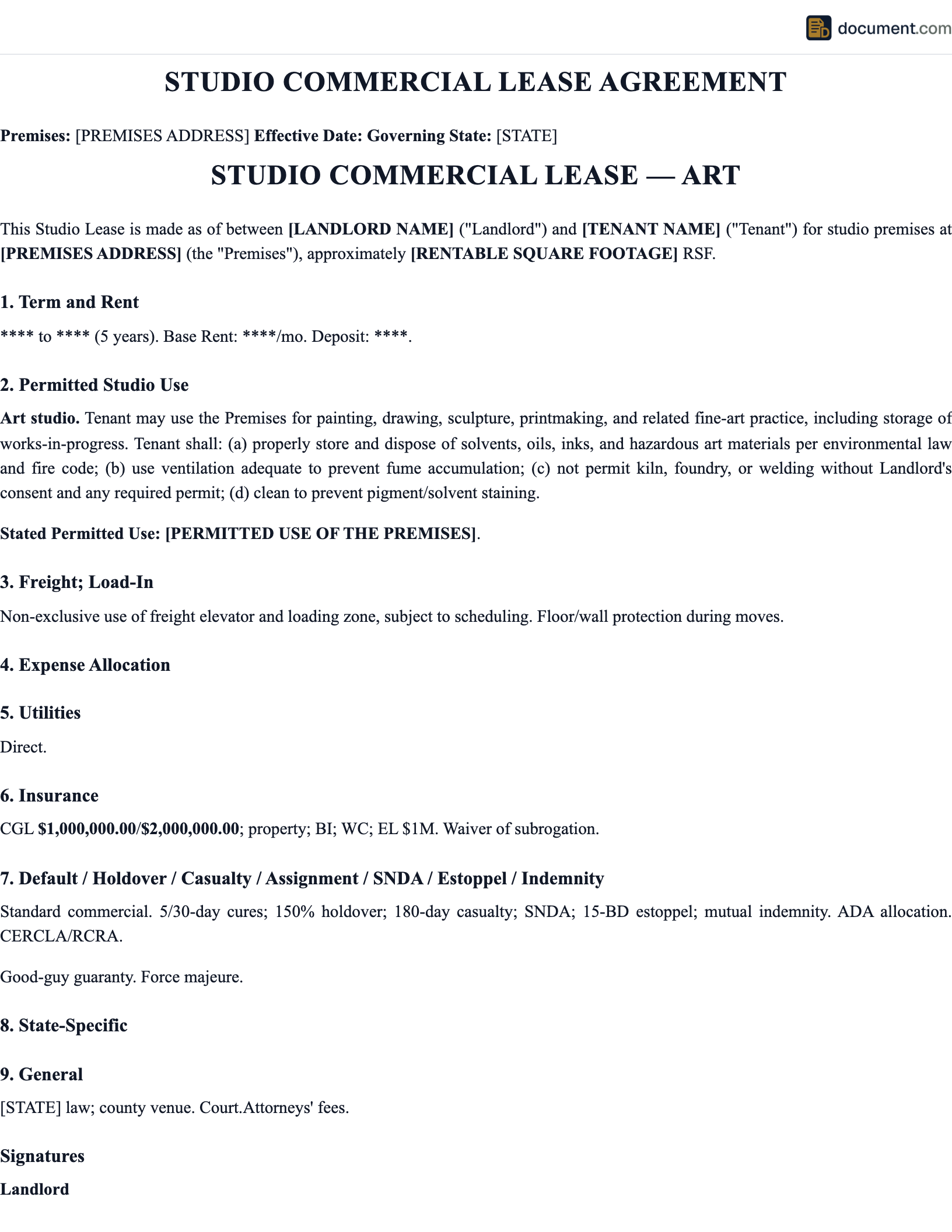



Wisconsin Studio Rental Agreement Overview
Wisconsin commercial studio leases are governed by contract law with no dedicated statute addressing creative space tenancies. Artists, musicians, photographers, fabricators, and small production companies renting studio space in Milwaukee, Madison, or smaller Wisconsin markets rely entirely on their written lease agreements for legal protection. Wis. Stat. Ch. 704 provides a general landlord-tenant framework but is primarily oriented toward residential tenancies, leaving most commercial studio disputes resolved through general contract law principles.
Wisconsin's manufacturing heritage has created a genuine supply of industrial and warehouse space that converts well to studio uses. Milwaukee in particular offers former factory buildings in neighborhoods like Walker's Point, the Menomonee Valley, and Bay View at rents that remain accessible to working artists and small creative businesses. Madison's studio market is tighter and driven more by university demand. In either market, cold-climate provisions, particularly HVAC responsibility and heating system reliability, are material lease terms that should be explicitly addressed before signing.
$30
Filing fee
Required
Notarization
0
Witnesses required
Register
Filing office
Wisconsin Requirements
Wisconsin studio leases must address the cold-climate operational needs, zoning realities across a highly fragmented municipal landscape, and physical specifications of creative production spaces. No statute fills in missing terms, so each material condition must appear explicitly in the agreement before signing.
Wisconsin Specific Note
Wisconsin has no commercial landlord-tenant statute specific to studio spaces. Contract law governs entirely. Zoning classifications vary across Wisconsin's 72 counties and 1,800-plus municipalities, so confirm permitted use at the specific address rather than relying on general zone descriptions. HVAC provisions are particularly important in Wisconsin given extreme winter conditions, and older industrial buildings converted to studios may have aging heating systems. No sales tax applies to commercial rent in Wisconsin.
Lease Requirements
- Zoning and Permitted Use Confirmation: Verify that your specific studio activity is permitted at the address under the applicable municipal zoning code. Contact the city or county planning office directly and obtain written confirmation. Do not rely solely on landlord representations about permitted use.
- Physical Specifications: Document ceiling height, floor load rating, electrical panel amperage and circuit layout, and ventilation capacity in the lease or an attached exhibit. These specifications are material to studio operations and should be warranted by the landlord in writing.
- HVAC and Heating Provisions: Clearly define who maintains and repairs heating systems, who bears repair costs above defined thresholds, and what the landlord's response time obligation is for heating failures during Wisconsin winters. Specify minimum temperature maintenance requirements during occupied hours.
- Modification Rights: Negotiate explicit rights to install soundproofing, dedicated electrical circuits, and other studio improvements. Define who owns those improvements at lease end and whether the tenant must restore the original condition. Get modification approvals in writing as lease exhibits.
- Noise and Operating Hours: Specify permitted operating hours and any noise restrictions in the lease. Without written provisions, a landlord can restrict activities conflicting with neighboring tenants or residential uses in mixed-use buildings, which is a common issue in Milwaukee's mixed-use industrial conversion districts.
- Security Deposit and Holdover Terms: Negotiate the deposit amount and written return deadline. Define the rent rate during any holdover period to avoid penalty rent clauses that are common in Wisconsin commercial leases. Wisconsin imposes no statutory cap on commercial security deposits.
How to Execute a Wisconsin Commercial Studio Lease
Executing a commercial studio lease in Wisconsin requires physical inspection, zoning verification, and careful negotiation of cold-climate provisions before signing. Because contract law governs entirely, what the lease says is what you are bound by.
Inspect Thoroughly, Including Building Systems
Physically measure ceiling heights, test electrical capacity, and assess HVAC system condition and age. In Milwaukee's converted industrial buildings, heating systems can be aging and maintenance histories are inconsistent. Ask for documentation of recent boiler or HVAC servicing. Test actual electrical capacity by running your equipment simultaneously, not just reviewing what the panel says it supports.
Confirm Zoning and Permitted Operations
Contact the city or county planning and zoning office to verify that your specific studio activity is permitted at the address. Wisconsin's 1,800-plus municipalities each have their own zoning codes, and what is permitted in a Milwaukee light industrial zone may not apply in adjacent suburban communities. Obtain written confirmation and identify any special use permits your operations may require.
Negotiate Modification Rights, HVAC, and Physical Specs
Secure explicit written rights to install soundproofing, dedicated electrical circuits, and specialized ventilation. Define minimum temperature maintenance requirements for winter months and the landlord's response time for heating failures. Establish physical specifications (ceiling height, floor load, panel amperage) as landlord-warranted lease exhibits so they are legally binding representations.
Execute the Lease
Both parties sign the final lease with all exhibits attached. Wisconsin commercial leases do not require notarization to be enforceable between the parties, but having signatures witnessed adds evidentiary protection. Each party should retain a fully executed original or conformed copy. Do not begin occupancy before signatures are complete on all exhibits.
Complete Move-In Requirements
Pay the security deposit and first month's rent, obtain a local business license from the applicable municipality, secure commercial general liability insurance at the required coverage level, and complete a detailed move-in condition checklist. If you plan to install any studio improvements immediately after taking possession, confirm that the written landlord approvals are in place before work begins.
Wisconsin Studio Lease Tax Implications and Costs
Wisconsin does not impose sales tax on commercial rent, and has no B&O-style gross receipts tax. Studio tenants should understand the corporate income tax structure, property tax passthrough mechanics, and realistic market rents before negotiating.
| Cost / Tax Item | Details |
|---|---|
| Sales Tax on Commercial Rent | None. Wisconsin does not impose sales tax on commercial lease payments. |
| Corporate Income Tax | 7.9% on net income for C-corporations with Wisconsin nexus. Pass-through entities (LLCs, S-corps) pay at individual rates. No B&O or gross receipts tax at the state level. |
| Property Tax Passthrough | Common in NNN and gross-modified leases. Milwaukee County property taxes are among the higher rates in Wisconsin. Confirm whether property tax is included in base rent or billed as a separate charge. |
| Typical Studio Rents (Milwaukee) | $8 to $18 per square foot per year for converted industrial space. Walker's Point and Menomonee Valley at lower end; newer dedicated arts facilities can run higher. |
| Typical Studio Rents (Madison) | $12 to $22 per square foot per year. Supply of large-format industrial space is more limited than Milwaukee, which constrains availability and supports higher rents for quality studio space. |
| Utility Costs | Heating costs are a significant expense in Wisconsin winters, particularly for large-format industrial studio spaces with high ceilings and older insulation. Confirm whether utilities are included or separately metered before executing the lease. |
Sample Wisconsin Studio Rental Agreement
Below is a preview of our Wisconsin-specific template. Your customized document will include all fields and provisions required for filing in any Wisconsin county.
STUDIO RENTAL AGREEMENT
STATE OF WISCONSIN
Legal Document Template
STUDIO OWNER / OPERATOR
Company: [Studio Name]
Address: [Studio Address]
Contact: [Phone/Email]
License #: [Business License]
RENTER
Name: [Full Legal Name / Entity]
Address: [Mailing Address]
Phone: [Contact Number]
Insurance: [Policy Number]
STUDIO DETAILS
Studio: [Room Name/Number]
Size: [Square Feet]
Type: [Photo/Music/Art/Rehearsal]
Equipment: [See Inventory List]
Access Hours: [Available Hours]
RENTAL TERMS
Rate: $[Amount] per [Hour/Day/Month]
Booking: [Date/Time]
Deposit: $[Amount]
Cancellation: [Policy]
Insurance Required: [Yes - Minimum Coverage]
Wisconsin Studio Rental Agreement FAQ
Answers to common questions about filing a studio rental agreement in Wisconsin, including requirements, fees, and procedures.
Official Wisconsin Resources
Use these official state resources to verify requirements, find your local filing office, and access government forms for Wisconsin.
Related Wisconsin Documents
Depending on your situation, you may need additional documents alongside your Wisconsin studio rental agreement.
Create your Wisconsin Commercial Studio Lease Agreement in under 5 minutes.
Answer a few questions and download a Wisconsin-compliant document, ready for the state agency.