
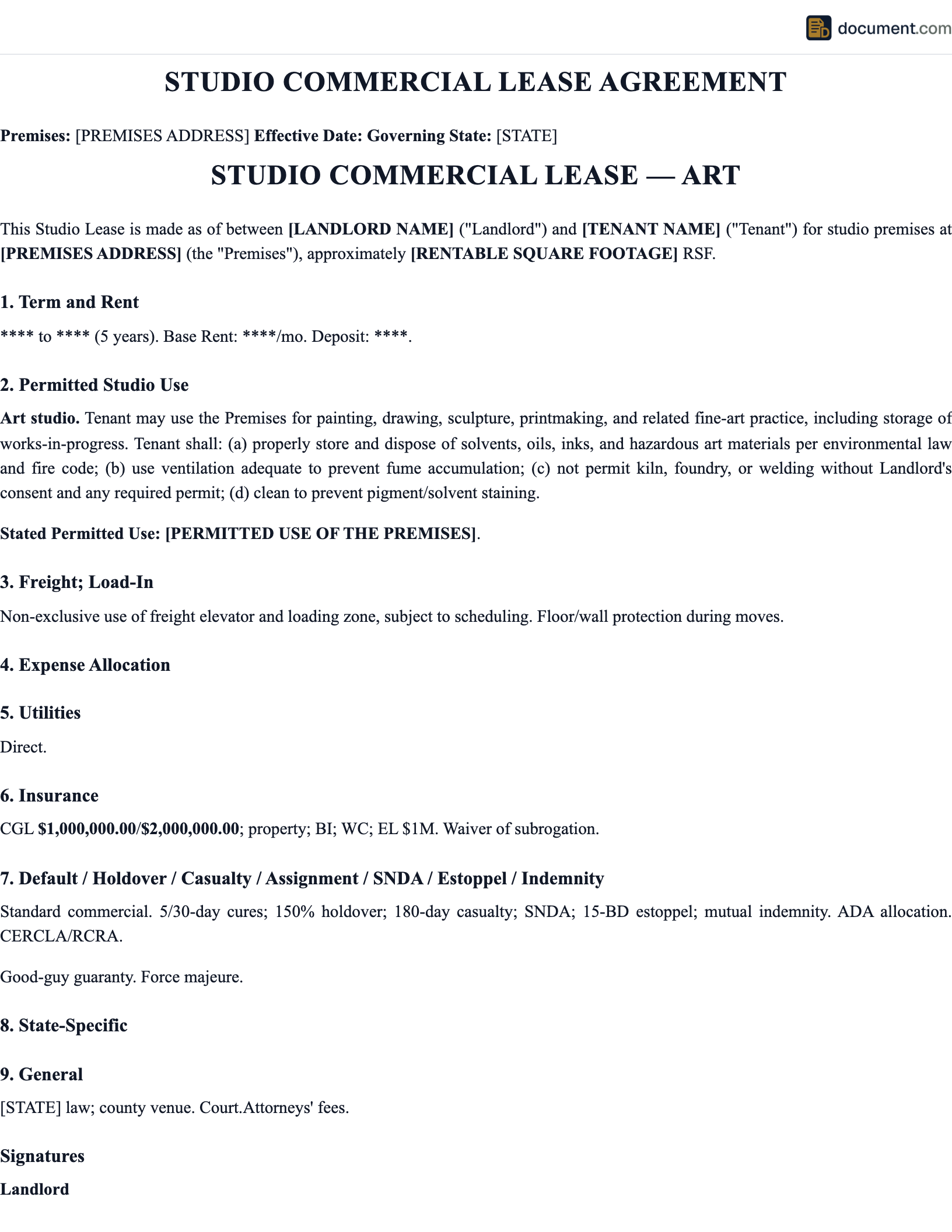



Virginia Studio Rental Agreement Overview
Commercial studio leases in Virginia cover a wide range of creative and industrial uses, from photography studios and recording facilities in Northern Virginia to ceramics and fine arts studios in Richmond's arts districts to production and fabrication shops in the Hampton Roads industrial corridor. Virginia's commercial lease law is driven almost entirely by contract, with no separate statute for artist or creative industry tenants. What the lease says is what governs.
Richmond has developed the most active creative studio real estate scene in the state, with neighborhood districts like Scott's Addition, Manchester, and Shockoe Bottom offering a mix of adaptive reuse industrial buildings and purpose-built creative spaces. Northern Virginia has higher rents but also more demand from production companies, media firms, and content creators tied to the D.C. market. Virginia's independent city structure means that zoning classifications, noise ordinances, signage rules, and business license requirements vary substantially from one creative district to another, even within a few miles. Tenants should verify local rules specific to the address, not just the general region.
$12
Filing fee
Required
Notarization
0
Witnesses required
Circuit
Filing office
Virginia Requirements
Virginia has specific requirements for this type of legal document. Meeting these requirements ensures your document is accepted by the circuit court clerk and is legally enforceable.
Virginia-Specific Note
Virginia has no statute specifically protecting commercial studio or creative space tenants. Lease terms are enforced as written under Virginia contract law. Because zoning and noise rules vary widely across Virginia's 38 independent cities and 95 counties, tenants should verify local requirements at the specific address before signing. Modifications to studio space, including soundproofing or ventilation, require explicit landlord consent and should be documented in the lease.
Document Requirements
- Zoning Confirmation: Verify with the specific city or county zoning office that the intended studio use is permitted; industrial art studio use differs from commercial photography studio use in many Virginia codes
- Permitted Use Clause: Define the specific studio activities in the permitted use clause, including any chemical, heat, or noise-generating processes, to prevent landlord disputes later
- Modification Rights: Negotiate explicit written permission for any structural modifications including soundproofing, ventilation, drainage, and floor reinforcement; Virginia landlords are not required to approve alterations unless the lease so provides
- Ceiling Height and Load Specifications: Document actual ceiling clearance and floor load capacity in the lease to create a record if the landlord later disputes the condition
- Security Deposit Terms: Since Virginia has no commercial deposit cap or return deadline statute, specify the return timeline, permissible deduction categories, and dispute process in the lease
- Noise and Hours: Address local noise ordinance compliance and specify permitted operating hours, particularly for music studios, recording facilities, or metalworking spaces
How to Execute a Virginia Studio Rental Agreement
Virginia commercial studio leases are executed between the parties without court filing. The process involves confirming the space is legally suited to your use, negotiating key provisions, and properly signing the agreement.
Conduct a Pre-Lease Inspection
Physically inspect the space for ceiling height, floor load capacity, electrical capacity (amperage and panel access), ventilation systems, loading dock or freight access, and soundproofing characteristics. Document existing conditions with photographs. These factors cannot be negotiated after signing if they were not addressed beforehand.
Confirm Zoning and Permitted Use
Contact the zoning office for the specific Virginia city or county to confirm your studio activities are permitted at the address. Virginia's 38 independent cities each apply their own zoning codes. A Richmond industrial zone and a Fairfax County mixed-use zone will have different rules for studio operations involving noise, chemicals, or evening hours.
Negotiate Modification and Use Rights
Negotiate in writing any modifications you need, whether soundproofing walls, installing ventilation hoods, adding floor drains, or reinforcing flooring. Specify who pays for the work, who owns it at lease end, and the restoration standard. Virginia landlords are not required to approve modifications unless the lease requires it.
Execute the Lease
Both parties sign the written lease. For terms exceeding one year, Virginia's statute of frauds requires a written signed agreement. Ensure the person signing for any entity has actual authority to bind the organization. Notarization is not required for enforceability between parties but is required if the lease will be recorded for constructive notice purposes.
Complete Move-In Requirements
Pay the security deposit, obtain the required insurance and deliver a certificate of insurance naming the landlord as additional insured, apply for the local business license from the appropriate Virginia city or county, and document the condition of the space with a written move-in inspection checklist signed by both parties.
Virginia Studio Lease Tax and Cost Context
Virginia does not impose a statewide sales tax on commercial rent. Studio tenants face other tax obligations that vary by locality and business activity.
| Cost or Tax Item | Details |
|---|---|
| Sales Tax on Commercial Rent | No statewide sales tax on commercial rent in Virginia |
| BPOL Business License Tax | Each Virginia city and county levies this on gross receipts; artists and creative businesses may qualify for specific rate categories depending on business classification |
| Property Tax Passthrough | Industrial and light industrial properties in Virginia have varying property tax rates by locality; landlords often pass increases through via NNN or modified gross lease structures |
| Typical Studio Rents (Richmond) | Industrial creative studio space in Richmond ranges from roughly $8 to $18 per square foot per year depending on neighborhood and building quality |
| Typical Studio Rents (Northern Virginia) | Creative and production studio space in Northern Virginia ranges from $20 to $40 per square foot per year or higher for purpose-built facilities near D.C. |
Sample Virginia Studio Rental Agreement
Below is a preview of our Virginia-specific template. Your customized document will include all fields and provisions required for filing in any Virginia county.
STUDIO RENTAL AGREEMENT
STATE OF VIRGINIA
Legal Document Template
STUDIO OWNER / OPERATOR
Company: [Studio Name]
Address: [Studio Address]
Contact: [Phone/Email]
License #: [Business License]
RENTER
Name: [Full Legal Name / Entity]
Address: [Mailing Address]
Phone: [Contact Number]
Insurance: [Policy Number]
STUDIO DETAILS
Studio: [Room Name/Number]
Size: [Square Feet]
Type: [Photo/Music/Art/Rehearsal]
Equipment: [See Inventory List]
Access Hours: [Available Hours]
RENTAL TERMS
Rate: $[Amount] per [Hour/Day/Month]
Booking: [Date/Time]
Deposit: $[Amount]
Cancellation: [Policy]
Insurance Required: [Yes - Minimum Coverage]
Virginia Studio Rental Agreement FAQ
Answers to common questions about filing a studio rental agreement in Virginia, including requirements, fees, and procedures.
Official Virginia Resources
Use these official state resources to verify requirements, find your local filing office, and access government forms for Virginia.
Related Virginia Documents
Depending on your situation, you may need additional documents alongside your Virginia studio rental agreement.
Create your Virginia Commercial Studio Lease Agreement in under 5 minutes.
Answer a few questions and download a Virginia-compliant document, ready for the state agency.