
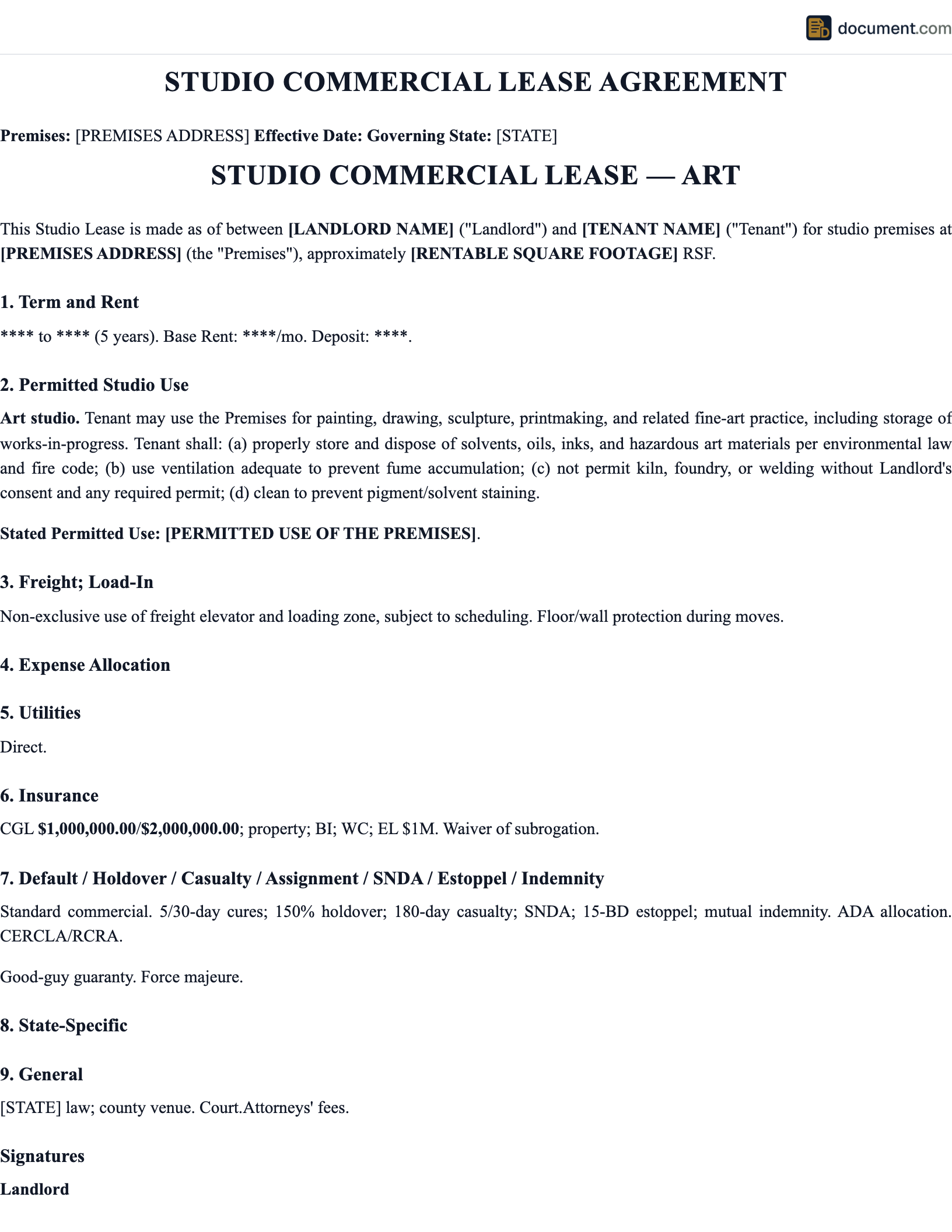



Vermont Studio Rental Agreement Overview
Vermont's creative economy has produced a distinctive market for commercial studio space, driven by the state's active arts community, farm-to-table food culture, craft manufacturing sector, and destination wedding photography industry. Burlington and its immediate environs serve as the hub for most commercial studio activity, with converted mill buildings in Winooski, industrial spaces in South Burlington, and downtown commercial properties in Burlington's Old North End neighborhood housing photographers, recording artists, visual artists, and small-batch producers. Outside Burlington, Barre's granite industry heritage has left a stock of commercial buildings suitable for heavy creative uses, and Brattleboro supports a strong arts community in its own downtown commercial district.
Vermont commercial studio leases are governed by contract law rather than any specific commercial landlord-tenant statute. Vermont's statute of frauds (12 V.S.A. Section 181) requires leases exceeding one year to be in writing. The state's Act 250 land use law may affect significant build-out projects, and tenants should confirm municipal zoning compliance for their specific use before signing. Vermont's long winters create significant heating cost exposure in large or poorly insulated studio spaces, and leases should address utility responsibility, minimum temperature obligations, and after-hours access in detail.
$15
Filing fee
Required
Notarization
2
Witnesses required
Town
Filing office
Vermont Requirements
Vermont has specific requirements for this type of legal document. Meeting these requirements ensures your document is accepted by the town clerk and is legally enforceable.
Vermont Studio Lease Note
Vermont commercial studio leases are governed by contract law. Vermont's statute of frauds (12 V.S.A. Section 181) requires leases exceeding one year to be in writing. The state provides no statutory default protections for commercial studio tenants. Vermont's Act 250 may affect significant build-out projects. Verify municipal zoning for your specific studio use with the relevant Vermont municipality before executing the lease, since each Vermont town maintains its own zoning bylaws.
Document Requirements
- Written Agreement: Vermont's statute of frauds (12 V.S.A. Section 181) requires commercial leases exceeding one year to be in writing; all studio leases should be documented in writing regardless of term length
- Permitted Use and Zoning Verification: The lease must describe the specific permitted use, and the tenant should verify the zoning designation allows that use with the relevant Vermont municipal zoning office before signing
- Alteration Rights and Improvement Ownership: Specify what improvements the tenant may install, who bears the cost, and who owns the improvements at lease end; under Vermont contract law, improvements default to the landlord unless the lease says otherwise
- Heating and Utility Obligations: Vermont's long winters make heating provisions unusually material; specify who pays for heating, what minimum temperature the landlord will maintain, and how after-hours HVAC is handled
- Soundproofing and Noise: Any soundproofing obligations must be stated explicitly in the lease; also confirm compliance with the relevant municipality's noise ordinance, particularly in Burlington where mixed-use neighborhoods adjoin commercial studio zones
- Act 250 Status: For spaces where significant build-out is planned, confirm with the landlord whether the building has an Act 250 permit and what conditions it carries under Vermont's land use law (10 V.S.A. Chapter 151)
How to Execute a Vermont Studio Lease
Executing a studio lease in Vermont requires verifying zoning, understanding Act 250 requirements, and negotiating provisions for Vermont's specific climate and legal environment.
Verify Zoning and Act 250 Status
Before touring any space seriously, confirm the municipal zoning designation and whether your specific studio use is permitted. Contact Burlington's Department of Planning and Zoning for Burlington addresses, or the relevant Vermont municipality's zoning administrator for other locations. Also ask the landlord whether the building has an existing Act 250 permit and what conditions it carries. In Vermont, both layers of land use regulation matter, and discovering a conflict after executing the lease is expensive to resolve.
Assess Physical Specifications and Winter Suitability
Measure actual ceiling height, confirm electrical amperage and panel capacity, and assess the building's insulation and heating system. For Vermont studio spaces, particularly converted mill buildings and older commercial structures that are common in Barre and Burlington, heating capacity during January and February is a critical evaluation criterion. Ask for prior year utility bills. A space that costs $10 per RSF in rent may cost another $4 to $6 per RSF in winter heating costs that are not reflected in the initial lease rate.
Negotiate Alteration Rights, Improvement Ownership, and Heating
Studio tenants in Vermont typically need to make improvements to the space. Negotiate the right to make specific improvements with landlord approval, agree on cost allocation (tenant improvement allowance versus self-fund), and establish who owns improvements at lease end. Vermont contract law defaults to improvements becoming the landlord's property, which must be overridden explicitly in the lease. Also negotiate heating obligations: specify who maintains the heating system, the minimum temperature guarantee, and who bears utility cost variability through Vermont's long heating season.
Draft and Execute the Written Lease
Vermont's statute of frauds (12 V.S.A. Section 181) requires commercial leases exceeding one year to be in writing. The written lease should cover permitted use, zoning compliance, Act 250 status, alteration rights, improvement ownership, heating obligations, operating hours, noise restrictions, security deposit terms, and holdover provisions. Both parties' authorized representatives must sign. Notarization is not required between private parties for enforceability, but is required if you intend to record the lease with the Town Clerk to protect your leasehold interest.
Pull Permits Before Starting Alterations
Any structural alterations, electrical upgrades, HVAC modifications, soundproofing construction, or plumbing changes in a Vermont studio space require building permits from the local municipality. Burlington's building permits are issued through the Department of Planning and Zoning. Vermont towns vary in permitting speed, and smaller municipalities may take longer than Burlington. Do not begin alteration work before obtaining all required permits. Unpermitted work can result in fines, stop-work orders, and lease default claims. Build a realistic permitting timeline into your studio build-out schedule.
Tax Implications for Vermont Studio Leases
Vermont's tax environment for studio tenants involves a progressive income tax and a complex property tax system, but no sales tax on commercial rent. Winter heating costs are a material occupancy cost that should be budgeted separately.
| Tax / Cost Category | Vermont Treatment |
|---|---|
| State Income Tax | Vermont imposes a progressive income tax on individuals ranging from 3.35% to 8.75% depending on income level. C corporations pay an 8.5% Vermont corporate income tax on income attributable to Vermont operations. Vermont's income tax rates are among the higher rates in New England, which affects the net after-tax return on creative business activity in the state. |
| Sales Tax on Commercial Rent | Vermont does not impose sales tax on commercial real property rental. Vermont's sales tax rate is 6% on goods and taxable services, but pure studio lease payments are generally exempt from sales tax. If your agreement bundles taxable services with space access, those components may create sales tax exposure under Vermont law. |
| Property Tax Passthrough | Vermont's property tax system is unusually complex, with commercial properties subject to both a municipal property tax and a statewide education tax under Acts 60 and 68. In net leases, both components pass through to tenants. The combined property tax burden on commercial real estate in Chittenden County can be higher than the local mill rate alone suggests due to the education tax component. Annual reconciliation statements may result in additional tenant billings or credits. |
| Winter Heating Costs | Heating costs are a material and often underestimated occupancy cost for Vermont studio tenants. Burlington averages over 80 inches of snow annually, and the heating season runs from November through early April. Large studio spaces, particularly warehouse conversions and older mill buildings popular with artists, can have significant heating oil or natural gas costs in winter. Net leases pass utility costs directly to tenants. Ask for prior year utility bills before signing any Vermont studio lease with net utility provisions. |
| Federal Business Expense Deduction | Studio lease payments for business use are deductible as ordinary business expenses under IRC Section 162. Vermont largely conforms to federal income tax treatment of business expenses. Tenant-funded improvements including acoustic treatment, electrical upgrades, and HVAC modifications may qualify as Qualified Improvement Property under federal tax rules, eligible for bonus depreciation. Consult a Vermont-licensed CPA before investing in significant studio build-out. |
Sample Vermont Studio Rental Agreement
Below is a preview of our Vermont-specific template. Your customized document will include all fields and provisions required for filing in any Vermont county.
STUDIO RENTAL AGREEMENT
STATE OF VERMONT
Legal Document Template
STUDIO OWNER / OPERATOR
Company: [Studio Name]
Address: [Studio Address]
Contact: [Phone/Email]
License #: [Business License]
RENTER
Name: [Full Legal Name / Entity]
Address: [Mailing Address]
Phone: [Contact Number]
Insurance: [Policy Number]
STUDIO DETAILS
Studio: [Room Name/Number]
Size: [Square Feet]
Type: [Photo/Music/Art/Rehearsal]
Equipment: [See Inventory List]
Access Hours: [Available Hours]
RENTAL TERMS
Rate: $[Amount] per [Hour/Day/Month]
Booking: [Date/Time]
Deposit: $[Amount]
Cancellation: [Policy]
Insurance Required: [Yes - Minimum Coverage]
Important Considerations for Vermont Studio Tenants
Vermont studio tenants operate with no statutory safety net, in a constrained market, with weather conditions that affect costs and access in ways not found in most other states. These considerations should inform your approach before signing.
Vermont's Studio Market Is Genuinely Constrained
Vermont has no large industrial districts comparable to what studio tenants find in major metros. Suitable studio space with adequate ceiling height, electrical capacity, and loading access is scarce, particularly in Burlington and Chittenden County. Spaces in converted mill buildings and former industrial properties are sought after and rarely stay vacant for long. Tenants with specific technical requirements for their studio use should begin their search well in advance and be prepared to consider build-to-suit options or longer commute distances if existing Burlington inventory does not meet their needs.
Act 250 and Municipal Zoning Both Apply
Vermont studio tenants must navigate two layers of land use regulation. Each Vermont municipality maintains its own zoning bylaws governing permitted uses in commercial, mixed-use, and industrial zones. Above that, Vermont's Act 250 state land use law governs commercial development and significant renovation projects above certain thresholds. Discovering after signing that your intended studio use is not permitted under municipal zoning, or that a planned build-out requires an Act 250 permit, creates expensive delays and potential lease liability. Verify both layers before committing.
Winter Heating Is a Major Budget Variable
Burlington's winters are long and cold, averaging over 80 inches of snow and temperatures below 0°F. For studio tenants in net leases, heating costs from November through April are a material and variable expense that can significantly exceed initial estimates in poorly insulated or high-ceiling spaces. Before signing any Vermont studio lease with net utility provisions, ask for three years of prior heating bills for the space, have the building's insulation and heating system assessed, and confirm who is responsible for heating system maintenance and emergency repairs during extreme cold events.
Improvement Ownership Defaults to the Landlord
Vermont contract law defaults tenant-installed improvements to the landlord's ownership at lease end unless the lease explicitly provides otherwise. For studio tenants who invest in acoustic panels, soundproofing construction, custom electrical work, or HVAC modifications, this default represents a significant financial loss at departure. Before spending on studio improvements, negotiate a written provision granting you ownership and removal rights for specified improvements, or requiring the landlord to credit you for unamortized improvement value if the landlord retains them. This negotiation is standard in Vermont commercial leases and should not be difficult to complete with a cooperative landlord.
Vermont Studio Rental Agreement FAQ
Answers to common questions about filing a studio rental agreement in Vermont, including requirements, fees, and procedures.
Official Vermont Resources
Use these official state resources to verify requirements, find your local filing office, and access government forms for Vermont.
Related Vermont Documents
Depending on your situation, you may need additional documents alongside your Vermont studio rental agreement.
Create your Vermont Commercial Studio Lease Agreement in under 5 minutes.
Answer a few questions and download a Vermont-compliant document, ready for the state agency.