
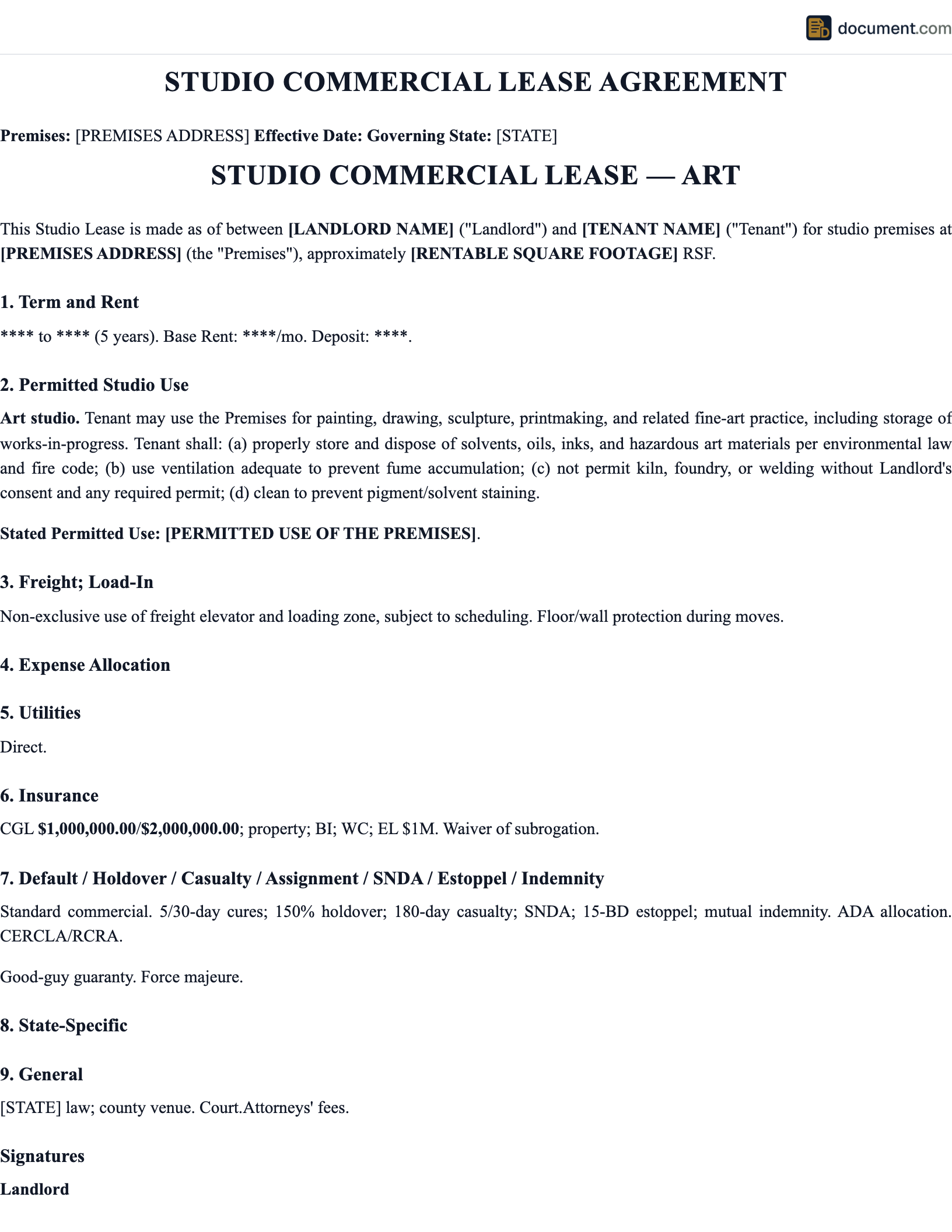



Utah Studio Rental Agreement Overview
Salt Lake City's creative community has carved out studio space in warehouse conversions in neighborhoods like Granary Row and the Central 9th district, as well as in mixed-use commercial buildings throughout the Wasatch Front. Photography studios, recording studios, visual art spaces, and light fabrication workshops all operate in Utah under commercial leases governed by contract law rather than any specific commercial tenant statute. Utah's relatively affordable rents compared to coastal markets and its strong business formation environment attract creative entrepreneurs, but those tenants should understand that Utah law provides no default protections for commercial studio users.
Utah's statute of frauds (Utah Code Section 25-5-1) requires any commercial lease exceeding one year to be in writing. Studio leases in Utah should address zoning compliance for the specific creative use, electrical capacity for equipment-intensive operations, alteration and soundproofing rights, winter heating costs (which are substantial for large warehouse-style spaces), and improvement ownership at lease end. The state's cold winters also make HVAC provisions material in ways that may surprise tenants relocating from warmer climates.
$40
Filing fee
Required
Notarization
0
Witnesses required
County
Filing office
Utah Requirements
Utah has specific requirements for this type of legal document. Meeting these requirements ensures your document is accepted by the county recorder and is legally enforceable.
Utah Studio Lease Note
Utah has no commercial landlord-tenant statute providing default protections for studio tenants. Commercial studio leases are governed by contract law and Utah Code Section 25-5-1, which requires leases exceeding one year to be in writing. Verify zoning for your specific use before signing, and negotiate all space-specific provisions including alteration rights, improvement ownership, and HVAC obligations into the written lease.
Document Requirements
- Written Agreement: Utah Code Section 25-5-1 requires commercial leases exceeding one year to be in writing; studio leases should always be documented in writing regardless of term length
- Permitted Use and Zoning: The lease must describe the specific permitted use, and the tenant should verify the zoning designation allows that use with Salt Lake City Planning or the relevant county zoning authority
- Alteration Rights: Specify what alterations, acoustic treatment, electrical upgrades, and soundproofing the tenant may install, who bears the cost, and who owns the improvements at lease end
- Electrical Capacity: Confirm the available amperage, panel capacity, and whether the landlord will upgrade electrical service if required for your studio equipment; heavy users may need 200 amps or more
- HVAC and Winter Heating: Specify who is responsible for heating costs in winter, the minimum temperature the landlord will maintain, and how HVAC service hours are defined for tenants with non-standard operating schedules
- Hours of Operation and Noise: Define permitted hours of operation and any noise or vibration restrictions, particularly in mixed-use or urban infill buildings where residential uses may be nearby
How to Execute a Utah Studio Lease
Executing a studio lease in Utah requires verifying zoning, assessing physical suitability, and negotiating provisions that Utah's landlord-favorable legal environment will not supply by default.
Verify Zoning and Permitted Use First
Before touring any space in depth, confirm the zoning designation and whether your specific studio use is permitted. Contact Salt Lake City's Planning Division for city addresses, or your county planning office for unincorporated areas. Photography studios, recording studios, visual art spaces, and light fabrication have different zoning requirements. Some creative districts in Salt Lake City's Granary Row or Central 9th neighborhoods allow broader creative use under overlay zoning, but confirm this in writing.
Assess Physical Specifications
Measure actual ceiling height at the center of the room, not at the perimeter where mechanical infrastructure reduces clearance. Confirm available electrical amperage and panel capacity. For recording studios, assess existing STC ratings or have an acoustic consultant evaluate wall, floor, and ceiling construction. For winter occupancy, test the space's heating capacity and ask the landlord what the minimum temperature guarantee is during Utah's coldest months.
Negotiate Alteration Rights and Improvement Ownership
Studio tenants in Utah typically need to make improvements to the space, ranging from acoustic treatment to electrical upgrades to HVAC modifications. Negotiate the right to make these improvements with landlord approval, agree on who bears the cost (tenant improvement allowance versus tenant self-fund), and critically establish who owns the improvements at lease end. Utah property law defaults to the improvements becoming the landlord's property. This is negotiable, but it must be stated in the lease.
Draft and Execute the Written Lease
Utah Code Section 25-5-1 requires commercial leases exceeding one year to be in writing. For studio leases, the written document should cover permitted use, zoning compliance, alteration rights, electrical capacity, HVAC obligations, operating hours, noise restrictions, security deposit terms, and holdover provisions. Both parties' authorized representatives must sign. Notarization is not required between private parties but is required if you intend to record the lease with the county recorder's office.
Pull Permits Before Starting Work
Any structural alterations, electrical upgrades, HVAC modifications, or sound isolation construction in a Utah studio space requires building permits from the local authority. In Salt Lake City, permits are issued through the Building Services division. Do not begin alteration work before obtaining permits, since unpermitted work can result in fines, required remediation, and lease default claims. Coordinate your permit timeline with the landlord and build a realistic project schedule before committing your rent commencement date.
Tax Implications for Utah Studio Leases
Utah's tax treatment of studio leases is generally favorable, with no sales tax on commercial rent and a flat income tax rate. Key cost variables are property tax passthrough and winter heating costs.
| Tax / Cost Category | Utah Treatment |
|---|---|
| State Income Tax | Utah imposes a flat 4.85% income tax on individuals and pass-through entities operating in the state. C corporations pay the same 4.85% rate. No special studio tax applies at the state level. |
| Sales Tax on Commercial Rent | Utah does not impose sales tax on commercial real property rental, which benefits studio tenants who pay significant monthly lease payments. If your studio agreement bundles taxable services with space access, those service components may be subject to Utah's combined sales tax rate of approximately 7.19% in Salt Lake County. |
| Property Tax Passthrough | In net leases, tenants pay their proportionate share of the building's property taxes. Salt Lake County property tax rates average 1.0% to 1.4% of assessed value, moderate compared to coastal markets. Annual reconciliation statements from the landlord may result in additional billings or credits depending on actual versus estimated taxes. |
| Winter Heating Costs | For warehouse conversions and large studio spaces in Utah, winter heating is a material cost that should be factored into your total occupancy budget. Net leases typically pass utility costs through to tenants, and heating large, poorly insulated spaces through Utah's cold winters can significantly exceed initial estimates. Gross leases include utilities, which provides cost certainty but may cost more per square foot. |
| Federal Business Expense Deduction | Studio lease payments for business use are generally deductible as ordinary business expenses under IRC Section 162. Tenant-funded build-out costs including acoustic panels, electrical upgrades, and HVAC modifications may qualify as Qualified Improvement Property under federal tax rules, potentially eligible for bonus depreciation. Consult a tax advisor before investing in major studio improvements. |
Sample Utah Studio Rental Agreement
Below is a preview of our Utah-specific template. Your customized document will include all fields and provisions required for filing in any Utah county.
STUDIO RENTAL AGREEMENT
STATE OF UTAH
Legal Document Template
STUDIO OWNER / OPERATOR
Company: [Studio Name]
Address: [Studio Address]
Contact: [Phone/Email]
License #: [Business License]
RENTER
Name: [Full Legal Name / Entity]
Address: [Mailing Address]
Phone: [Contact Number]
Insurance: [Policy Number]
STUDIO DETAILS
Studio: [Room Name/Number]
Size: [Square Feet]
Type: [Photo/Music/Art/Rehearsal]
Equipment: [See Inventory List]
Access Hours: [Available Hours]
RENTAL TERMS
Rate: $[Amount] per [Hour/Day/Month]
Booking: [Date/Time]
Deposit: $[Amount]
Cancellation: [Policy]
Insurance Required: [Yes - Minimum Coverage]
Important Considerations for Utah Studio Tenants
Utah's creative economy is growing, but studio tenants in the state operate with no statutory safety net. These points should shape your negotiating strategy before you sign.
Verify Zoning Before Committing
Signing a studio lease for a space that turns out to be in the wrong zone for your intended use is an expensive mistake in Utah. The state has no mechanism to override local zoning even if the landlord allows the use in the lease. Salt Lake City's zoning code distinguishes photography studios, recording studios, and light fabrication at the zoning level, and some neighborhoods have overlay districts that affect permitted uses further. Verify the zoning designation and your specific use with the relevant planning authority before executing the lease.
Winter Heating Is a Material Budget Item
Salt Lake City's winters are cold, and large creative spaces, particularly warehouse conversions in the Granary Row and Central 9th neighborhoods, can carry significant heating costs from November through March. If your studio lease is structured as a triple-net or modified gross lease, confirm whether utilities are passed through and get the prior year's utility bills from the landlord before signing. A space that costs $12 per RSF per year in rent may have another $3 to $5 per RSF in winter utility costs that are not visible in the initial lease rate.
Improvement Ownership Defaults to the Landlord
Under Utah property law, tenant-installed improvements become the property of the landlord at lease end unless the lease explicitly states otherwise. For studio tenants who invest in acoustic panels, custom electrical work, soundproof doors, or HVAC modifications, this default can represent a significant financial loss at the end of the lease. Negotiate a written provision that grants you ownership and removal rights for specified improvements, or requires the landlord to pay for improvements based on a depreciation schedule if they remain with the property.
No Statutory Protections for Commercial Studio Tenants
Utah's commercial tenants have no statutory protections comparable to what residential tenants receive under the Utah Fit Premises Act. There is no implied warranty of habitability for commercial spaces, no cap on security deposits, no required cure period before eviction, and no statute governing deposit returns. Every protection a studio tenant needs, including notice periods, cure rights, quiet enjoyment, and HVAC guarantees, must be negotiated and written into the lease. Do not assume the landlord's standard form addresses your interests.
Utah Studio Rental Agreement FAQ
Answers to common questions about filing an studio rental agreement in Utah, including requirements, fees, and procedures.
Official Utah Resources
Use these official state resources to verify requirements, find your local filing office, and access government forms for Utah.
Related Utah Documents
Depending on your situation, you may need additional documents alongside your Utah studio rental agreement.
Create your Utah Commercial Studio Lease Agreement in under 5 minutes.
Answer a few questions and download a Utah-compliant document, ready for the state agency.