
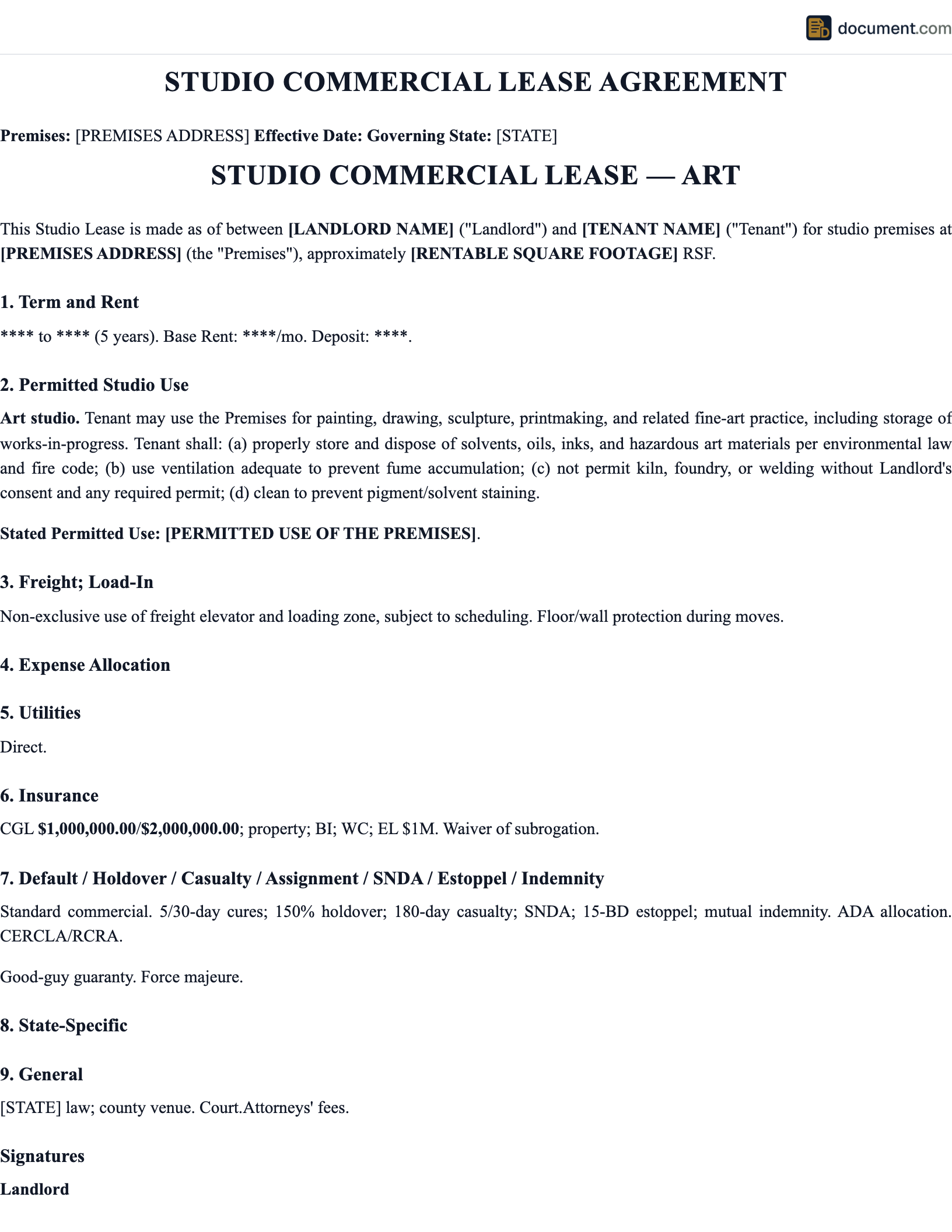



Texas Studio Rental Agreement Overview
Texas has one of the most diverse and active commercial studio lease markets in the country. Austin's recording studio and music production community, while smaller than Nashville's, is significant and growing, anchored by the city's deep live music heritage and a wave of music industry businesses that have followed the broader tech and creative sector expansion. Dallas has a substantial photography, video production, and commercial media studio market driven by corporate headquarters activity and a large advertising and marketing industry. Houston has active studio demand in the oil and gas communications sector, visual arts, and urban creative communities. San Antonio has a growing creative scene with studio activity in photography, crafts, and visual arts.
Texas commercial studio leases are governed by Texas Property Code and general contract law. The state provides no specialized protections for artists, creative tenants, or studio operators. Texas is explicitly landlord-favorable, meaning studio tenants have minimal implied protections and must negotiate every important right into the written lease before signing. Key provisions include permitted use language that accurately describes the studio activity, explicit soundproofing and alteration rights, electrical capacity specifications, hours of operation, ADA compliance allocation, security deposit conditions, and the treatment of installed improvements at lease end. Houston's unique absence of a traditional zoning code requires studio tenants there to rely more heavily on deed restriction analysis than city zoning verification.
$26
Filing fee
Required
Notarization
0
Witnesses required
County
Filing office
Texas Requirements
Texas studio leases follow the same commercial contract framework as all other commercial leases in the state. There are no specialized studio protections, making the written lease the sole source of the tenant's rights.
Texas Studio Lease Note
Texas is among the most landlord-favorable states in the country for commercial leases. Studio tenants who sign standard landlord form leases without negotiating modifications have very limited legal protection if disputes arise. Houston's absence of traditional zoning requires particular attention to deed restrictions governing the property. In Austin, studios in mixed-use zones must comply with the city's noise ordinance. All electrical work, soundproofing, and structural modifications require city permits regardless of which Texas city the studio is located in.
Document Requirements
- Written Agreement: Required by Texas Business & Commerce Code Section 26.01 for leases exceeding one year; written agreement recommended regardless of term given studio tenant improvement investment
- Permitted Use: Must specify the exact studio activity; broad permitted use language reduces the risk of future disputes about whether a particular activity is allowed
- Zoning/Deed Restriction Compliance: In Austin and Dallas, verify city zoning permits the use; in Houston, review deed restrictions governing the property since Houston has no traditional zoning code
- Alteration Rights: Written consent for soundproofing, electrical upgrades, and structural modifications; ownership of improvements at lease end; restoration obligations
- Electrical Capacity: Available amperage, circuit configuration, right to add dedicated circuits, and who pays for electrical upgrades and permitting
- HVAC and Heat Management: Texas summer heat makes HVAC reliability critical; specify maintenance obligations, temperature guarantees, and after-hours HVAC availability
How to Execute a Studio Lease in Texas
Leasing a commercial studio in Texas requires market-specific preparation. These steps guide studio tenants through the process effectively.
Verify Land Use Compliance
In Austin and Dallas, confirm your studio use is permitted by city zoning. In Houston, review deed restrictions on the property since the city has no traditional zoning ordinance. In San Antonio, check both city zoning and any deed restrictions. Zoning or deed restriction violations can result in forced closure even after significant improvement investment.
Assess Physical Specifications
Measure and document ceiling height, column spacing, floor load capacity, electrical service, HVAC system quality, loading access, and the building envelope. Texas summer heat means HVAC reliability is especially critical for photography and recording studios where equipment sensitivity and human comfort both matter. Inspect the HVAC system and request service history.
Negotiate Improvement Rights and TI Allowance
Secure written permission for all planned improvements before signing. Negotiate a tenant improvement allowance if the landlord benefits from the upgrades. Texas property law defaults to landlord ownership of attached improvements, so explicit ownership language protecting the tenant's investment in soundproofing and electrical work must be in the lease.
Draft and Execute the Lease
Use a Texas commercial studio lease template and negotiate modifications to the standard form. Both parties sign. Texas does not require notarization for a commercial lease to be binding between parties; notarization is needed only for county recording purposes.
Pull Permits Before Starting Work
Electrical work, structural changes, and certain acoustic installations require permits from the applicable Texas city's building department. Austin, Dallas, Houston, and San Antonio all have permit requirements for commercial construction work. Starting permitted work without permits violates the lease and may result in orders to remove completed improvements.
Tax Implications for Texas Studio Leases
Texas imposes no state income tax, but studio tenants should understand how sales tax, property tax, and lease structure interact with their costs.
| Tax / Cost Category | Texas Treatment |
|---|---|
| State Income Tax | None. Texas has no personal or corporate income tax, which benefits both studio operators and tenants operating as pass-through entities. |
| Sales Tax on Bundled Services | 8.25% combined rate (6.25% state + up to 2% local). If the studio lease bundles equipment use, services, or production support with the space, Texas Comptroller guidance may treat portions of that income as taxable services. Pure real property rental is generally not subject to sales tax. |
| Property Tax Passthrough | Texas has some of the highest effective property tax rates in the nation, averaging 1.5% to 2.5% of assessed value. Net leases typically pass this cost through to tenants. In creative and industrial districts in Austin, Dallas, and Houston, reassessments have increased passthrough costs substantially in recent years. |
| Federal Business Expense Deduction | Studio lease payments are generally deductible as ordinary business expenses under IRC Section 162 when used in an income-producing creative activity. Photographers, recording artists, filmmakers, and other creative tenants should retain documentation of business use. |
| Qualified Improvement Property | Tenant-funded build-outs (acoustic panels, electrical upgrades, HVAC modifications) may qualify as Qualified Improvement Property under federal tax law, potentially eligible for bonus depreciation. Consult a tax advisor before executing major improvements. |
Sample Texas Studio Rental Agreement
Below is a preview of our Texas-specific template. Your customized document will include all fields and provisions required for filing in any Texas county.
STUDIO RENTAL AGREEMENT
STATE OF TEXAS
Legal Document Template
STUDIO OWNER / OPERATOR
Company: [Studio Name]
Address: [Studio Address]
Contact: [Phone/Email]
License #: [Business License]
RENTER
Name: [Full Legal Name / Entity]
Address: [Mailing Address]
Phone: [Contact Number]
Insurance: [Policy Number]
STUDIO DETAILS
Studio: [Room Name/Number]
Size: [Square Feet]
Type: [Photo/Music/Art/Rehearsal]
Equipment: [See Inventory List]
Access Hours: [Available Hours]
RENTAL TERMS
Rate: $[Amount] per [Hour/Day/Month]
Booking: [Date/Time]
Deposit: $[Amount]
Cancellation: [Policy]
Insurance Required: [Yes - Minimum Coverage]
Important Considerations for Texas Studio Tenants
Texas law gives studio tenants very few automatic protections. These points should inform your negotiating strategy before you sign.
Texas Is Strongly Landlord-Favorable
The Texas Property Code provides minimal protections for commercial tenants. Studio tenants have no right to withhold rent for habitability issues, and landlords retain broad contractual flexibility. Every protection you want, including cure periods for lease defaults, quiet enjoyment, and return of your security deposit on a defined schedule, must be negotiated into the lease document itself. Verbal agreements are unenforceable for leases longer than one year under the Texas Business and Commerce Code Section 26.01.
Houston: No Traditional Zoning
Houston is the only major U.S. city without a traditional zoning ordinance. Creative studios in Houston are governed primarily by deed restrictions, which vary by neighborhood and subdivision. A space that looks industrial or commercial may carry deed restrictions that prohibit your specific use, including recording, fabrication, or photography with client traffic. Review the deed restrictions for any Houston studio space with an attorney before executing the lease.
Austin Noise Ordinance Applies to Leased Studios
Austin City Code Chapter 9-2 governs amplified sound and noise levels citywide. Recording studios, rehearsal spaces, and live music venues in Austin are subject to this ordinance regardless of lease terms. If your studio lease permits late-night sessions or amplified instruments, confirm that the building's construction and the surrounding zoning allow for it. Noise violations can result in fines and give the landlord grounds for lease termination if the lease ties compliance to a "quiet enjoyment" or "no nuisance" clause.
Improvements Default to the Landlord Under Texas Law
In Texas, tenant-installed improvements, including acoustic panels, soundproofing, custom lighting, and electrical upgrades, generally become the property of the landlord at lease end unless the lease explicitly states otherwise. Before spending on studio build-out, negotiate a written provision that either grants you ownership and removal rights at departure or requires the landlord to compensate you for unamortized improvement value. Get this in the lease, not in a side letter.
Texas Studio Rental Agreement FAQ
Answers to common questions about studio leases in Texas, including zoning, tax treatment, and tenant rights.
Official Texas Resources
Use these official state resources to verify requirements, find your local filing office, and access government forms for Texas.
Related Texas Documents
Depending on your situation, you may need additional documents alongside your Texas studio rental agreement.
Create your Texas Commercial Studio Lease Agreement in under 5 minutes.
Answer a few questions and download a Texas-compliant document, ready for the state agency.