



South Carolina Studio Rental Agreement Overview
South Carolina's artist and creative studio market spans three distinct cities. Charleston is the most active market, with industrial space in the NoMo district, North Charleston, and scattered throughout the peninsula increasingly sought by visual artists, photographers, and makers who value the city's creative community and coastal lifestyle. The challenge in Charleston is that the same demand from relocating remote workers driving up office rents is now pressuring studio inventory as well, making the market tighter than it was five years ago. Columbia's Vista neighborhood and the Five Points corridor host an arts community anchored by USC, with more accessible rents than Charleston. Greenville's arts district has matured rapidly alongside the city's broader economic growth, making it an emerging alternative for artists priced out of Charleston.
South Carolina has no statute specifically governing artist studio leases or creative commercial tenancies. Studio leases are governed by general contract law under the South Carolina Code of Laws, and the residential Landlord and Tenant Act (S.C. Code Section 27-40-100 et seq.) does not apply. Charleston tenants additionally face the potential layer of historic district review requirements that can affect improvement rights in buildings subject to Board of Architectural Review oversight. The lease document is the artist's only protection, and it must be specific enough to cover the practical realities of studio use: permitted activities, improvement rights, ventilation and sound obligations, and holdover rates.
3 Markets
Charleston, Columbia, Greenville
No Cap
Security deposit
Contract
Law governs
No Tax
SC commercial rent tax
South Carolina Requirements
South Carolina commercial studio leases must be in writing for terms exceeding one year under the state's statute of frauds (S.C. Code Section 32-3-10). There is no studio-specific statutory framework, so the lease document must be comprehensive enough to govern all practical aspects of studio tenancy without relying on any statutory backstop.
Charleston Historic District and Coastal Storm Provisions
Charleston studio tenants in buildings subject to the Board of Architectural Review should confirm which modifications require BAR approval before signing, particularly for ventilation equipment, signage, and exterior-visible improvements. Separately, all coastal South Carolina studio tenants should address force majeure, casualty, and rent abatement provisions for hurricane events. Studio tenants who have invested in permanent improvements (kiln installations, darkroom buildouts, soundproofing) face particular risk if a storm renders the space unusable and the lease does not provide clear rent abatement and restoration timeline obligations for the landlord.
Key Lease Provisions
- Written agreement: Required for terms over one year under S.C. Code Section 32-3-10; include all material terms since no SC commercial tenant statute provides fallback protections
- Zoning verification: Confirm permitted use for your specific studio activities (production vs. retail sales vs. live-work) with the applicable Charleston, Columbia, or Greenville planning department before signing
- Permitted use specificity: List the actual media and activities you will conduct (photography, ceramics, metalwork, music recording) rather than a generic "artist studio" designation that may not cover all intended uses
- Improvement rights: Address soundproofing, ventilation, kiln installation, darkroom plumbing, and other specialized improvements; specify who pays, what approvals are required (including BAR for Charleston historic buildings), and whether improvements remain or may be removed at lease end
- Security deposit: No SC cap for commercial leases; negotiate amount (1 to 3 months), return conditions, and return timeline (negotiate 30 days since no SC statute mandates a deadline)
- Coastal casualty provisions: For Charleston and coastal markets, include hurricane force majeure, rent abatement during periods of inaccessibility, and landlord restoration timeline with tenant termination right if restoration is not completed within a defined period
How to Execute a South Carolina Studio Lease
South Carolina studio leases, like most commercial leases in the state, are governed by contract law with no artist-specific protections. Follow these steps to protect your interests through the lease negotiation and execution process.
Confirm Zoning and Historic District Status
Before committing to any South Carolina studio space, verify the zoning classification with the applicable municipal planning department. Confirm that your specific studio activities (production, retail sales, live-work) are permitted in that zone. For Charleston buildings, check whether the space is in the Old and Historic Charleston District or another historic district subject to Board of Architectural Review oversight, which could affect your ability to make improvements and affect your build-out cost and timeline.
Negotiate Studio-Specific Lease Terms
Push for explicit permitted use language listing your actual activities and media. Negotiate improvement rights that cover any specialized installations: kiln venting, darkroom plumbing, soundproofing, spray booth ventilation, reinforced flooring for heavy equipment. Specify who pays for improvements, what approvals (including BAR for Charleston historic buildings) are required, and whether improvements remain at lease end or may be removed. For coastal properties, negotiate hurricane force majeure, rent abatement, and landlord restoration timeline provisions.
Address Access, Ventilation, and After-Hours Use
Confirm 24-hour access rights in writing. Verify that HVAC and ventilation are adequate for your studio activities, and document who is responsible for maintaining and modifying ventilation systems. Charleston studio buildings, particularly older warehouses in North Charleston, sometimes have building-wide HVAC systems with limited individual studio customization. Confirm whether after-hours building access requires coordination with building management or is fully self-directed.
Execute in Writing with Authorized Signatories
South Carolina's statute of frauds (S.C. Code Section 32-3-10) requires leases exceeding one year to be in writing and signed by both parties. Confirm the landlord signatory has authority to bind the building owner; for LLC or corporate landlords, request evidence of signing authority if any doubt exists. Keep a fully signed original copy of the lease, and confirm the landlord has signed the same version you have reviewed and agreed to.
Move-In Documentation and Optional Recording
Photograph and document the studio's condition at move-in, including any pre-existing damage to floors, walls, and infrastructure. This is your primary protection against deposit disputes at lease end, since South Carolina has no commercial deposit return statute. For studio tenants with long-term leases and significant investment in improvements, consider recording a memorandum of lease with the county Register of Deeds to provide constructive notice of your occupancy rights to subsequent purchasers or lenders.
South Carolina Studio Lease: Typical Costs
South Carolina imposes no commercial rent tax on studio lease payments, and state sales tax does not apply to base commercial rent. Studio rents vary significantly between Charleston, Columbia, and Greenville, with Charleston commanding the highest rates among the three due to constrained industrial inventory and strong demand from the creative economy.
| Fee / Cost | Amount |
|---|---|
| Base rent (Charleston industrial / NoMo) | $10 - $20 per sqft annually |
| Base rent (Columbia / Greenville) | $7 - $14 per sqft annually |
| SC commercial rent / sales tax on studio rent | None |
| Security deposit | 1 - 3 months' rent (no SC statutory cap) |
| Property tax passthrough (NNN leases) | Varies; negotiate annual CAM cap |
| Attorney review | $500 - $1,500 typical for SC studio leases |
Sample South Carolina Studio Rental Agreement
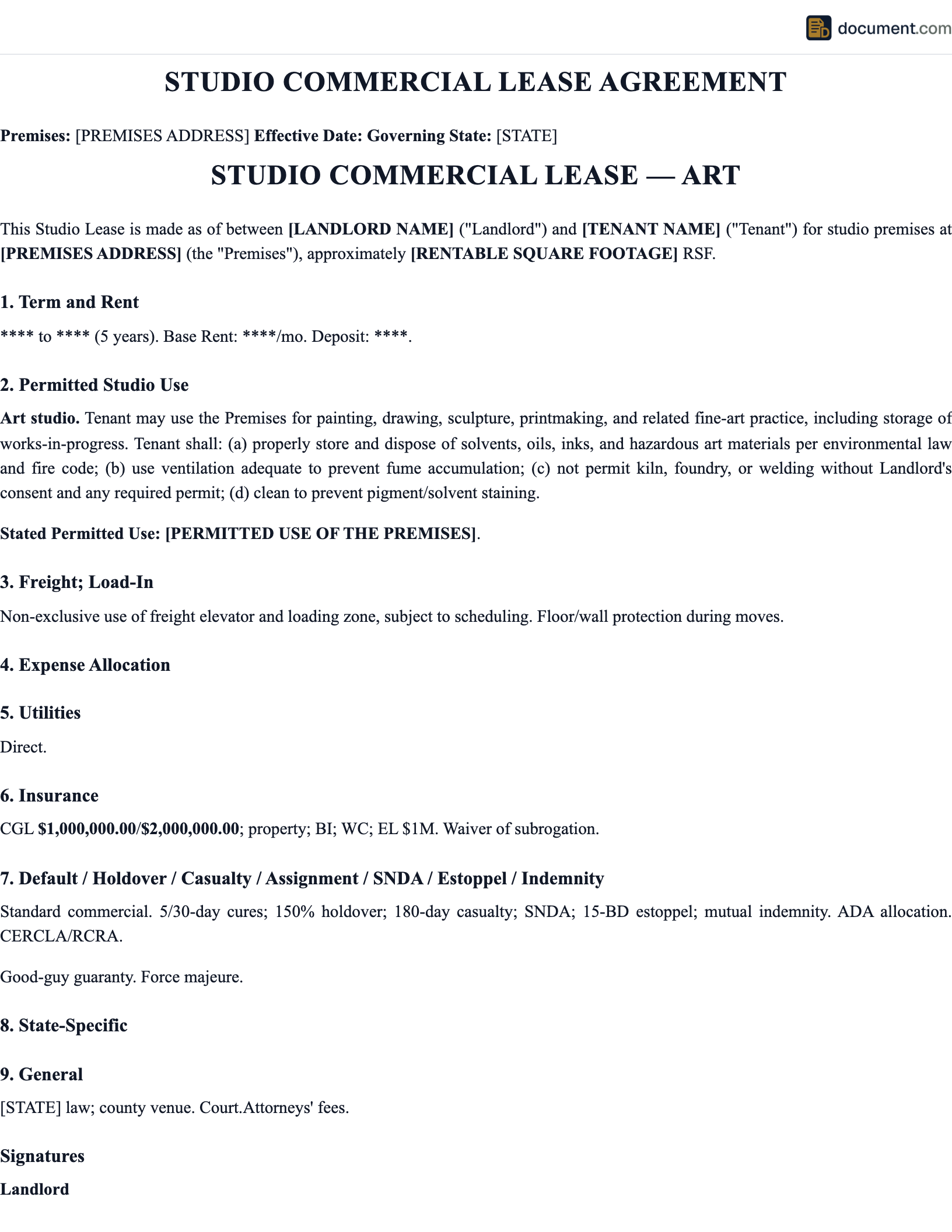
Below is a preview of our South Carolina-specific template. Your customized document will include all fields and provisions required for filing in any South Carolina county.
STUDIO RENTAL AGREEMENT
STATE OF SOUTH CAROLINA
Legal Document Template
STUDIO OWNER / OPERATOR
Company: [Studio Name]
Address: [Studio Address]
Contact: [Phone/Email]
License #: [Business License]
RENTER
Name: [Full Legal Name / Entity]
Address: [Mailing Address]
Phone: [Contact Number]
Insurance: [Policy Number]
STUDIO DETAILS
Studio: [Room Name/Number]
Size: [Square Feet]
Type: [Photo/Music/Art/Rehearsal]
Equipment: [See Inventory List]
Access Hours: [Available Hours]
RENTAL TERMS
Rate: $[Amount] per [Hour/Day/Month]
Booking: [Date/Time]
Deposit: $[Amount]
Cancellation: [Policy]
Insurance Required: [Yes - Minimum Coverage]
South Carolina Studio Rental Agreement FAQ
Answers to common questions about filing a studio rental agreement in South Carolina, including requirements, fees, and procedures.
Official South Carolina Resources
Use these official state resources to verify requirements, find your local filing office, and access government forms for South Carolina.
Related South Carolina Documents
Depending on your situation, you may need additional documents alongside your South Carolina studio rental agreement.
Create your South Carolina Commercial Studio Lease Agreement in under 5 minutes.
Answer a few questions and download a South Carolina-compliant document, ready for the state agency.