
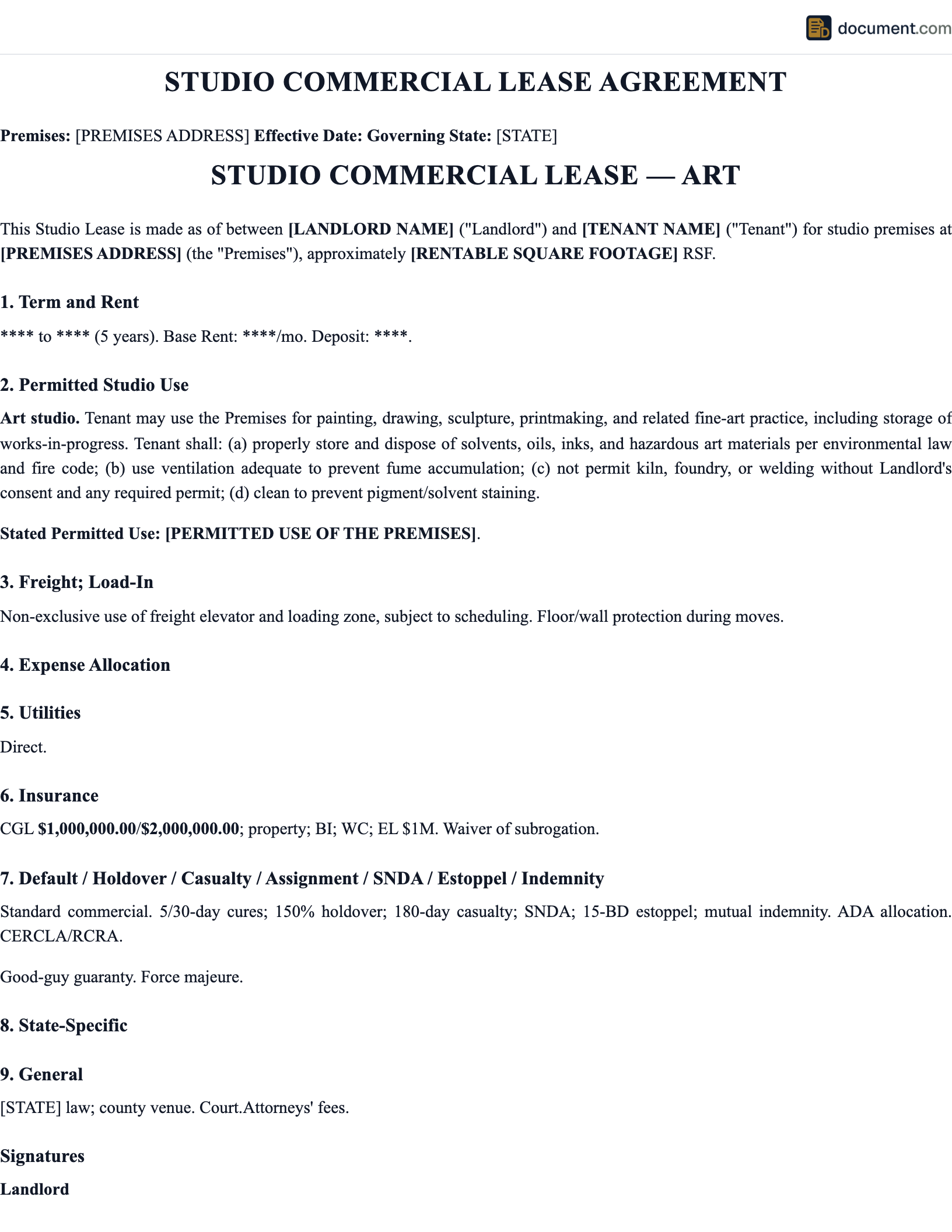



Rhode Island Studio Rental Agreement Overview
Rhode Island's artist studio market is small but unusually rich given the state's size. The Rhode Island School of Design's presence in Providence generates a persistent pipeline of working artists seeking studio space, and the spillover effect has made the Olneyville neighborhood, the Westminster Street corridor, and nearby Pawtucket among the more affordable and active creative studio clusters in New England. The mill and factory building stock in these areas offers high ceilings, large floor plates, and open layouts that artists value, and rents remain well below comparable spaces in Boston or even Cambridge. Pawtucket in particular has emerged as a satellite market where RISD graduates and Providence-connected artists relocate when Providence rents tighten.
Rhode Island has no statute specifically governing artist studio leases or creative tenancies. Commercial studio leases in Rhode Island are governed by general contract law under the Rhode Island General Laws, and the residential Landlord and Tenant Act (RIGL Chapter 34-18) does not apply. This means security deposit amounts, permitted use restrictions, improvement rights, and holdover rates are entirely negotiated terms. Artists should approach Rhode Island studio leases with the same diligence as any commercial lease, addressing these provisions explicitly in writing rather than assuming any statutory protection exists.
No Cap
Security deposit
RISD
Creative economy anchor
Contract
Law governs
No Tax
Commercial rent tax
Rhode Island Requirements
Rhode Island artist and commercial studio leases must be in writing for terms exceeding one year under the state's statute of frauds (RIGL Section 9-1-4). There is no studio-specific statutory framework, so the lease document must be comprehensive enough to address all the practical realities of studio tenancy: zoning compliance, permitted use specificity, improvement rights, and holdover treatment.
Historic District and Zoning Considerations
Some Providence studio buildings fall within local historic districts or are listed on the National Register of Historic Places, which can restrict exterior modifications and certain interior structural changes. Verify the building's historic status with the Providence Department of Planning and Development before signing if you plan any alterations. Separately, zoning verification is essential: Providence distinguishes between pure studio production use and retail or gallery sales, which may require a different zone classification or conditional use permit. Contact the Providence Department of Planning and Development or the Pawtucket Planning Department for zoning confirmation.
Key Lease Provisions
- Written agreement: Required for terms over one year under RIGL Section 9-1-4; include all material terms in the lease document itself since RI commercial tenants have no statutory fallback protections
- Zoning verification: Confirm permitted use for your specific studio activity (production only vs. retail sales vs. live-work) with the applicable municipal planning department before signing
- Permitted use specificity: List the actual media and activities you will conduct (ceramics, metalwork, printmaking, music recording) rather than using a generic "artist studio" designation that may not cover all your uses
- Improvement rights: Specify what structural improvements you may make (soundproofing, ventilation, kiln installation, darkroom plumbing), who pays, what landlord approvals are needed, and whether improvements revert to the landlord or can be removed at lease end
- Security deposit: No RI cap for commercial leases; negotiate amount (typically 1 to 2 months), return conditions, and return timeline (negotiate 30 days since no RI statute mandates a deadline)
- Holdover rate: Specify 125 to 150 percent of final month's base rent to avoid default month-to-month conversion at the original rate under RI common law
How to Execute a Rhode Island Studio Lease
Rhode Island studio leases move faster than large commercial transactions, but artists should not skip the substantive steps that protect against mid-lease disputes over improvements, use rights, and deposit returns.
Confirm Zoning and Historic Status
Before committing to any Providence or Pawtucket studio space, verify the zoning classification with the applicable planning department. Confirm that your specific activities (production, retail sales, live-work) are permitted in that zone, and check whether the building is in a local historic district or subject to Rhode Island Historical Preservation and Heritage Commission review, which could affect your ability to make improvements.
Negotiate Studio-Specific Lease Terms
Push for explicit permitted use language listing your actual media and activities. Negotiate improvement rights covering any specialized installations you need: kiln venting, darkroom plumbing, soundproofing, spray booth ventilation, or reinforced flooring for heavy equipment. Specify who pays for improvements, what landlord approval is required, and whether improvements remain or may be removed at lease end. Rhode Island has no studio tenant protection statute, so everything must be negotiated in writing.
Address Access, HVAC, and After-Hours Use
Providence and Pawtucket studio tenants should confirm 24-hour access rights in writing, since many older mill buildings restrict after-hours entry through shared building systems. Verify that HVAC or ventilation is adequate for your use (ceramics kilns, chemistry-based printmaking, and metalwork all require specialized ventilation), and document who is responsible for maintaining it. Older Pawtucket mill buildings sometimes have HVAC systems tied to building-wide controls that cannot support individual studio modifications.
Execute in Writing and Obtain Landlord Signature
Rhode Island's statute of frauds (RIGL Section 9-1-4) requires leases exceeding one year to be in writing signed by both parties. Confirm the landlord signatory has authority to bind the building owner. For corporate or LLC landlords, request evidence of authorization if any dispute about authority could arise later. Keep a fully signed original copy of the lease.
Move-In Documentation and Optional Recording
Photograph and document the studio's condition at move-in, including any pre-existing damage. This is the primary protection for recovering your deposit at lease end, since Rhode Island has no commercial deposit return statute to back you up. For long-term studio leases with purchase options or significant improvement investments, consider recording a memorandum of lease with the applicable Town or City Recorder to provide public notice of your occupancy rights.
Rhode Island Studio Lease: Typical Costs
Rhode Island imposes no commercial rent tax or sales tax on studio lease payments, so the total occupancy cost is base rent plus any separately itemized CAM or property tax passthrough. Studio rents in Providence and Pawtucket are modest compared to Boston and are among the most accessible in New England for artists seeking meaningful square footage.
| Fee / Cost | Amount |
|---|---|
| Base rent (Providence Olneyville / Jewelry District) | $7 - $14 per sqft annually |
| Base rent (Pawtucket mill buildings) | $5 - $11 per sqft annually |
| RI commercial rent / sales tax on studio rent | None |
| Security deposit | 1 - 2 months' rent (no RI statutory cap) |
| Property tax passthrough (NNN leases) | Varies; Providence rates among highest in RI |
| Attorney review | $500 - $1,500 typical for RI studio leases |
Sample Rhode Island Studio Rental Agreement
Below is a preview of our Rhode Island-specific template. Your customized document will include all fields and provisions required for filing in any Rhode Island county.
STUDIO RENTAL AGREEMENT
STATE OF RHODE ISLAND
Legal Document Template
STUDIO OWNER / OPERATOR
Company: [Studio Name]
Address: [Studio Address]
Contact: [Phone/Email]
License #: [Business License]
RENTER
Name: [Full Legal Name / Entity]
Address: [Mailing Address]
Phone: [Contact Number]
Insurance: [Policy Number]
STUDIO DETAILS
Studio: [Room Name/Number]
Size: [Square Feet]
Type: [Photo/Music/Art/Rehearsal]
Equipment: [See Inventory List]
Access Hours: [Available Hours]
RENTAL TERMS
Rate: $[Amount] per [Hour/Day/Month]
Booking: [Date/Time]
Deposit: $[Amount]
Cancellation: [Policy]
Insurance Required: [Yes - Minimum Coverage]
Rhode Island Studio Rental Agreement FAQ
Answers to common questions about filing a studio rental agreement in Rhode Island, including requirements, fees, and procedures.
Official Rhode Island Resources
Use these official state resources to verify requirements, find your local filing office, and access government forms for Rhode Island.
Related Rhode Island Documents
Depending on your situation, you may need additional documents alongside your Rhode Island studio rental agreement.
Create your Rhode Island Commercial Studio Lease Agreement in under 5 minutes.
Answer a few questions and download a Rhode Island-compliant document, ready for the state agency.