



Ohio Studio Rental Agreement Overview
Ohio is one of the most interesting states in the country for creative studio tenants because of the combination of affordable industrial real estate, a genuine arts manufacturing tradition, and thriving urban creative districts in multiple cities. Columbus's Franklinton neighborhood has emerged as the state's most concentrated arts district, with photography, video production, music, and visual arts studios occupying renovated industrial buildings along West Broad Street and its surrounding blocks. Cleveland's near-west side and Gordon Square Arts District have decades of arts manufacturing heritage, with ceramics, metalworking, woodworking, and fine arts studios in converted factory spaces. Cincinnati's OTR and Northside corridors have growing creative communities built around design, visual arts, and music. Beyond these three cities, Ohio's manufacturing legacy has left large inventories of former factory and warehouse buildings in Youngstown, Dayton, Akron, and Canton that are being converted to studio uses at rents that are among the most affordable in the country for comparable space.
Ohio has no studio-specific statute. Commercial studio leases are governed entirely by Ohio contract law, and courts enforce them as written. The combination of affordable rents and a lack of statutory overlay makes Ohio an accessible market for creative professionals, but the absence of regulatory protection makes the lease itself the only source of tenant rights. Key areas to address in writing include permitted use specificity, soundproofing and noise provisions, improvement and restoration obligations, zoning compliance for the intended creative use, and HVAC reliability for any space that requires climate control for sensitive media or materials.
$34
Filing fee
Required
Notarization
0
Witnesses required
County
Filing office
Ohio Requirements
Ohio imposes no studio-specific statutory requirements. The lease agreement is the primary and in most cases the only source of tenant rights. These are the practical requirements for a well-drafted Ohio commercial studio lease.
Zoning and Improvement Provisions Are Critical in Ohio Studio Leases
Ohio cities have varying zoning frameworks that affect what creative activities are permitted in specific buildings. Music studios and fabrication arts that generate noise or fumes may need industrial zoning that not all commercial zones accommodate. Separately, Ohio's manufacturing-to-studio conversions often involve spaces that need HVAC upgrades, electrical improvements, and soundproofing. Who pays for those improvements and what happens to them at lease end must be addressed in the lease before you sign, not after you have invested in the space.
What an Ohio Studio Lease Should Include
- Written agreement: Ohio's statute of frauds requires leases over one year to be in writing. All commercial studio leases should be documented in writing regardless of term, and signed by parties with actual authority to bind their entities.
- Specific permitted use language: Identify the exact type of studio use, any restrictions on noise levels or operating hours, whether clients may visit, and what activities are prohibited. Vague permitted-use clauses in Ohio studio leases have led to disputes in arts buildings where different tenants have conflicting noise tolerance thresholds.
- Soundproofing and noise provisions: If your studio generates sound, clarify who is responsible for soundproofing improvements, who pays for them, and what noise limits apply to your use. In Columbus's Franklinton and Cleveland's near-west side arts buildings, multiple studio tenants in the same building with different noise tolerances can create conflicts without clear lease provisions.
- Improvements and restoration obligations: Ohio studio tenants commonly invest in darkrooms, isolation rooms, exhaust ventilation, and specialized electrical. Specify in the lease what you may install, who owns those improvements, and whether restoration is required at lease end. In Ohio's affordable markets, landlords are often willing to offer TI allowances or rent abatement for longer-term commitments.
- Ceiling height and structural capacity: Document the actual clear ceiling height and confirm floor load ratings if your work requires heavy equipment, large format presses, or substantial materials storage. Ohio's manufacturing-era buildings have widely varying structural specifications.
- Insurance requirements: Ohio studio landlords typically require commercial general liability coverage. Specialized equipment, such as photographic gear or recording equipment, may require separate inland marine or equipment coverage. Confirm minimum amounts and whether the landlord must be named as an additional insured.
How to Execute an Ohio Studio Lease
Ohio's affordable and accessible studio market rewards tenants who take a few specific steps before committing. The process below reflects the practical realities of leasing in Ohio's creative districts and former industrial spaces.
Inspect the Space and Verify Zoning
Visit the space and measure the actual clear ceiling height, check the electrical panel capacity, assess natural light and ventilation, and evaluate sound transmission between units. Check with the Columbus, Cleveland, or Cincinnati planning department to confirm the specific address is zoned for your creative use. In Columbus, the Franklinton Arts District has specific overlay zoning; in other areas, you may need industrial classification for noise-generating activities.
Negotiate Noise, Permitted Use, and Improvements Before LOI
Before signing a letter of intent, confirm verbally and then in writing that the landlord accepts your noise level, operating hours, and intended client activities. Agree on TI allowance or rent abatement for any build-out you plan. Ohio's affordable market gives tenants real leverage to negotiate these terms before committing to a full lease draft.
Negotiate Improvement Ownership and Restoration Obligations
Clarify in the lease whether studio improvements such as soundproofing, darkrooms, or specialized exhaust systems become the landlord's property at lease end or whether you must remove them. Restoration costs for specialized build-outs can be significant. In Ohio's many manufacturing-era buildings, some landlords prefer to keep improvements; others insist on restoration. Agree in writing before starting construction.
Confirm HVAC, Utilities, and After-Hours Access
Many Ohio former industrial buildings have HVAC systems that are adequate for light use but inadequate for climate-sensitive art media or photography. Verify actual temperature and humidity control capabilities, confirm utility metering, and ensure after-hours 24/7 access is available. Loading dock or freight elevator access is also worth confirming if you move large work or equipment.
Execute and Document Conditions
Sign the lease with full legal names or proper entity names. Photograph the space thoroughly before move-in and email the photos to the landlord to create a timestamped record. Attach a condition report as a lease exhibit. These simple steps are the most reliable protection for your security deposit at lease end.
Tax Implications of an Ohio Studio Lease
Ohio has no commercial rent tax, which is a meaningful advantage for studio tenants. The primary tax considerations are federal, with some Ohio-specific nuances for municipal income taxes and the Commercial Activity Tax.
| Tax / Cost Item | Notes |
|---|---|
| No commercial rent tax | Ohio imposes no statewide tax on commercial rent. Studio tenants pay only base rent and any CAM or utility charges without an additional rent tax layer at the state level. |
| Rent deductibility | Studio rent paid for business-use creative work is generally deductible as an ordinary and necessary business expense for federal income tax purposes. Ohio's Commercial Activity Tax taxes gross receipts at low rates and does not create a direct rent tax burden for tenants. |
| Ohio municipal income taxes | Ohio workers pay municipal income taxes based on where they work. A Columbus studio location means income earned there is subject to Columbus's 2.5% municipal tax. Cleveland levies 2.5%. Cincinnati levies 1.8%. Creative professionals in smaller Ohio cities with lower municipal tax rates may find this creates a meaningful after-tax difference between markets. |
| Improvement cost treatment | Studio build-out costs such as soundproofing, darkroom construction, or specialized electrical upgrades may need to be capitalized as leasehold improvements and depreciated rather than deducted immediately. Consult a CPA, particularly for improvements that become fixtures transferring to the landlord at lease end, as the ownership transfer affects the tax treatment. |
| Property tax pass-through | Net leases in Ohio often pass property taxes through to tenants as part of CAM. Property tax rates vary significantly by Ohio county, with Cuyahoga County (Cleveland) and Franklin County (Columbus) having higher effective rates than smaller Ohio markets. Understand the net lease structure and request prior-year CAM reconciliation statements before signing. |
Important Considerations for Ohio Studio Tenants
Ohio's creative studio market has characteristics that make it genuinely attractive for artists and creative professionals. Understanding the specific dynamics of each major market helps you make better decisions about where and how to lease.
- Columbus's Franklinton is Ohio's most active arts district and prices are still accessible: Franklinton has developed a genuine critical mass of creative tenants, galleries, and event spaces that create networking and exhibition opportunities alongside physical studio space. Rents have risen from the early Franklinton development era but remain well below comparable markets in coastal arts districts. If you are choosing an Ohio base for a creative practice, Franklinton offers the most integrated arts community in the state.
- Cleveland's arts manufacturing tradition offers genuine industrial infrastructure: Cleveland's near-west side and Gordon Square areas have studios in buildings purpose-built for manufacturing, which means high ceilings, heavy electrical, loading access, and structural capacity that most markets cannot match at comparable rents. For artists working in metal, ceramics, large-format printmaking, or heavy fabrication, Cleveland's industrial building stock is among the most suitable in the Midwest.
- Youngstown, Dayton, and other smaller Ohio cities offer extraordinary value: For creative professionals who can work independently of a major city's networking ecosystem, smaller Ohio markets offer former industrial buildings with exceptional space at very low rents. Some of these spaces require HVAC upgrades and basic renovation, but at rents that are a fraction of Columbus or Cleveland rates, the economics of a longer-term lease with tenant-funded improvements can work very well.
- Gentrification pressure is real in Franklinton and OTR: As Columbus's Franklinton and Cincinnati's OTR have developed, some longtime creative tenants have faced rent increases or displacement as commercial and residential development raises property values. If you are signing a lease in these markets, negotiate the longest term your commitment allows with defined renewal options at predetermined increases, rather than accepting market-rate renewals that could price you out.
- HVAC and climate control deserve serious due diligence in older Ohio buildings: Many Ohio creative districts are in buildings from the early-to-mid twentieth century with HVAC systems that were not designed for climate-sensitive art media. Photography, archival work, ceramics, and painting on sensitive supports may require temperature and humidity control that older systems cannot maintain. Negotiate landlord responsibility for maintaining specified environmental conditions before signing any lease in an older Ohio industrial building.
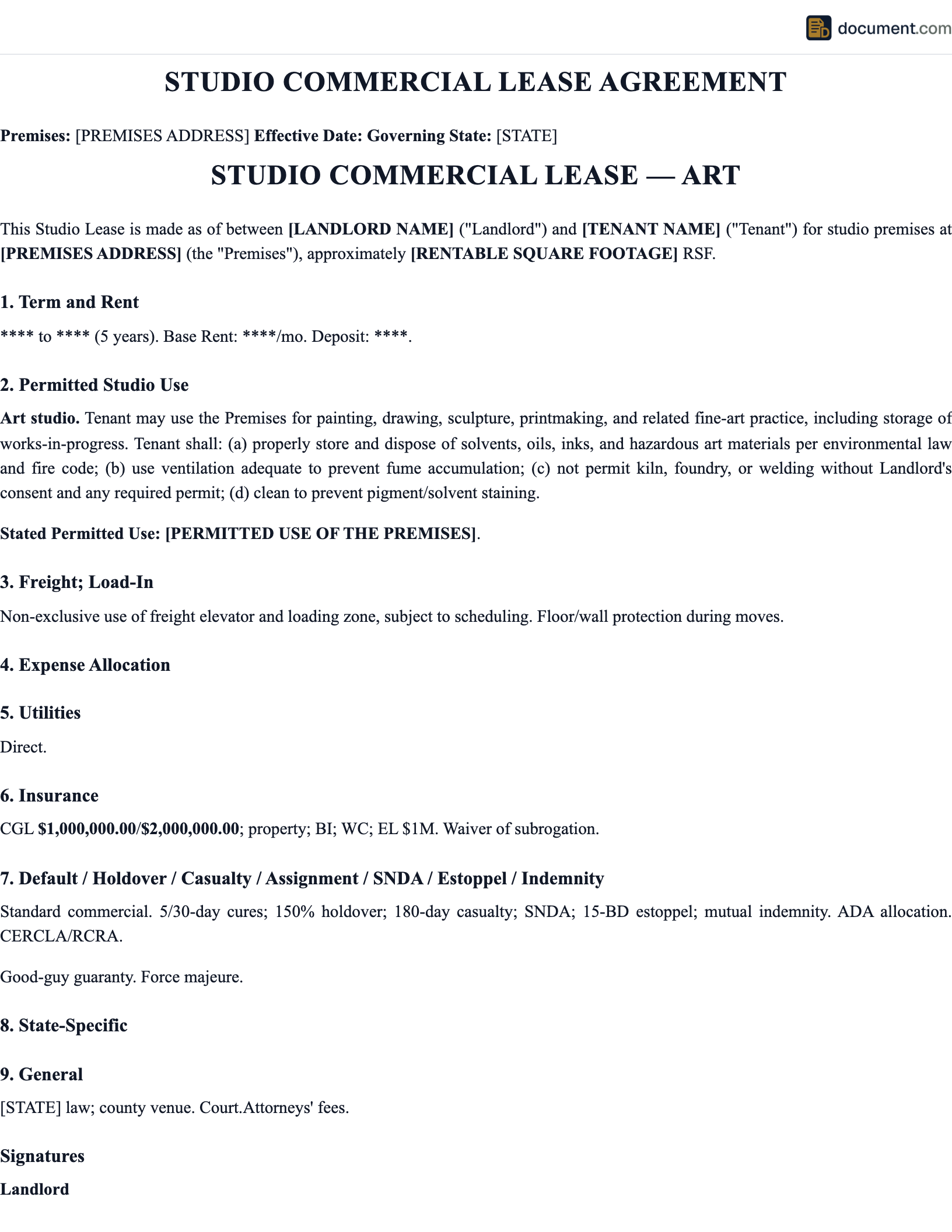
Sample Ohio Studio Rental Agreement
Below is a preview of our Ohio-specific template. Your customized document will include all fields and provisions required for filing in any Ohio county.
STUDIO RENTAL AGREEMENT
STATE OF OHIO
Legal Document Template
STUDIO OWNER / OPERATOR
Company: [Studio Name]
Address: [Studio Address]
Contact: [Phone/Email]
License #: [Business License]
RENTER
Name: [Full Legal Name / Entity]
Address: [Mailing Address]
Phone: [Contact Number]
Insurance: [Policy Number]
STUDIO DETAILS
Studio: [Room Name/Number]
Size: [Square Feet]
Type: [Photo/Music/Art/Rehearsal]
Equipment: [See Inventory List]
Access Hours: [Available Hours]
RENTAL TERMS
Rate: $[Amount] per [Hour/Day/Month]
Booking: [Date/Time]
Deposit: $[Amount]
Cancellation: [Policy]
Insurance Required: [Yes - Minimum Coverage]
Ohio Studio Rental Agreement FAQ
Answers to common questions about filing an studio rental agreement in Ohio, including requirements, fees, and procedures.
Official Ohio Resources
Use these official state resources to verify requirements, find your local filing office, and access government forms for Ohio.
Related Ohio Documents
Depending on your situation, you may need additional documents alongside your Ohio studio rental agreement.
Create your Ohio Commercial Studio Lease Agreement in under 5 minutes.
Answer a few questions and download a Ohio-compliant document, ready for the state agency.