
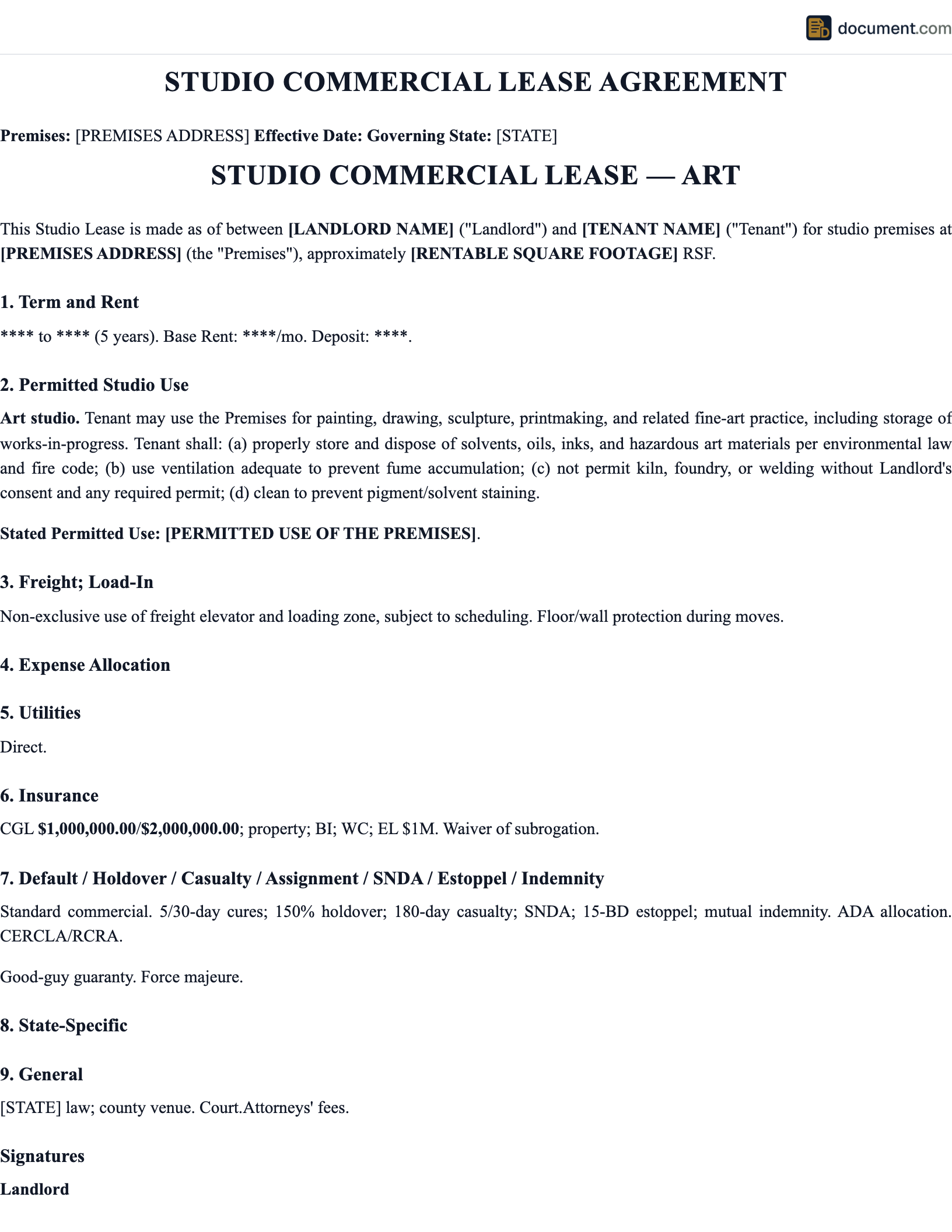



North Dakota Studio Rental Agreement Overview
North Dakota's creative studio market centers on Fargo, where a growing arts, music, and film community has developed around North Dakota State University and a downtown arts district that has expanded significantly in the past decade. Fargo has photography studios, music rehearsal and recording facilities, and visual art studios scattered across commercial and light industrial zones. Bismarck has a smaller creative sector, with some studio space tied to state arts programs and regional artists who serve the capital city's professional and government communities. Outside these two cities, dedicated commercial studio space is uncommon, and artists in smaller communities typically adapt agricultural buildings or home-based spaces rather than leasing purpose-built commercial studios.
North Dakota has no studio-specific statute or artist district protection. Studio leases are governed entirely by general North Dakota contract law, and courts enforce them as written with little statutory overlay. Two issues are more significant in North Dakota than in other states: cold climate provisions and zoning compliance. A studio lease that leaves HVAC responsibility vague creates serious problems in a state where temperatures regularly fall below zero. Similarly, noise-generating uses such as music production or industrial arts may face zoning restrictions that vary meaningfully between Fargo, Bismarck, and smaller communities. Verifying zoning before signing protects both the creative use and the security deposit.
$10
Filing fee
Required
Notarization
0
Witnesses required
Register
Filing office
North Dakota Requirements
North Dakota imposes no studio-specific statutory requirements. A commercial studio lease is enforceable based on contract law principles, and the written agreement is the primary source of both parties' rights. Given the cold climate and the state's limited arts infrastructure outside Fargo, these requirements focus on practical provisions that matter in the ND context.
Verify Zoning and Heating Provisions Before Signing
North Dakota's two primary issues for studio tenants are zoning compliance and heating. Music studios and other noise-generating uses require specific zoning classifications that vary by city. Fargo and Bismarck have different zoning overlay structures, and a landlord's representation that your use is permitted does not substitute for checking the city planning portal. Separately, HVAC responsibility and specifications belong in the lease itself. Heating system failure in a North Dakota winter is not a minor inconvenience.
What a North Dakota Studio Lease Should Include
- Written agreement: Any lease over one year must be in writing under North Dakota contract principles. Month-to-month studio rentals should also be documented in writing to protect both parties on deposit return, permitted use, and access hours.
- Specific permitted use language: Identify the exact studio type and activities permitted, including any restrictions on client visits, operating hours, or noise levels. A vague permitted-use clause leaves you vulnerable if a landlord later objects to your activities.
- HVAC responsibility and specifications: Specify who maintains the heating system, the temperature the landlord must maintain during operating hours, and the tenant's remedy if the heating system fails. In older industrial buildings common in Fargo's creative districts, heating system age and reliability vary significantly.
- Soundproofing and noise provisions: If your studio generates sound, address noise levels and operating hours in the lease. Determine whether soundproofing improvements are permitted and which party is responsible for their cost. Also check North Dakota city noise ordinances, which can create compliance obligations independent of the lease.
- Improvements, ownership, and restoration: Clarify whether you may make studio-specific improvements such as electrical upgrades, darkrooms, or ventilation. Identify who owns those improvements at lease end and whether you must restore the space to original condition. Restoration obligations for specialized studio build-outs can be expensive if not negotiated upfront.
- Insurance requirements: Most North Dakota studio landlords require commercial general liability insurance and may require coverage for specialized equipment. Confirm minimum coverage amounts and add the landlord as an additional insured if required.
How to Execute a North Dakota Studio Lease
Leasing a studio in North Dakota involves fewer regulatory steps than in larger states, but the cold climate and limited studio inventory in most ND communities make physical inspection and specific contractual provisions more critical than in other markets.
Inspect the Space and Verify Zoning
Visit the space and assess ceiling height, electrical panel capacity, HVAC system age and condition, and sound transmission through walls and floors. Check the Fargo or Bismarck city planning portal to verify zoning allows your intended use. Music studios and other noise-generating operations require specific zoning classifications that do not apply in all commercial zones.
Negotiate Heating, Noise, and Improvements
Before signing or even submitting a letter of intent, confirm the landlord's position on three things: who maintains and pays for heating, whether your noise level and operating hours are acceptable, and whether you may make studio-specific improvements. Get the landlord's agreement on all three in writing before proceeding to a full lease draft.
Address Improvements and Restoration Obligations
If you plan to soundproof walls, upgrade electrical, or build out ventilation, negotiate a tenant improvement allowance or rent abatement period. Specify in the lease whether those improvements become the landlord's property or must be removed. Leaving restoration obligations unaddressed can result in significant end-of-lease costs.
Confirm Utility Structure and After-Hours Access
Understand exactly how utilities are metered and billed. In older industrial buildings common in Fargo's creative areas, utilities may be shared or sub-metered in ways that create unexpected costs. Also confirm whether after-hours 24/7 access is included and whether the building is reliably accessible during severe winter weather.
Execute and Document Move-In Conditions
Sign the lease using full legal names or proper entity names. Photograph the space thoroughly and send the photos to the landlord by email on move-in day to create a timestamped record. Attach a condition report to the lease as an exhibit. These steps are simple but important for protecting your security deposit at lease end.
Tax Implications of a North Dakota Studio Lease
North Dakota has no commercial rent tax, which is a significant advantage compared to states like Florida or Washington that impose rent taxes. The primary tax considerations for studio tenants in ND are federal, with some state-specific nuances.
| Tax / Cost Item | Notes |
|---|---|
| No commercial rent tax | North Dakota imposes no statewide rent tax on commercial studio leases. Tenants pay base rent and any agreed utilities or CAM charges without an additional tax layer on the lease itself. |
| Rent deductibility | Studio rent paid for business-use creative work is generally deductible as an ordinary and necessary business expense for both federal and North Dakota income tax purposes. North Dakota's income tax rates have been reduced in recent years and are among the lower rates in the region. |
| Heating and utility costs | Utility costs paid directly by the tenant are deductible as business expenses. In North Dakota, heating costs can be a material budget item, particularly in older industrial buildings. Track utility costs separately from rent for cleaner tax reporting. |
| Improvement cost treatment | Studio build-out costs such as soundproofing, electrical upgrades, or ventilation systems may need to be capitalized and depreciated rather than deducted immediately if they qualify as capital improvements. Consult a CPA to determine proper treatment, particularly for improvements that become fixtures and transfer to the landlord at lease end. |
| Property tax pass-through | If your lease passes property taxes through to tenants as part of CAM charges, those amounts are generally deductible as business expenses when paid for business purposes. Cass County (Fargo) property values have been rising, which can push CAM reconciliation amounts up at year end. |
Important Considerations for North Dakota Studio Tenants
Leasing a creative studio in North Dakota requires attention to a few issues that are unique to the state's climate, market size, and arts infrastructure.
- Studio supply is limited and turnover is slow: North Dakota's small creative market means quality studio space, particularly soundproofed music facilities and large-format visual art spaces, is genuinely rare. When a suitable space becomes available, response time matters. Come prepared with financial information, a business description, and insurance details so you can move quickly without waiving important lease protections.
- Building mechanical reliability is a real operational risk: Older industrial buildings in Fargo's arts areas often have aging heating systems. A boiler failure during a North Dakota January can make the space unusable for days. Ask the landlord for maintenance records, ask other tenants in the building about their experiences, and make sure the lease gives you clear remedies including rent abatement if the space becomes unusable due to heating failure.
- Cold and dry climate affects certain creative media: North Dakota's cold dry winters can affect photography, archival work, ceramics, and certain painting media in ways that humid climate studios do not experience. If climate control is critical for your work, specify temperature and humidity requirements in the lease and confirm the HVAC system can maintain those parameters year-round.
- Fargo's arts community is accessible and collaborative: Unlike larger metros where studio tenants often operate in isolation, Fargo's creative community is relatively connected. Spaces in and around the downtown arts district often provide informal networking and collaboration opportunities that are worth considering alongside purely physical factors like rent and square footage.
- Attorney review is affordable and worthwhile in ND: Commercial real estate attorneys in Fargo and Bismarck charge significantly less than those in coastal markets. For any studio lease involving meaningful build-out or a term over 12 months, a few hundred dollars of attorney review time is a reasonable investment to ensure the HVAC, improvements, and holdover provisions work in your favor.
Sample North Dakota Studio Rental Agreement
Below is a preview of our North Dakota-specific template. Your customized document will include all fields and provisions required for filing in any North Dakota county.
STUDIO RENTAL AGREEMENT
STATE OF NORTH DAKOTA
Legal Document Template
STUDIO OWNER / OPERATOR
Company: [Studio Name]
Address: [Studio Address]
Contact: [Phone/Email]
License #: [Business License]
RENTER
Name: [Full Legal Name / Entity]
Address: [Mailing Address]
Phone: [Contact Number]
Insurance: [Policy Number]
STUDIO DETAILS
Studio: [Room Name/Number]
Size: [Square Feet]
Type: [Photo/Music/Art/Rehearsal]
Equipment: [See Inventory List]
Access Hours: [Available Hours]
RENTAL TERMS
Rate: $[Amount] per [Hour/Day/Month]
Booking: [Date/Time]
Deposit: $[Amount]
Cancellation: [Policy]
Insurance Required: [Yes - Minimum Coverage]
North Dakota Studio Rental Agreement FAQ
Answers to common questions about filing a studio rental agreement in North Dakota, including requirements, fees, and procedures.
Official North Dakota Resources
Use these official state resources to verify requirements, find your local filing office, and access government forms for North Dakota.
Related North Dakota Documents
Depending on your situation, you may need additional documents alongside your North Dakota studio rental agreement.
Create your North Dakota Commercial Studio Lease Agreement in under 5 minutes.
Answer a few questions and download a North Dakota-compliant document, ready for the state agency.