



North Carolina Studio Rental Agreement Overview
North Carolina has developed a meaningful studio leasing market driven by distinct creative clusters in different cities. Asheville's River Arts District is the most developed arts economy in the state, with a concentration of working artists, galleries, and craft producers that creates real underlying demand for studio space in the district's former industrial buildings along the French Broad River. Charlotte's arts scene is growing, with studio concentrations in Plaza Midwood, NoDa, and the Optimist Park neighborhoods. Durham's American Tobacco Campus and nearby districts attract music, film, and media production. Raleigh has a smaller but growing creative economy supported by the state's arts funding infrastructure and proximity to the Research Triangle's creative tech community.
North Carolina has no artist studio-specific commercial lease statute. Studio leases are governed by general contract law and the state's property statutes. The lack of mandatory commercial tenant protections means that the studio lease document itself carries all the legal weight. North Carolina courts enforce commercial lease terms as written between parties who are assumed to have negotiated at arm's length. A studio tenant who signs a lease with broad landlord restoration rights, no limit on deposit deductions, and no holdover rate specification has agreed to those terms regardless of whether they fully understood the implications.
$26
Filing fee
Required
Notarization
0
Witnesses required
Register
Filing office
North Carolina Requirements
North Carolina imposes no special statutory framework on commercial studio leases, but several practical requirements separate an enforceable agreement from a dispute waiting to happen. Getting these elements right at the start avoids costly disagreements about permitted use, noise, and improvements down the line.
Zoning and Permitted Use Are Everything
Before signing a studio lease in North Carolina, verify that the local zoning classification actually permits your intended use. Asheville, Charlotte, Durham, and Raleigh each have distinct industrial and arts zoning overlays. Music studios that generate amplified sound may require a different zoning classification than visual art studios. Signing a lease for a space that cannot legally support your use creates a serious problem that no lease language can fix.
What a North Carolina Studio Lease Must Include
- Written agreement for terms over three years: NCGS 22-2 requires leases exceeding three years to be in writing. Most studio leases are shorter, but any renewal options that push the total term past three years should also be documented in writing.
- Specific permitted use language: The lease should identify the studio type (recording, photography, visual arts, rehearsal) and any restrictions on clients, noise levels, or hours of operation. Vague permitted-use clauses are a common source of landlord-tenant disputes in arts districts.
- Ceiling height and structural specifications: Document the actual clear ceiling height and load-bearing capacity if your work requires rigging, large equipment, or heavy machinery. Discovered after move-in, these shortfalls are expensive to work around.
- Noise and soundproofing responsibilities: Clarify which party is responsible for any soundproofing improvements, who pays for them, and whether the tenant must restore the space at lease end. In mixed-use buildings, this is particularly important in Asheville and Charlotte's rapidly densifying neighborhoods.
- Improvements and restoration obligations: Studio tenants frequently invest in build-outs such as isolation rooms, darkrooms, or ventilation for fumes. The lease should specify what the tenant may install, who owns those improvements, and whether restoration is required on exit.
- Insurance requirements: Most North Carolina studio landlords require commercial general liability coverage, often $1 million per occurrence, and many require proof of coverage for specialized equipment such as recording gear or photography equipment.
How to Execute a North Carolina Studio Lease
Negotiating and executing a commercial studio lease in North Carolina takes more preparation than signing a standard office agreement. The steps below reflect the specific concerns artists and creative professionals face in NC markets from Asheville to Charlotte to the Triangle.
Inspect the Space and Verify Zoning
Visit the space before negotiating any terms. Measure the actual clear ceiling height, test electrical capacity, and check the city or county planning portal to confirm the zoning allows your studio type. In Asheville, arts and commercial zoning overlays can be complex, and landlords do not always know the details.
Negotiate Noise, Hours, and Permitted Use in Writing
Before a letter of intent, confirm with the landlord that your specific activities are permitted and that noise levels, client visits, and operating hours are acceptable. Get those agreements into the lease itself. Verbal assurances are unenforceable under North Carolina contract law once the written lease is signed.
Address Improvements, Ownership, and Restoration
If you plan any build-out, negotiate a tenant improvement allowance or rent abatement period in exchange. Clarify in the lease whether your improvements become the landlord's property or whether you must remove them. Restoration obligations at lease end can be a significant cost if not addressed upfront.
Review CAM Provisions and Utility Costs
Studio spaces in repurposed industrial buildings often have unmetered or shared utility arrangements. Understand exactly what utilities are included in rent and what will be billed separately. CAM charges in multi-tenant arts complexes can include roof maintenance, parking lot upkeep, and common area cleaning.
Execute with Authorized Signatories and Document Conditions
Both parties sign the lease using full legal names or proper entity names. If you are signing on behalf of an LLC or corporation, confirm you have authority to bind the entity. Photograph the space thoroughly before moving in and attach a condition report to the lease as an exhibit. This protects both parties when the lease ends.
Tax Implications of a North Carolina Studio Lease
North Carolina imposes no commercial rent tax, which keeps the baseline tax burden on studio tenants lower than in states like New York or Washington. That said, there are several tax considerations worth understanding before signing.
| Tax / Cost Item | Notes |
|---|---|
| No commercial rent tax | North Carolina does not impose a statewide tax on commercial rent. Studio tenants pay only the base rent and any CAM charges without an additional tax layer on the lease itself. |
| Rent deductibility | Studio rent paid for business purposes is generally deductible as a business expense for federal and North Carolina income tax purposes. NC's corporate income tax rate has been declining, reaching 2.5% in recent years, making NC one of the more favorable states for business income. |
| Property tax pass-through via CAM | Many NC commercial leases pass property taxes through to tenants as part of CAM charges. Review the lease for gross vs. net structure. Buncombe County (Asheville) and Mecklenburg County (Charlotte) have experienced rising assessed values, which can push CAM costs up at reconciliation time. |
| Tenant improvement cost treatment | Build-out costs you fund directly, such as isolation rooms or specialized ventilation, may be depreciable capital improvements rather than immediately deductible expenses. Consult a CPA on the proper treatment, particularly for improvements that become fixtures and transfer to the landlord at lease end. |
| NC arts tax incentives (limited) | North Carolina eliminated its broad film and arts tax incentive program, but certain local programs exist. Asheville and Durham offer targeted arts district incentives in some cases. These are project-specific and not a general offset to studio rent costs. |
Important Considerations for North Carolina Studio Tenants
Each of North Carolina's major creative markets operates differently, and what works as a lease strategy in Asheville may not translate to Charlotte or the Triangle. These considerations are specific to the NC studio landscape.
- Asheville's arts districts face gentrification pressure: The River Arts District has been transforming rapidly since major flood damage in 2024, and redevelopment has pushed some longtime studio tenants out as property values rise. If you are leasing in Asheville, negotiate the longest term you can justify, with renewal options at defined rent increases rather than open market resets.
- Charlotte's arts districts are newer and less legally established: Plaza Midwood, NoDa, and Optimist Park are active creative neighborhoods, but they lack the long-standing zoning protections of older arts districts in other states. Confirm that the specific building you are considering is not on a redevelopment tract by checking Mecklenburg County planning records before committing.
- Music studio noise is a real conflict risk: North Carolina cities enforce local noise ordinances actively, and mixed-use areas in Raleigh, Durham, and Charlotte increasingly have residential tenants living adjacent to creative spaces. A lease that grants you the right to operate does not override a municipal noise citation. Verify decibel limits and operating hours before signing.
- Humidity and climate affect some studio uses: North Carolina's humid subtropical climate can create problems for photography, archival work, and certain fine art media. If you need climate-controlled space, verify that the HVAC system can maintain temperature and humidity specifications, and negotiate landlord responsibility for maintaining those conditions throughout the lease term.
- Durham's American Tobacco Campus and similar complexes have specific rules: Multi-tenant creative campuses in NC often have their own rules of conduct, signage restrictions, and access policies layered on top of the lease. Read the house rules and any recorded covenants before signing. Violations can be grounds for termination even if you are current on rent.
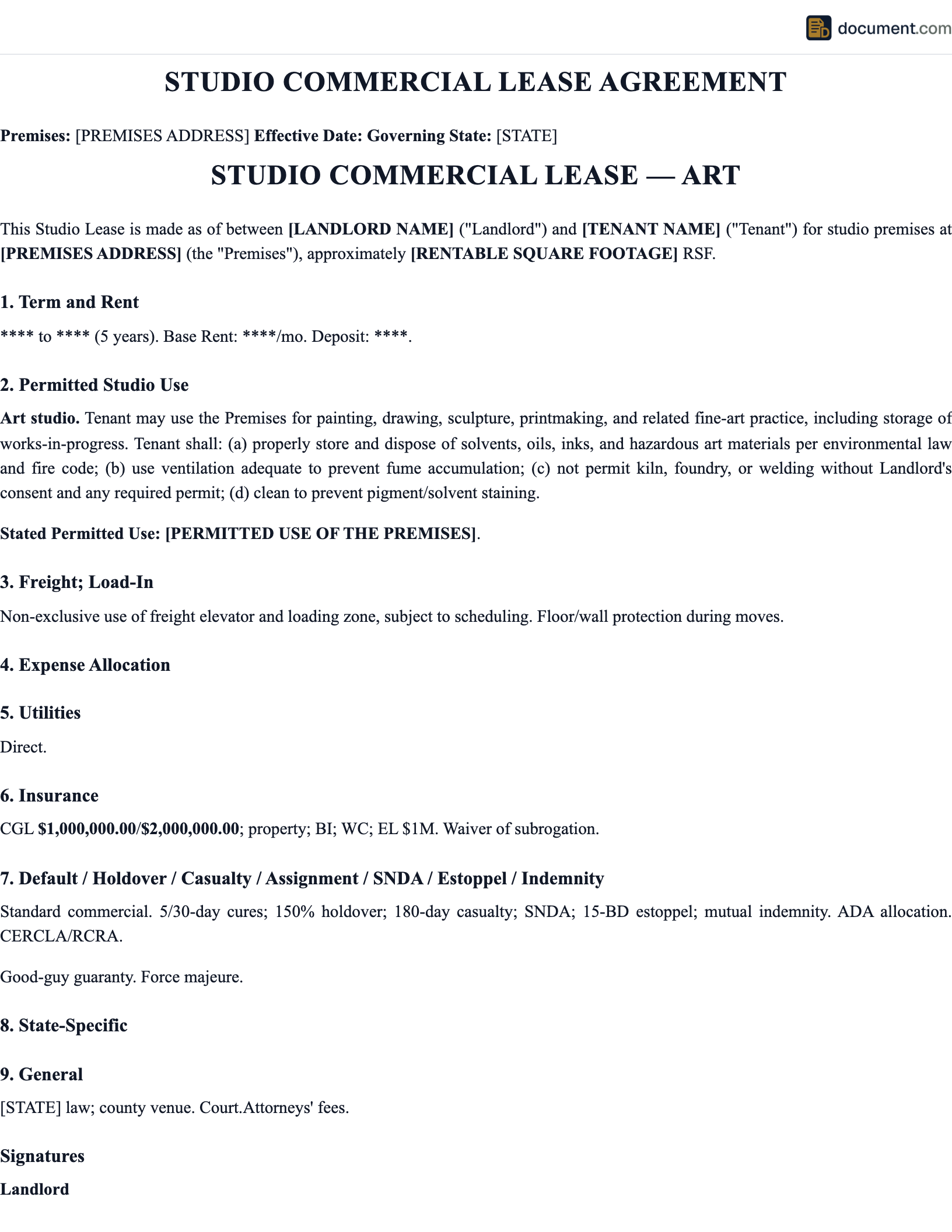
Sample North Carolina Studio Rental Agreement
Below is a preview of our North Carolina-specific template. Your customized document will include all fields and provisions required for filing in any North Carolina county.
STUDIO RENTAL AGREEMENT
STATE OF NORTH CAROLINA
Legal Document Template
STUDIO OWNER / OPERATOR
Company: [Studio Name]
Address: [Studio Address]
Contact: [Phone/Email]
License #: [Business License]
RENTER
Name: [Full Legal Name / Entity]
Address: [Mailing Address]
Phone: [Contact Number]
Insurance: [Policy Number]
STUDIO DETAILS
Studio: [Room Name/Number]
Size: [Square Feet]
Type: [Photo/Music/Art/Rehearsal]
Equipment: [See Inventory List]
Access Hours: [Available Hours]
RENTAL TERMS
Rate: $[Amount] per [Hour/Day/Month]
Booking: [Date/Time]
Deposit: $[Amount]
Cancellation: [Policy]
Insurance Required: [Yes - Minimum Coverage]
North Carolina Studio Rental Agreement FAQ
Answers to common questions about filing a studio rental agreement in North Carolina, including requirements, fees, and procedures.
Official North Carolina Resources
Use these official state resources to verify requirements, find your local filing office, and access government forms for North Carolina.
Related North Carolina Documents
Depending on your situation, you may need additional documents alongside your North Carolina studio rental agreement.
Create your North Carolina Commercial Studio Lease Agreement in under 5 minutes.
Answer a few questions and download a North Carolina-compliant document, ready for the state agency.