
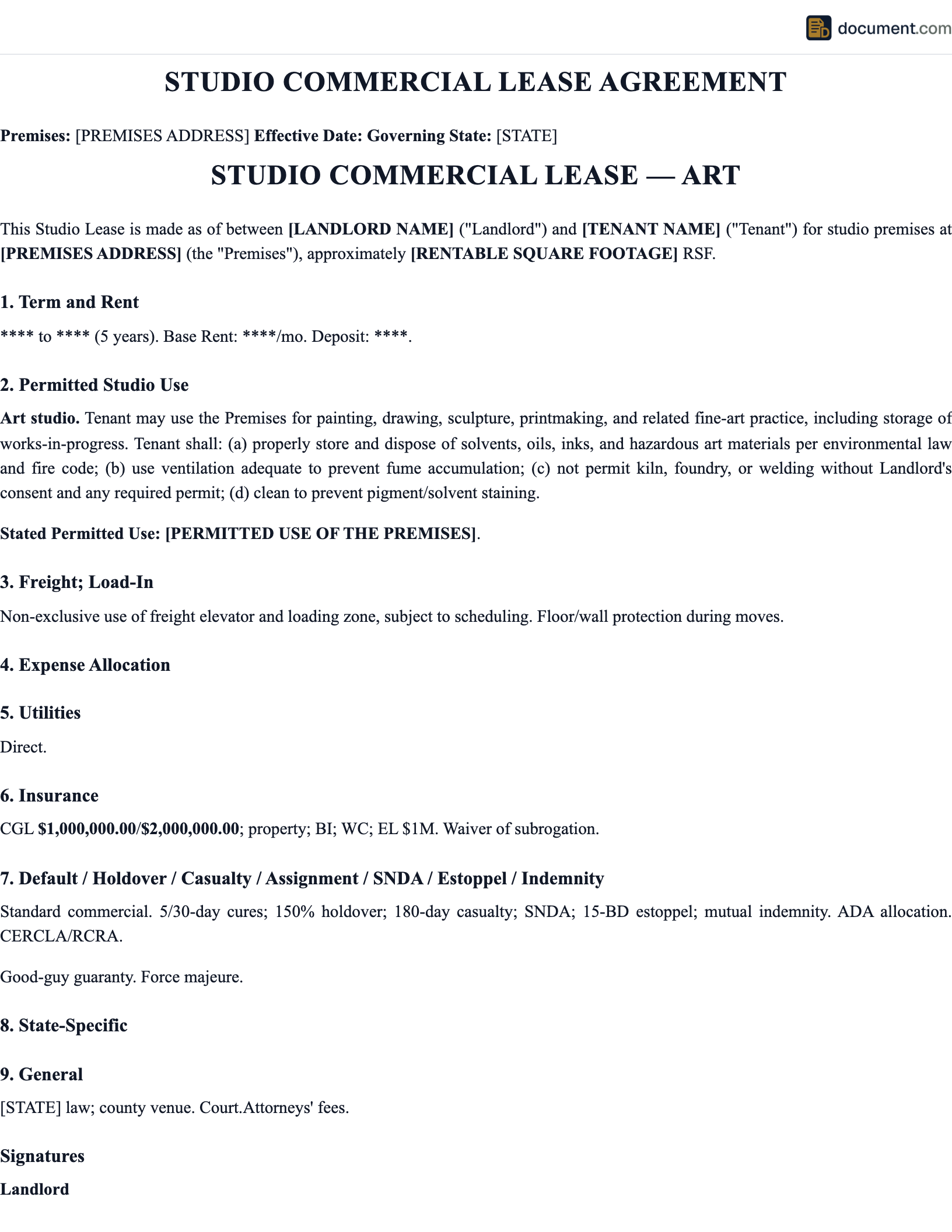



New York Studio Rental Agreement Overview
New York City has one of the most storied artist studio markets in the world, shaped by decades of conversion from industrial manufacturing space to creative use. Brooklyn neighborhoods like Bushwick, Gowanus, Red Hook, and Sunset Park have become nationally recognized studio districts. Manhattan still has artist studios in Chelsea, the Lower East Side, and the far west side near the Hudson Yards, though rents are dramatically higher than Brooklyn equivalents. The Long Island City waterfront in Queens has attracted large studio complexes serving visual artists, filmmakers, and performance companies. Outside NYC, the Hudson Valley has developed a meaningful artist community with studio space in smaller, more affordable buildings along the corridor from Yonkers to Hudson.
New York has no artist studio-specific commercial lease statute. NYC's zoning rules, however, play a critical role in determining what studio uses are permitted in which buildings, and the city's complex loft law history adds background legal context for artists considering live-work arrangements. Commercial studio tenants who use the space purely for working rather than as a primary residence are governed by general commercial lease law under the Real Property Law. New York courts are experienced in commercial lease disputes and will enforce lease terms as written between parties assumed to be commercially sophisticated, which makes careful upfront drafting essential.
$55
Filing fee
Required
Notarization
0
Witnesses required
County
Filing office
New York Requirements
Commercial studio leases in New York must be in writing for any term exceeding one year under the Real Property Law statute of frauds. For shorter-term arrangements, a written agreement is still essential given NYC's complex dispute environment and the significant investment that studio tenants often make in improvements.
Zoning, Noise, and Restoration Obligations
NYC studio leases carry three risk areas that are often underestimated: first, zoning compliance for specialized activities like kilns, spray booths, or live music requires verification with the NYC Department of Buildings before signing; second, soundproofing requirements and noise ordinance compliance are strictly enforced and can require expensive remediation if violated; third, restoration obligations at lease end can require the tenant to remove all improvements and return the space to its original condition, a cost that can easily exceed tens of thousands of dollars for studios with significant build-outs.
Core Studio Lease Requirements
- Zoning Verification: Confirm the specific studio activities are as-of-right permitted uses under the building's NYC zoning classification before signing the lease
- Permitted Use Language: Define the permitted studio use with specificity in the lease, including what equipment will be used and what activities will occur on the premises
- Soundproofing Responsibilities: Specify who is responsible for soundproofing installation cost, what decibel standards must be met, permitted noise hours, and whether soundproofing improvements must be removed at lease end
- Improvement and Restoration Obligations: Negotiate explicitly whether tenant improvements (electrical upgrades, soundproofing, HVAC modifications) must be removed at lease end and document the restoration standard clearly
- After-Hours Access: Define building and studio access hours; for music studios, photography studios, and production facilities that operate late nights or weekends, confirm 24/7 access is available and how it is managed
- Insurance Requirements: NYC landlords typically require commercial general liability with minimum $1 million per occurrence; studios with valuable equipment or artwork may need additional coverage riders
How to Execute a New York Studio Lease
NYC studio lease negotiations move faster than traditional office deals but involve unique technical due diligence that artists and creative professionals should not skip.
Inspect the Space and Measure the Actual Clear Height
Bring a tape measure. Measure the actual clear ceiling height at multiple points across the studio, since structural beams, HVAC ductwork, and sprinkler systems often reduce the usable height substantially below the advertised figure. For large-format painters and sculptors, 14 feet of actual clear height may be the minimum viable threshold. Also check the electrical capacity, load-bearing floor strength, and freight elevator or loading dock dimensions if you need to move large works in and out.
Verify Zoning and Permitted Use with NYC DOB
For any specialized use such as a kiln, spray booth, metalworking, or music studio, contact the NYC Department of Buildings to confirm the use is as-of-right permitted under the building's zoning or requires a special permit. Do not rely solely on the landlord's representation that the use is permitted. Zoning violations discovered after move-in can result in stop-work orders and lease termination demands.
Negotiate Soundproofing and Noise Hours Explicitly
NYC's noise code and 311 complaint system are real enforcement mechanisms. Before signing, establish in writing what your permitted operating hours are, what decibel standards you must meet, who pays for soundproofing, and whether the landlord provides any warranty about adjacent tenant activities or building sound transmission. Get the neighbor situation, not just the zoning.
Negotiate Improvement Ownership and Restoration Scope
In NYC's artist studio market, restoration obligations at lease end are a major financial exposure. Push back on broad landlord-right restoration clauses that would require you to remove soundproofing, electrical upgrades, or specialized HVAC modifications you install. Where possible, negotiate the right to leave improvements in place in exchange for an agreed-upon credit, or get the landlord to acknowledge in writing which specific improvements can remain.
Have an Attorney Review Before Signing
For any NYC studio lease involving significant improvements, a multi-year term, or a large security deposit, attorney review is a reasonable investment. An NYC commercial real estate attorney familiar with creative space leasing can identify restoration obligations, holdover penalties, and landlord conversion rights that could have significant financial consequences if discovered only at lease end.
New York Tax Implications for Studio Tenants
NYC studio tenants face a tax environment shaped by the city's high cost of real estate and the various taxes that flow through from landlords to commercial tenants through operating expense pass-throughs.
| Tax or Cost Item | Details |
|---|---|
| NYC Property Tax Pass-Through | NYC property taxes are among the highest in the nation; triple-net studio leases pass the tenant's pro-rata share through as an operating expense; negotiate a cap on annual property tax escalation pass-throughs |
| Studio Rent Deductibility | Studio rent paid as a business expense is generally deductible for federal, NY state, and NYC income tax purposes; keep detailed records of all rent payments and any CAM charges |
| NYC Art Sales and Unincorporated Business Tax | NYC artists who sell artwork from their studio may be subject to NYC's Unincorporated Business Tax on net income above certain thresholds; consult a CPA familiar with NYC's artist tax treatment |
| Improvement Depreciation | Capital improvements to the studio space may be depreciable over time or, if the tenant has elected bonus depreciation, potentially deductible in the year the improvement is placed in service; consult a CPA for current rules |
| CAM Reconciliation | Annual CAM true-ups in multi-tenant studio buildings can produce significant additional charges; negotiate a CAM audit right and ideally a cap on controllable CAM increases in the lease |
Important Considerations for New York Studio Tenants
Gentrification is one of the defining forces in NYC's artist studio market. Neighborhoods that once had affordable industrial studio space in Williamsburg, DUMBO, and parts of Long Island City have seen rents increase dramatically as those areas became desirable for residential and tech office use. Artists looking for affordable studio space are increasingly pushed to Bushwick, East New York, Red Hook, and the South Bronx. Understanding which neighborhoods are earlier in the gentrification cycle can help artists lock in reasonable rents before the next wave of commercial demand arrives.
NYC's multi-tenant studio building market has a distinct dynamic. Many of these buildings are operated by nonprofits or arts organizations that specifically curate their tenant mix to support working artists rather than commercial businesses. These spaces often offer below-market rents in exchange for an application process, income restrictions, or commitments around artistic practice. Organizations like the Brooklyn Arts Council, the Lower Manhattan Cultural Council, and various NYC cultural institutions maintain lists of studio resources for artists that can open doors to affordable space not widely advertised.
For music studios and recording facilities, NYC's increasingly residential character in former industrial neighborhoods creates real noise conflict risk. 311 noise complaints can trigger city inspections, and repeated violations can result in fines and pressure on the landlord to address the noise source, which may mean the landlord pressures the studio tenant even if the use is technically permitted. Before signing a music studio lease in NYC, assess the immediate neighborhood carefully for residential tenants and confirm that the building's existing soundproofing and the landlord's track record with sound-generating tenants support your intended use.
Sample New York Studio Rental Agreement
Below is a preview of our New York-specific template. Your customized document will include all fields and provisions required for filing in any New York county.
STUDIO RENTAL AGREEMENT
STATE OF NEW YORK
Legal Document Template
STUDIO OWNER / OPERATOR
Company: [Studio Name]
Address: [Studio Address]
Contact: [Phone/Email]
License #: [Business License]
RENTER
Name: [Full Legal Name / Entity]
Address: [Mailing Address]
Phone: [Contact Number]
Insurance: [Policy Number]
STUDIO DETAILS
Studio: [Room Name/Number]
Size: [Square Feet]
Type: [Photo/Music/Art/Rehearsal]
Equipment: [See Inventory List]
Access Hours: [Available Hours]
RENTAL TERMS
Rate: $[Amount] per [Hour/Day/Month]
Booking: [Date/Time]
Deposit: $[Amount]
Cancellation: [Policy]
Insurance Required: [Yes - Minimum Coverage]
New York Studio Rental Agreement FAQ
Answers to common questions about filing a studio rental agreement in New York, including requirements, fees, and procedures.
Official New York Resources
Use these official state resources to verify requirements, find your local filing office, and access government forms for New York.
Related New York Documents
Depending on your situation, you may need additional documents alongside your New York studio rental agreement.
Create your New York Commercial Studio Lease Agreement in under 5 minutes.
Answer a few questions and download a New York-compliant document, ready for the state agency.