



New Mexico Studio Rental Agreement Overview
New Mexico is genuinely one of the better states in the country for artist studio leasing, driven almost entirely by Santa Fe's sustained cultural economy and Albuquerque's emerging creative district activity. Santa Fe's reputation as an arts destination creates real downstream demand for working studio space from painters, sculptors, ceramicists, photographers, jewelers, and mixed-media artists who need proper workspace separate from their gallery representation. In Albuquerque, the conversion of older industrial buildings in the South Valley, Barelas, and Downtown Nob Hill corridors has produced affordable, high-ceiling studio space that attracts working artists priced out of Santa Fe's tighter and more expensive market.
New Mexico has no dedicated statute governing artist studio leases or commercial creative space tenancies. Studio agreements are governed by general contract law, which means the terms negotiated between the landlord and tenant carry all the legal weight. This gives tenants meaningful room to negotiate on issues like security deposit terms, permitted use definitions (critical for studios that involve hazardous materials, kilns, or loud equipment), soundproofing obligations, improvement ownership, and holdover rules. Rents are significantly more affordable than comparable studio markets in California or New York, making the state attractive for artists who want serious square footage at a price that does not require commercial gallery-scale sales to sustain.
$25
Filing fee
Required
Notarization
0
Witnesses required
County
Filing office
New Mexico Requirements
New Mexico commercial studio leases must be in writing for any term exceeding one year under the state's statute of frauds. Even for shorter-term studio arrangements, a written lease is essential because studio tenancies involve specific permitted use questions, equipment and improvement ownership issues, and noise or hazardous material conditions that require clear contractual definitions to be enforceable.
Zoning and Permitted Use Are Critical
New Mexico studio leases often involve specialized uses such as ceramic kilns, spray booths, metal fabrication, recording equipment, or live performance rehearsal. Before signing, verify with the relevant Albuquerque or Santa Fe planning department that your specific activities are permitted under the property's zoning. A permitted use clause in the lease that does not align with actual zoning approval is not a substitute for a proper use permit.
Core Studio Lease Requirements
- Written Agreement: Required by NM statute of frauds for leases over one year; recommended in writing for all terms regardless of length
- Permitted Use Definition: Describe the specific studio activities precisely, including whether kilns, spray booths, heavy equipment, or live music are permitted under both the lease and applicable local zoning
- Ceiling Height and Structural Details: Document the actual clear ceiling height, floor load capacity, door dimensions, and loading dock or freight access, all of which matter for artists working at scale
- Soundproofing and Noise: Specify permitted noise hours, which party is responsible for any soundproofing installation or improvement, and what decibel standards the tenant must meet
- Improvements and Equipment: Address who owns tenant-installed improvements (walls, soundproofing, electrical upgrades, HVAC modifications) at lease end and whether they must be removed
- Insurance Requirements: Most New Mexico landlords require commercial general liability and may require proof of renter's insurance for equipment and artwork stored on premises
How to Execute a New Mexico Studio Lease
Studio leases in New Mexico's artist markets are sometimes informal, particularly in Santa Fe where personal relationships and community trust play a large role. That makes it even more important to formalize the agreement properly, because informal arrangements leave both parties unprotected when something goes wrong.
Inspect the Space and Verify Zoning Before Signing
Visit the studio space during active hours to evaluate ceiling height, natural light, electrical capacity, ventilation, and loading access. Then contact the relevant city or county planning department to confirm that your intended use is permitted under current zoning. For specialized uses like kilns, spray booths, or live music rehearsal, this step is not optional.
Negotiate Permitted Use, Hours, and Noise Provisions
Define the permitted use specifically in the lease rather than leaving it as "artist studio." Specify what equipment you will use, what your operating hours are, and whether the landlord's noise restrictions apply to your practice. In Albuquerque industrial districts, landlords are often flexible on hours and noise; in mixed-use Santa Fe buildings near residential neighbors, restrictions are more likely.
Address Improvements and Equipment Ownership
Artists frequently install improvements that are costly to remove, such as specialized lighting, soundproofing, or kiln ventilation. The lease should state whether these improvements become the landlord's property at lease end or can be removed by the tenant. For expensive infrastructure, negotiate the right to leave improvements in place in exchange for a credit or allowance.
Confirm GRT Pass-Through and All-In Monthly Cost
Ask whether the quoted rent is net of New Mexico's gross receipts tax. In Santa Fe and Albuquerque, the GRT add-on typically falls between 7.5 and 9 percent, which can add meaningfully to the monthly occupancy cost. Get the complete all-in number before budgeting.
Document the Condition of the Space at Move-In
Photograph the walls, floors, ceiling, electrical panel, and any existing equipment or improvements before moving in any of your own work. New Mexico's lack of commercial tenant statutory protections means the landlord has broad discretion over deposit deductions, and move-in photos are the most effective way to protect your deposit when you eventually vacate.
New Mexico Tax Implications for Studio Tenants
Artists and creative professionals in New Mexico face a mix of studio-specific tax considerations that differ somewhat from standard commercial office tenants. Understanding these helps with both lease negotiation and annual tax planning.
| Tax or Cost Item | Details |
|---|---|
| GRT on Studio Rent | NM gross receipts tax applies to studio rent; combined state and local rate in Albuquerque and Santa Fe typically 7.5 to 9 percent; confirm whether quoted rent is inclusive or exclusive of GRT |
| Studio Rent Deductibility | Studio rent paid as part of a business operation is generally deductible for NM and federal income tax; artists operating as sole proprietors should track studio expenses carefully as Schedule C deductions |
| GRT on Art Sales | New Mexico artists who sell their work are subject to NM gross receipts tax on those sales; the studio lease is separate from this obligation, but both should be factored into overall NM tax planning |
| Improvement Cost Treatment | Capital improvements to the studio space may be depreciable business assets; consult a CPA about whether improvements that become part of the building are deductible versus capitalized over time |
| Property Tax Pass-Through | Triple-net studio leases pass the tenant's share of property taxes through as an additional charge; NM property taxes are generally lower than coastal states, but confirm whether the lease includes a property tax escalation provision |
Important Considerations for New Mexico Studio Tenants
Santa Fe's historic district creates real constraints on commercial studio space. The city's historic design standards limit exterior modifications and can affect ventilation, signage, and loading access for artists who need to move large work in and out of the building. If the studio is in or near a historic district, confirm whether any planned modifications to the space require historic preservation review by the City of Santa Fe Historic Design Review Board.
Albuquerque's studio market is more fluid and industrial in character. Artists looking for maximum square footage at the lowest cost should explore the South Valley and Barelas neighborhoods, where former light manufacturing buildings have been subdivided into affordable studio units. These spaces often have excellent ceiling heights and loading dock access but may require the tenant to handle their own electrical upgrades for kilns, spray booths, or other specialized equipment.
New Mexico's dry climate is an advantage for some art forms and a challenge for others. The low humidity is excellent for certain painting media, paper-based work, and photography, but it can create problems for ceramicists who need controlled drying conditions and for woodworkers whose lumber may crack or warp if humidity is not managed. Factor climate control requirements into your evaluation of a potential studio space, particularly whether the building has evaporative cooling (common in NM) versus refrigerated air conditioning and how each system performs at peak summer temperatures.
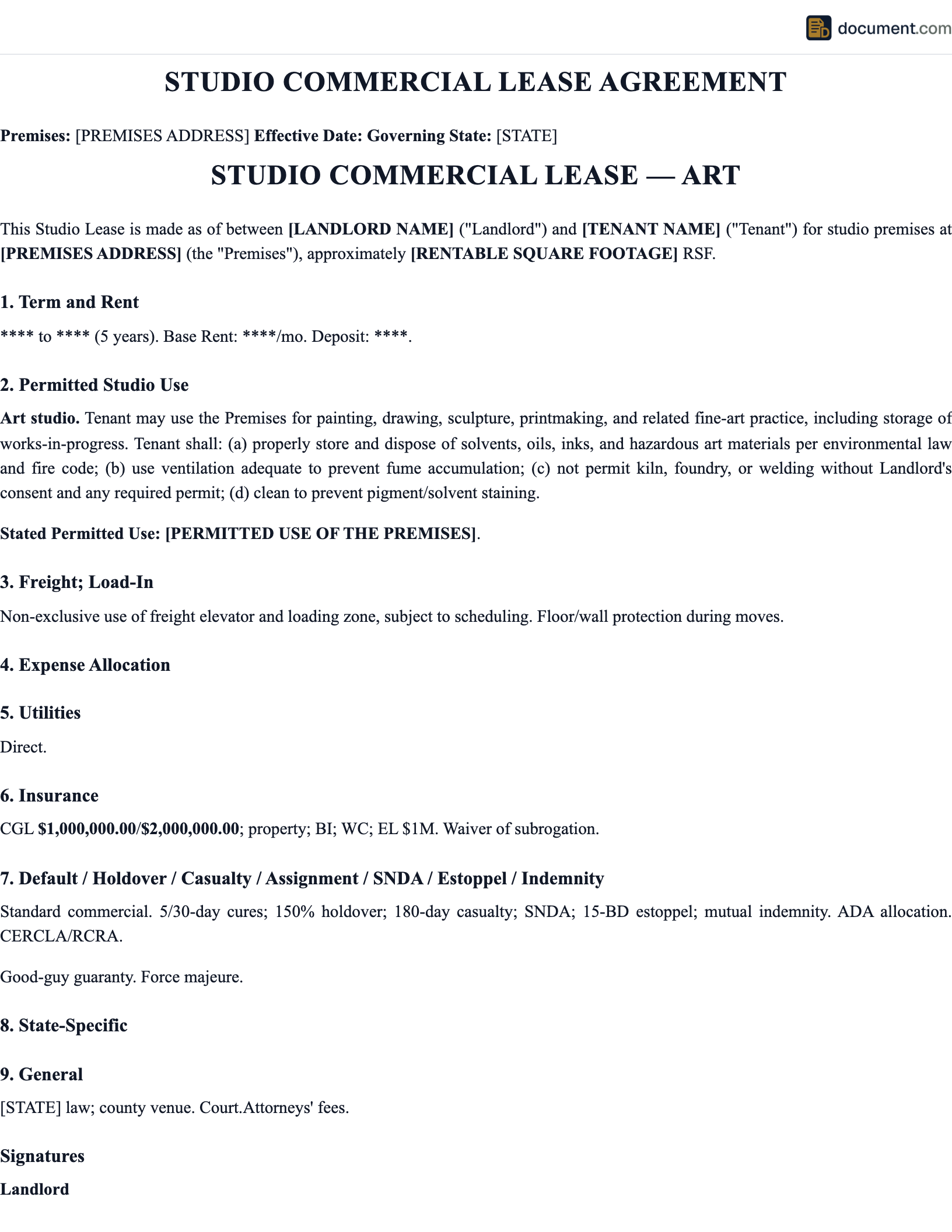
Sample New Mexico Studio Rental Agreement
Below is a preview of our New Mexico-specific template. Your customized document will include all fields and provisions required for filing in any New Mexico county.
STUDIO RENTAL AGREEMENT
STATE OF NEW MEXICO
Legal Document Template
STUDIO OWNER / OPERATOR
Company: [Studio Name]
Address: [Studio Address]
Contact: [Phone/Email]
License #: [Business License]
RENTER
Name: [Full Legal Name / Entity]
Address: [Mailing Address]
Phone: [Contact Number]
Insurance: [Policy Number]
STUDIO DETAILS
Studio: [Room Name/Number]
Size: [Square Feet]
Type: [Photo/Music/Art/Rehearsal]
Equipment: [See Inventory List]
Access Hours: [Available Hours]
RENTAL TERMS
Rate: $[Amount] per [Hour/Day/Month]
Booking: [Date/Time]
Deposit: $[Amount]
Cancellation: [Policy]
Insurance Required: [Yes - Minimum Coverage]
New Mexico Studio Rental Agreement FAQ
Answers to common questions about filing a studio rental agreement in New Mexico, including requirements, fees, and procedures.
Official New Mexico Resources
Use these official state resources to verify requirements, find your local filing office, and access government forms for New Mexico.
Related New Mexico Documents
Depending on your situation, you may need additional documents alongside your New Mexico studio rental agreement.
Create your New Mexico Commercial Studio Lease Agreement in under 5 minutes.
Answer a few questions and download a New Mexico-compliant document, ready for the state agency.