



New Jersey Studio Rental Agreement Overview
New Jersey hosts one of the most active creative studio markets on the East Coast, driven by proximity to New York City and significantly lower real estate costs. Newark's Ironbound and downtown arts districts, Jersey City's Powerhouse Arts District, Hoboken, Asbury Park, and the Millburn area all have established concentrations of photography, music, visual art, and production studios. Creative professionals in NJ can access the same New York talent pool, clients, and distribution networks while paying a fraction of Manhattan studio rates. The I-95 corridor and NJ Turnpike also give NJ studios easy access to the Philadelphia market.
Commercial studio leases in New Jersey are governed by general contract law and the terms the parties negotiate. New Jersey's security deposit statute does not apply to commercial leases; there is no cap on the deposit amount. The state has no statute mandating soundproofing standards, alteration rights, or accessibility provisions for commercial studio tenants. This means the lease document carries the full weight of defining the relationship: what modifications are permitted, who bears property tax cost increases, what electrical capacity is available, and how the deposit is handled at the end of the term. New Jersey's high commercial property tax environment is a particularly important issue for studio tenants in NNN lease structures.
No cap
Security deposit
High
Property tax burden
No
Sales tax on rent
NJ EDA
Film tax credit
New Jersey Requirements for Studio Leases
New Jersey studio leases for creative professionals have no state-mandated provisions specific to studio use. Zoning approval from the local municipality, careful negotiation of alteration rights, and explicit soundproofing and electrical capacity provisions are especially important given the technical demands of creative studio work.
New Jersey Studio Lease Note
New Jersey commercial leases have no statutory deposit cap (the residential statute does not apply). Property taxes in NJ are among the highest in the country and pass through to NNN studio tenants as a significant cost. Sales tax does not apply to commercial studio rent. Zoning approval requirements vary by the 565 individual NJ municipalities; verify before signing. Film and production tax credits may be available through the NJ Economic Development Authority.
Key Provisions for New Jersey Studio Leases
- Zoning and permitted use: Verify with the local municipal zoning office that the studio use type is permitted in the building's zone before signing; NJ's 565 municipalities each have their own zoning codes
- Property tax passthrough structure: Analyze the current property tax bill and assessed value; negotiate a base-year comparison rather than full NNN property tax exposure to limit cost escalation risk
- Clear ceiling height: Document usable ceiling height after ductwork, sprinklers, and utilities are accounted for; photography studios typically need 12 to 16 feet minimum, and production studios benefit from 18 feet or more
- Alteration and soundproofing rights: Negotiate explicit written permission to install acoustic panels, floating floors, and sound isolation materials; specify whether improvements must be removed at lease end and who bears that cost
- Electrical capacity: Confirm available amperage and panel capacity; older NJ industrial buildings may have insufficient electrical infrastructure for professional lighting, recording, or fabrication equipment without upgrades
- ADA and NJ LAD compliance: Allocate responsibility for ADA and New Jersey Law Against Discrimination accessibility compliance within the leased space; studios open to the public must ensure accessibility
How to Execute a Studio Lease in New Jersey
Securing a studio lease in New Jersey involves property-specific diligence around zoning, property taxes, and building systems that are especially important for creative tenants with specific technical requirements.
Verify Zoning with the Local Municipality
Contact the zoning or planning office of the specific NJ municipality before visiting properties. In Jersey City, this is the Division of Zoning. In Newark, the Department of Engineering and Inspections. In Asbury Park, the Planning and Zoning Board. Confirm that your specific studio use type (photography, music, fabrication, etc.) is permitted by right or whether it requires a conditional use permit or variance, which can take months to obtain.
Inspect the Physical Space Thoroughly
Measure usable ceiling height accounting for all ductwork and sprinklers. Test electrical service and confirm available amperage. Assess soundproofing from adjacent spaces and exterior noise sources. Ask for the property's current tax bill and assessed value to calculate your projected NNN property tax cost. In older NJ warehouse or mill buildings, also check roof condition and HVAC system age; expensive repairs in NNN leases may fall to the tenant.
Negotiate the Lease Terms
Submit a letter of intent addressing base rent, lease term, TI allowance, deposit, property tax structure (base year vs full NNN), alteration rights for soundproofing and electrical upgrades, ADA and NJ LAD allocation, and sublease or assignment rights. For sound-generating uses, negotiate explicit soundproofing permission and specify that the landlord will not restrict your use based on neighbor noise complaints if you are operating within permitted decibel levels.
Pull Required Permits
Any structural modifications, electrical upgrades, or permanent acoustic installations require building permits from the local municipal building department. In Newark, this is the Office of Construction Code. In Jersey City, the Division of Building. Work with the landlord to confirm the permit process and whether tenant improvements require a landlord co-application. Start the permit process only after the landlord has signed off on your improvement plan in writing.
Document Premises Condition at Move-In
Photograph every surface, document all existing damage, and note the condition of all building systems at move-in. Create a written move-in report signed by both parties. This documentation is essential for protecting your deposit at lease end and for establishing the baseline condition before any studio improvements are installed. In New Jersey, disputes over security deposits in commercial leases are resolved by the lease terms, not by statute.
Tax Implications for New Jersey Studio Tenants
New Jersey's tax environment presents a mixed picture for creative professionals: no sales tax on studio rent, but high property taxes that reach tenants through NNN lease structures, and significant state income tax rates on business income.
| Tax / Cost Item | New Jersey Treatment |
|---|---|
| State Income Tax on Creative Income | New Jersey has a graduated income tax with rates from 1.4% to 10.75%. Photography, music, illustration, and other creative professional income earned in NJ is subject to NJ gross income tax at the applicable rate. |
| Sales Tax on Studio Rent | None. New Jersey does not impose sales tax on commercial studio rent. Monthly rent payments to the landlord are not subject to NJ's 6.625% sales tax rate. |
| Property Tax Passthrough | New Jersey has among the highest commercial property taxes in the country. In Hudson, Essex, and Bergen counties, NNN studio tenants may see property tax passthroughs add $10 to $25 per RSF per year. Analyze the current assessed value and tax bill before signing any NNN studio lease in NJ. |
| Studio Rent Deductibility | Studio rent paid by a business is fully deductible against New Jersey Corporation Business Tax (9%) and federal income tax as an ordinary and necessary business expense. This deduction meaningfully reduces the after-tax cost of studio space. |
| Film and Production Tax Credits | The New Jersey Economic Development Authority administers film and digital media tax credits for qualifying production activity in NJ. Credits of 30 to 35% of qualified costs may be available and are transferable. Studio tenants doing film, television, or digital production work should check current eligibility with the NJ EDA. |
| Equipment Purchases | New Jersey's 6.625% sales tax applies to tangible personal property including studio equipment purchased in NJ. Equipment used exclusively in production of taxable services may qualify for exemptions; consult a NJ tax advisor on applicable exemptions for your specific equipment and use. |
Sample New Jersey Studio Rental Agreement
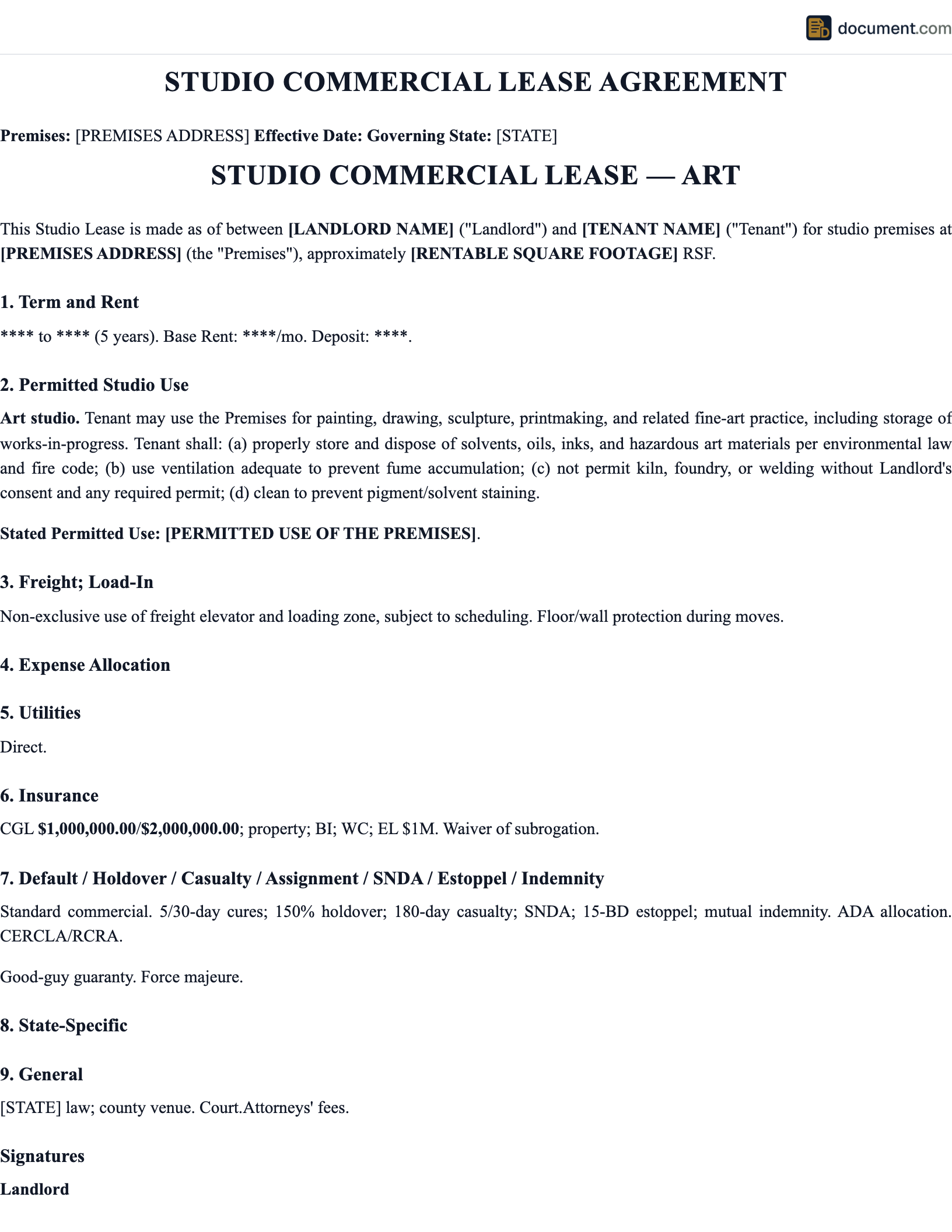
Below is a preview of our New Jersey-specific template. Your customized document will include all fields and provisions required for filing in any New Jersey county.
STUDIO RENTAL AGREEMENT
STATE OF NEW JERSEY
Legal Document Template
STUDIO OWNER / OPERATOR
Company: [Studio Name]
Address: [Studio Address]
Contact: [Phone/Email]
License #: [Business License]
RENTER
Name: [Full Legal Name / Entity]
Address: [Mailing Address]
Phone: [Contact Number]
Insurance: [Policy Number]
STUDIO DETAILS
Studio: [Room Name/Number]
Size: [Square Feet]
Type: [Photo/Music/Art/Rehearsal]
Equipment: [See Inventory List]
Access Hours: [Available Hours]
RENTAL TERMS
Rate: $[Amount] per [Hour/Day/Month]
Booking: [Date/Time]
Deposit: $[Amount]
Cancellation: [Policy]
Insurance Required: [Yes - Minimum Coverage]
New Jersey Studio Rental Agreement FAQ
Answers to common questions about filing a studio rental agreement in New Jersey, including requirements, fees, and procedures.
Official New Jersey Resources
Use these official state resources to verify requirements, find your local filing office, and access government forms for New Jersey.
Related New Jersey Documents
Depending on your situation, you may need additional documents alongside your New Jersey studio rental agreement.
Create your New Jersey Commercial Studio Lease Agreement in under 5 minutes.
Answer a few questions and download a New Jersey-compliant document, ready for the state agency.