



New Hampshire Studio Rental Agreement Overview
New Hampshire has a small but growing creative economy anchored by Portsmouth's Seacoast arts district and Manchester's Millyard, where former textile mill buildings have been repurposed into flexible creative and industrial spaces. Artists, photographers, musicians, and fabricators in New Hampshire benefit from the same structural tax advantages that attract businesses to the state: no personal income tax on wages, no general sales tax, and studio rent that is dramatically lower than comparable space in Boston, Providence, or New York. The result is a market where creative professionals can lease functional studio space at rates that would be impossible in larger coastal cities.
Commercial studio leases in New Hampshire are governed by general contract law and the terms the parties negotiate. No statute sets a floor or ceiling on security deposits, restricts alteration rights, or mandates specific disclosures for commercial tenants. This means the studio lease document itself defines the entire relationship: what modifications are permitted, who is responsible for heating and HVAC systems, what soundproofing obligations exist, and how the deposit is handled at the end of the term. Artists and creative professionals should review every provision carefully, particularly those governing alterations, since sound isolation, electrical upgrades, and structural modifications are often necessary for creative work and expensive to reverse.
None
Income tax
None
Sales tax on rent
No cap
Security deposit
RSA 477
Governing statute
New Hampshire Requirements for Studio Leases
New Hampshire studio leases for artists and creative professionals have no state-mandated provisions specific to the studio use type. Every material term is negotiated and the lease document controls. Creative tenants need to be particularly attentive to alteration rights, electrical capacity, zoning compliance, and soundproofing obligations.
New Hampshire Studio Lease Note
New Hampshire has no personal income tax and no general sales tax, so studio rent is not taxed at the state level. There is no cap on commercial security deposits. Municipal zoning controls whether studio or live-work uses are permitted; verify zoning before signing. Heating costs can be substantial in NH winters; confirm whether heat is included in rent or passed through separately.
Key Provisions for New Hampshire Studio Leases
- Zoning verification: Confirm that the studio use type (photography, music, fabrication, visual art) is permitted in the property's zone with the local planning or building department before signing
- Clear ceiling height: Document the clear usable ceiling height after all utilities, ductwork, and structural elements; 12 to 14 feet is typical for photography, 14 to 20 feet for larger visual or fabrication studios
- Electrical capacity: Confirm available amperage and panel capacity; photography studios with multiple strobes, recording studios with power conditioning equipment, and fabrication studios all have above-average electrical demand
- Alteration and soundproofing rights: Negotiate explicit permission to install sound isolation materials, acoustic panels, floating floors, or other studio-specific improvements; specify at lease end whether they must be removed or can remain
- Heating cost allocation: Confirm whether heating is included in base rent or passed through separately; NH winters make this a material cost item, particularly in large-volume spaces like mill buildings or warehouses
- ADA obligations: Specify who is responsible for ADA compliance within the leased space; for studios open to clients or the public, ensure the lease addresses accessibility upgrades and allocates responsibility for any required improvements
How to Execute a Studio Lease in New Hampshire
Securing a studio lease in New Hampshire involves the same steps as any commercial lease, but with added attention to zoning, building systems, and alteration rights that are uniquely important for creative uses.
Verify Zoning and Permitted Use
Contact the local planning or building department before visiting properties. In Portsmouth, verify with the Planning Division whether your studio type is permitted by right or requires a conditional use permit. In Manchester, the Building and Zoning Division handles this. For smaller NH municipalities, zoning boards can be slower, so start early.
Inspect the Physical Space
Measure usable ceiling height (account for ductwork and utilities), test available electrical amperage, check the heating system type and efficiency, and assess soundproofing from adjacent spaces. In older NH mill buildings, assess window quality for heat loss. Ask the landlord for at least two years of utility expense history if heating is separately metered or allocated by square footage.
Negotiate the Lease Terms
Submit a letter of intent establishing base rent, term length, deposit amount, TI allowance or improvement rights, and any specific provisions important to your work type. For soundproofing, negotiate explicit permission to install isolation materials and specify whether they must be removed at lease end. Address heating cost allocation, ADA responsibility, and sublease or assignment rights if your business may grow.
Pull Required Permits
Any structural modifications, electrical panel upgrades, or permanent soundproofing installations require permits from the local building department. In Manchester, permits are issued by the Building Inspection Division. In Portsmouth, the Code Enforcement Division handles permits. Starting permit work before the landlord approves the improvement plan can create problems; get written approval first, then apply for permits.
Document Premises Condition at Move-In
Photograph every wall, ceiling, floor, and utility panel at move-in. Note any existing damage, water stains, or building defects in writing and confirm with the landlord. This documentation protects your deposit at the end of the lease and establishes the baseline condition before any studio improvements are installed.
Tax Implications for New Hampshire Studio Tenants
New Hampshire's tax structure is highly favorable for creative professionals. Understanding the specific tax items that apply and those that do not affects how you budget total studio occupancy costs.
| Tax / Cost Item | New Hampshire Treatment |
|---|---|
| State Income Tax on Creative Income | None. New Hampshire has no personal income tax on wages or self-employment income. Photography, music, illustration, and other creative income earned in NH is not subject to state income tax. |
| Sales Tax on Studio Rent | None. New Hampshire has no general sales tax, so monthly studio rent payments are not subject to any state or local sales tax. |
| Property Tax Passthrough | New Hampshire municipalities levy some of the highest property taxes in New England. In NNN or modified-gross studio leases, property tax increases can pass through to tenants as operating expenses. Negotiate a cap on property tax expense increases in the lease. |
| Studio Rent Deductibility | Studio rent paid for a commercial space used exclusively for business is fully deductible as an ordinary and necessary business expense for federal income tax purposes. Home studio deductions follow different rules. |
| Equipment Purchases | New Hampshire has no general sales tax on equipment purchased within the state. Out-of-state purchases may be subject to a use tax obligation, though NH imposes no general sales tax on in-state purchases. |
| Business Profits Tax | Applies at 8.5% on net income for businesses with more than $50,000 in gross income. Studio rent is fully deductible against BPT liability. Sole proprietors below the threshold are not subject to BPT. |
Sample New Hampshire Studio Rental Agreement
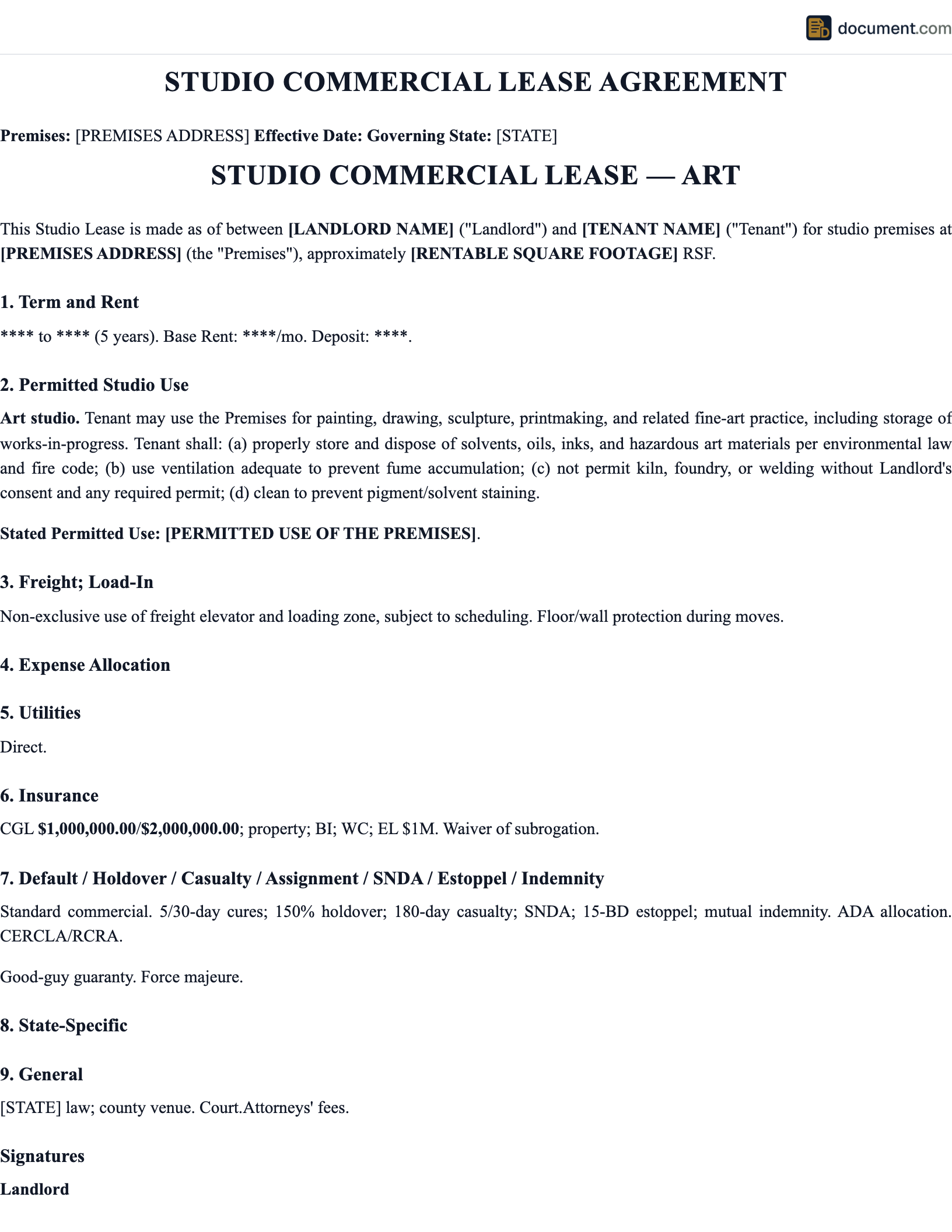
Below is a preview of our New Hampshire-specific template. Your customized document will include all fields and provisions required for filing in any New Hampshire county.
STUDIO RENTAL AGREEMENT
STATE OF NEW HAMPSHIRE
Legal Document Template
STUDIO OWNER / OPERATOR
Company: [Studio Name]
Address: [Studio Address]
Contact: [Phone/Email]
License #: [Business License]
RENTER
Name: [Full Legal Name / Entity]
Address: [Mailing Address]
Phone: [Contact Number]
Insurance: [Policy Number]
STUDIO DETAILS
Studio: [Room Name/Number]
Size: [Square Feet]
Type: [Photo/Music/Art/Rehearsal]
Equipment: [See Inventory List]
Access Hours: [Available Hours]
RENTAL TERMS
Rate: $[Amount] per [Hour/Day/Month]
Booking: [Date/Time]
Deposit: $[Amount]
Cancellation: [Policy]
Insurance Required: [Yes - Minimum Coverage]
New Hampshire Studio Rental Agreement FAQ
Answers to common questions about filing a studio rental agreement in New Hampshire, including requirements, fees, and procedures.
Official New Hampshire Resources
Use these official state resources to verify requirements, find your local filing office, and access government forms for New Hampshire.
Related New Hampshire Documents
Depending on your situation, you may need additional documents alongside your New Hampshire studio rental agreement.
Create your New Hampshire Commercial Studio Lease Agreement in under 5 minutes.
Answer a few questions and download a New Hampshire-compliant document, ready for the state agency.