



Missouri Studio Rental Agreement Overview
Missouri has two distinct creative studio markets with different supply profiles, rent levels, and community infrastructure. Kansas City's Crossroads Arts District is one of the most recognized arts districts in the Midwest — a dense concentration of galleries, studios, and maker spaces in warehouse buildings along the 19th to 21st Street corridor. The adjacent West Bottoms offers even more affordable raw industrial space with high ceilings and freight access. In St. Louis, the Cherokee Street corridor in South City and the Grand Center arts district anchor the studio market, with additional inventory in the Grove and warehouse districts along Manchester Avenue. Missouri studio rents are well below coastal markets, making both cities genuinely accessible for full-time working artists.
Missouri has no commercial tenant statute, so studio leases are governed entirely by contract law and local zoning rules. That means the written agreement is the complete legal protection for a studio tenant — what it says is what controls. Missouri does not impose sales tax on commercial real property leases, which keeps occupancy costs lower than in states like Mississippi or Arizona. The key legal framework for studio tenants is zoning — both Kansas City and St. Louis regulate creative uses through local zoning codes, and activities like public events, certain industrial processes, and live-work arrangements require specific zoning classifications. Confirm your intended use is permitted before signing.
None
Sales tax on rent
None
Deposit cap
Contract
Law governs
Crossroads
KC arts district
Missouri Requirements
Missouri commercial studio leases are governed by contract law and local zoning. The written agreement and zoning confirmation are the two essential steps before signing.
Confirm Zoning Before Signing
Kansas City and St. Louis each control zoning locally. Industrial and warehouse space popular for studio use may not permit public events, client visits, or certain production processes under the applicable zoning classification. The Kansas City Planning and Development Department and the St. Louis City Planning and Urban Design Agency can confirm whether your intended use is permitted. Do this before signing — a lease that is perfectly written will not protect you if your activities violate local zoning.
Key Provisions to Negotiate
- Permitted use specificity: Define the exact activities — media type, equipment, client visits, public events — rather than using a generic "studio" or "commercial" use clause that could create disputes later
- Alteration rights: Negotiate the right to install soundproofing, ventilation, specialized lighting, and reinforced flooring; specify whether improvements must be removed at lease end
- Electrical capacity: Confirm that circuit panel amperage and phase configuration support your equipment needs; specify that the landlord will not reduce electrical capacity during the lease term
- Public event permission: If you plan gallery openings, workshops, or client events, negotiate explicit permission and confirm the building's certificate of occupancy supports your anticipated occupancy level
- Hazardous materials: Specify permitted materials — solvents, paints, acids, resins — and confirm the space has adequate ventilation to handle them without violating the lease or fire code
- 24/7 access: Many studio tenants work irregular hours; confirm whether building access is restricted to business hours and negotiate 24/7 access if your practice requires it
How to Execute a Missouri Studio Lease
Missouri studio leases are private contracts — no government filing is required for a commercial lease to be binding. The process focuses on infrastructure verification, zoning confirmation, and negotiating the right lease terms for your practice.
Confirm Zoning with the Local Authority
Contact the Kansas City Planning and Development Department or the St. Louis City Planning and Urban Design Agency before signing. Confirm that your specific studio activities — including any industrial processes, client visits, or public events — are permitted under the applicable zoning classification for the building you are considering.
Inspect Infrastructure Before Negotiating
Assess electrical capacity, HVAC performance, ceiling height, loading access, and ventilation before you begin negotiating lease terms. In older Crossroads and Cherokee Street warehouse buildings, infrastructure limitations are common. Define in the lease which party is responsible for upgrades and what specifications apply.
Negotiate Alteration Rights and Permitted Use
Define exactly what activities are permitted and what modifications you can make without additional landlord consent. Missouri's competitive studio markets in the Crossroads and Cherokee Street give tenants negotiating room, particularly for longer lease commitments. Specify whether improvements must be removed at lease end or become the landlord's property.
Execute by Authorized Signatories
Sign as an individual or through your business entity. Verify the landlord signatory has authority to bind the property owner. Retain a fully executed copy with all attachments. Notarization is not required for a Missouri commercial lease to be enforceable.
Pull Building Permits for Approved Alterations
Any structural, electrical, or plumbing improvements in Missouri require permits from the Kansas City or St. Louis building department. Confirm with your landlord whether they pull permits for tenant improvements or whether that is the tenant's responsibility. Unpermitted work creates liability at lease end and can void your improvements' ownership status.
Tax and Cost Considerations
Missouri does not tax commercial real property leases at the state level, which is a meaningful advantage for studio tenants who often operate on creative economy budgets. The Crossroads and Cherokee Street markets offer some of the most affordable creative studio rents in the Midwest.
| Cost Item | Missouri Treatment |
|---|---|
| State sales tax on rent | Missouri does not impose sales tax on commercial real property leases — a cost advantage over states like Mississippi |
| St. Louis City earnings tax | 1% earnings tax applies to wages earned within St. Louis City limits; does not apply in Cherokee Street buildings in St. Louis City only if they are within city limits — confirm the address |
| Rent deductibility | Studio rent is generally deductible as an ordinary business expense for self-employed artists and creative businesses; retain documentation |
| Build-out depreciation | Leasehold improvements are amortized over the shorter of the lease term or the improvement's useful life; consult a tax professional for classification |
| Missouri Arts Council grants | MAC provides individual artist grants that can offset studio rent; check program availability at moartscollection.net |
Important Considerations
- Crossroads Arts District, Kansas City: One of the strongest arts districts in the Midwest with an established gallery walk and open studio tradition. Building owners in this district understand artist tenant needs and some have managed studio buildings for decades.
- Cherokee Street, St. Louis: An emerging arts and maker district with significant creative energy and some of the most affordable studio rents in the metro. The Cherokee Street corridor has active arts organizations and a monthly street fair that benefits studio businesses with street-facing visibility.
- Missouri Arts Council resources: The Missouri Arts Council at moartscollection.net offers individual artist grants and organizational support. The Regional Arts Commission in St. Louis (racstl.org) provides similar support specifically for St. Louis-based artists.
- West Bottoms, Kansas City: For artists needing raw industrial space at the lowest possible rent, the West Bottoms offers large-format warehouse space with high ceilings and freight access. Infrastructure in older West Bottoms buildings varies — inspect thoroughly before signing.
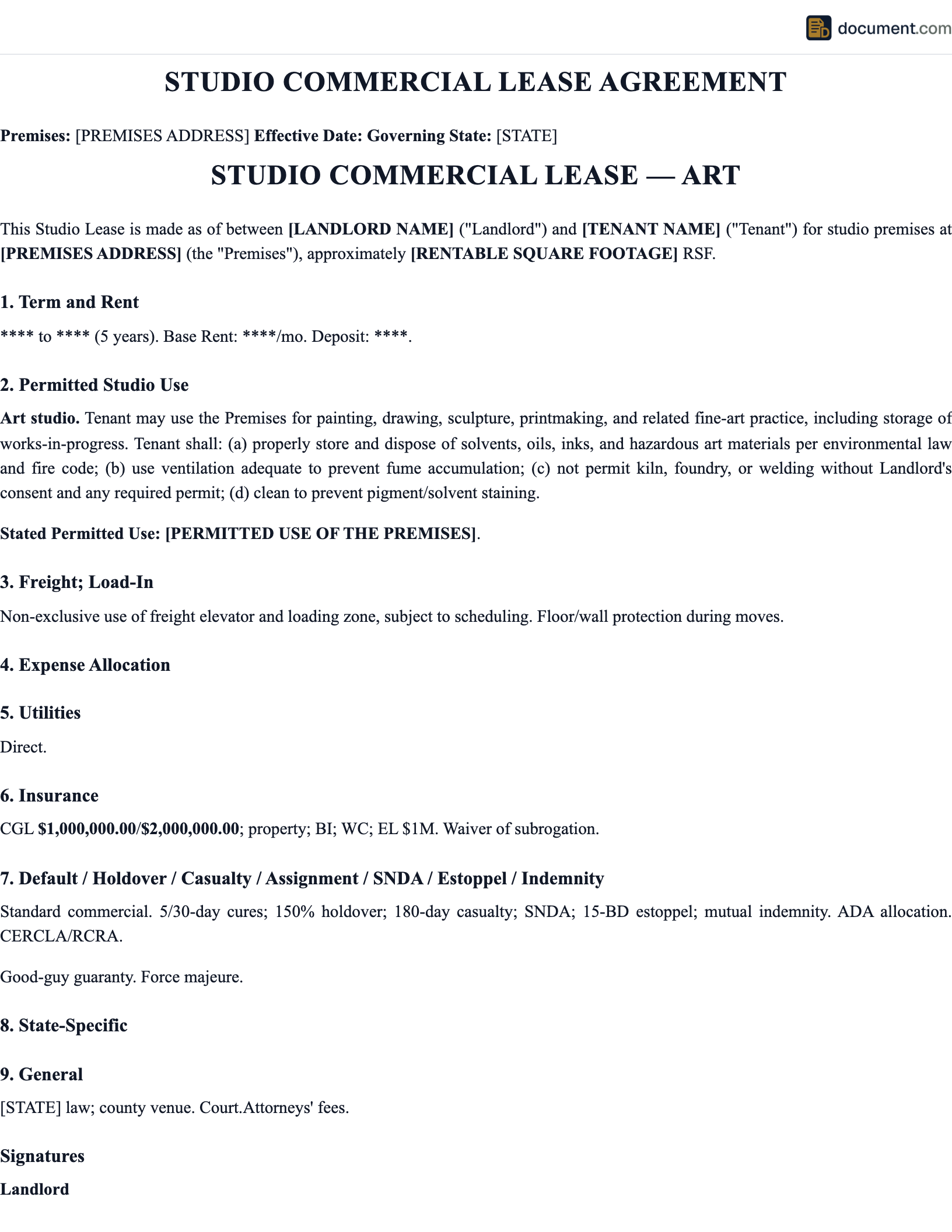
Sample Missouri Studio Rental Agreement
Below is a preview of our Missouri-specific template. Your customized document will include all fields and provisions required for filing in any Missouri county.
STUDIO RENTAL AGREEMENT
STATE OF MISSOURI
Legal Document Template
STUDIO OWNER / OPERATOR
Company: [Studio Name]
Address: [Studio Address]
Contact: [Phone/Email]
License #: [Business License]
RENTER
Name: [Full Legal Name / Entity]
Address: [Mailing Address]
Phone: [Contact Number]
Insurance: [Policy Number]
STUDIO DETAILS
Studio: [Room Name/Number]
Size: [Square Feet]
Type: [Photo/Music/Art/Rehearsal]
Equipment: [See Inventory List]
Access Hours: [Available Hours]
RENTAL TERMS
Rate: $[Amount] per [Hour/Day/Month]
Booking: [Date/Time]
Deposit: $[Amount]
Cancellation: [Policy]
Insurance Required: [Yes - Minimum Coverage]
Missouri Studio Rental Agreement FAQ
Answers to common questions about filing a studio rental agreement in Missouri, including requirements, fees, and procedures.
Official Missouri Resources
Use these official state resources to verify requirements, find your local filing office, and access government forms for Missouri.
Related Missouri Documents
Depending on your situation, you may need additional documents alongside your Missouri studio rental agreement.
Create your Missouri Commercial Studio Lease Agreement in under 5 minutes.
Answer a few questions and download a Missouri-compliant document, ready for the state agency.