



Minnesota Studio Rental Agreement Overview
Minnesota has a well-established arts community anchored in the Twin Cities, with Minneapolis's Northeast Arts District serving as the most concentrated hub of working artist studios in the state. Northeast Minneapolis warehouse and light industrial buildings have been converted to studio use over decades, creating a neighborhood where artists, fabricators, photographers, and ceramicists work in relative proximity. The Minneapolis Arts District also extends into the Warehouse District downtown, where larger loft spaces serve artists who need significant square footage at affordable rates compared to coastal arts markets.
Minnesota commercial studio leases are governed by contract law, not by any studio-specific statute. The written agreement controls who can use the space, what alterations are permitted, how utilities are allocated, and what restoration is required at the end of the lease. Minnesota's cold climate introduces genuine practical issues for studio tenants: heating costs for large-volume spaces can be substantial, HVAC obligations during winter months deserve careful attention, and the lease should address what temperature maintenance the landlord is obligated to provide. Natural light provisions are also particularly meaningful in Northeast Minneapolis's north-facing warehouse spaces, which are prized by visual artists working in natural light.
$46
Filing fee
Required
Notarization
0
Witnesses required
County
Filing office
Minnesota Requirements
Minnesota commercial studio leases are private agreements governed by contract law. No government filing is required. The statute of frauds requires a written agreement for any lease term exceeding one year, and the key legal requirements are those the parties negotiate into the document.
Minnesota Specific Note
Minnesota's cold climate creates HVAC issues for studio leases that rarely arise in warmer states. The lease should specify the landlord's obligation to maintain minimum temperatures in the space during winter months, particularly for studios in large-volume industrial or warehouse buildings where heating can be costly and inconsistent. Minneapolis zoning for the Northeast Arts District and Warehouse District includes provisions that affect what uses are permitted, what public access is allowed, and in some cases what artist certification is needed for preference in subsidized studio programs. Contact Minneapolis Community Planning and Economic Development for current zoning details.
Key Provisions for Minnesota Studio Leases
- HVAC and minimum temperature obligations: Specify the landlord's obligation to maintain minimum temperatures in the leased space during winter months, particularly if the studio is in a large-volume warehouse building with inefficient heating
- Natural light protections: Address whether the landlord can obstruct existing windows during the lease term and what notice and approval process applies to any adjacent construction
- Permitted use and public events: Specifically address whether public gallery openings, open studio events, or direct sales are included in the permitted use or require separate landlord consent and zoning verification
- Soundproofing allocation: Define who pays for soundproofing, what the tenant is permitted to install, and whether acoustic materials must be removed at lease end
- Utility metering and capacity: Confirm the electrical panel capacity and whether utilities are separately metered; studios with high electricity demand from kilns or equipment need this addressed explicitly
- Alteration and restoration rights: Define what physical modifications the tenant may make and whether those modifications must be removed at the end of the lease
How to Execute a Minnesota Studio Rental Agreement
Minnesota studio leases are private agreements. Here is how to get from a space showing to a signed, usable lease.
Confirm Zoning and Permitted Use
Contact Minneapolis Community Planning and Economic Development, the Hennepin County planning office, or the applicable municipal planning department to confirm the zoning classification and whether your intended activities are permitted at the property. Northeast Minneapolis has specific arts-related zoning provisions that differ from standard industrial classification.
Inspect the Space With Winter Conditions in Mind
Assess the building's heating system, insulation quality, and window condition. Ask the landlord or existing tenants how the space performs in January. Large warehouse spaces with inadequate insulation or aging heating systems can be difficult and expensive to maintain at working temperatures during Minnesota winters.
Negotiate HVAC, Utilities, and Alteration Rights
For a Minnesota studio, the utility allocation and landlord HVAC obligations are among the most financially significant provisions in the lease. Get specific commitments on minimum temperature maintenance, utility metering, and what improvements the tenant may make to the heating or electrical systems before signing.
Execute by Authorized Signatories
Both parties sign through individuals with authority to bind them. Minnesota commercial studio leases do not require notarization to be enforceable between the parties unless the lease will be recorded with the County Recorder, which is uncommon for standard studio arrangements.
Pull Building Permits Before Starting Work
Any structural, electrical, plumbing, or mechanical work requires a building permit from the local building official. Minneapolis building permits are obtained through Inspections Services. Work done without permits in Minnesota can result in stop-work orders, required removal, and complications at lease renewal.
Tax and Cost Considerations for Minnesota Studio Tenants
Minnesota studio tenants benefit from affordable industrial rents in Northeast Minneapolis and St. Paul, and the tax treatment follows standard commercial lease principles.
| Cost Item | Minnesota Treatment |
|---|---|
| Rent Deductibility | Studio rent paid for business creative work is deductible as an ordinary business expense under Minnesota income tax and at the federal level |
| Minnesota Sales Tax on Rent | Minnesota does not impose a general sales tax on commercial rent; some bundled services may be subject to Minnesota's 6.875% sales tax |
| Heating Costs | For large-volume studio spaces with separate utility metering, winter heating costs in Minnesota can be substantial; budget accordingly and deduct as a business expense |
| Build-Out Cost Treatment | Tenant-funded improvements may be depreciable as leasehold improvements; consult a tax advisor on treatment, particularly for soundproofing, HVAC upgrades, and electrical work |
| Property Tax Passthrough | NNN studio leases in Minnesota industrial buildings may include property tax passthroughs; gross leases absorb property taxes into base rent; confirm the structure before signing |
Important Considerations for Minnesota Studio Tenants
Minnesota studio tenants face specific state and market conditions that deserve careful attention.
- Northeast Minneapolis arts community: Northeast Minneapolis has a well-organized arts community with organizations like the Northeast Minneapolis Arts Association (NEMAA) that provide resources for artists, host events including the Art-A-Whirl studio tour, and can be valuable networks for new studio tenants. Locating in the Northeast Minneapolis arts district gives tenants access to this community infrastructure.
- Minneapolis arts subsidies: The City of Minneapolis and Hennepin County have historically supported arts infrastructure through grants and subsidized studio programs. Research current programs through the Minneapolis Office of Arts, Culture and the Creative Economy before committing to market-rate space.
- Natural light as a negotiating point: In Minnesota, natural light is particularly valued because of the long winter months with reduced daylight hours. North-facing windows in warehouse buildings provide consistent indirect light year-round. Include explicit language in the lease protecting existing window configurations from landlord obstruction during the lease term.
- Gentrification pressure in Northeast Minneapolis: The Northeast Minneapolis arts district has experienced significant residential development pressure, with new apartment buildings replacing some former industrial blocks. Studio rents in desirable Northeast locations have risen with the neighborhood's increased popularity. Locking in a longer lease term at a fixed rent with defined escalation caps provides more stability than month-to-month arrangements in this market.
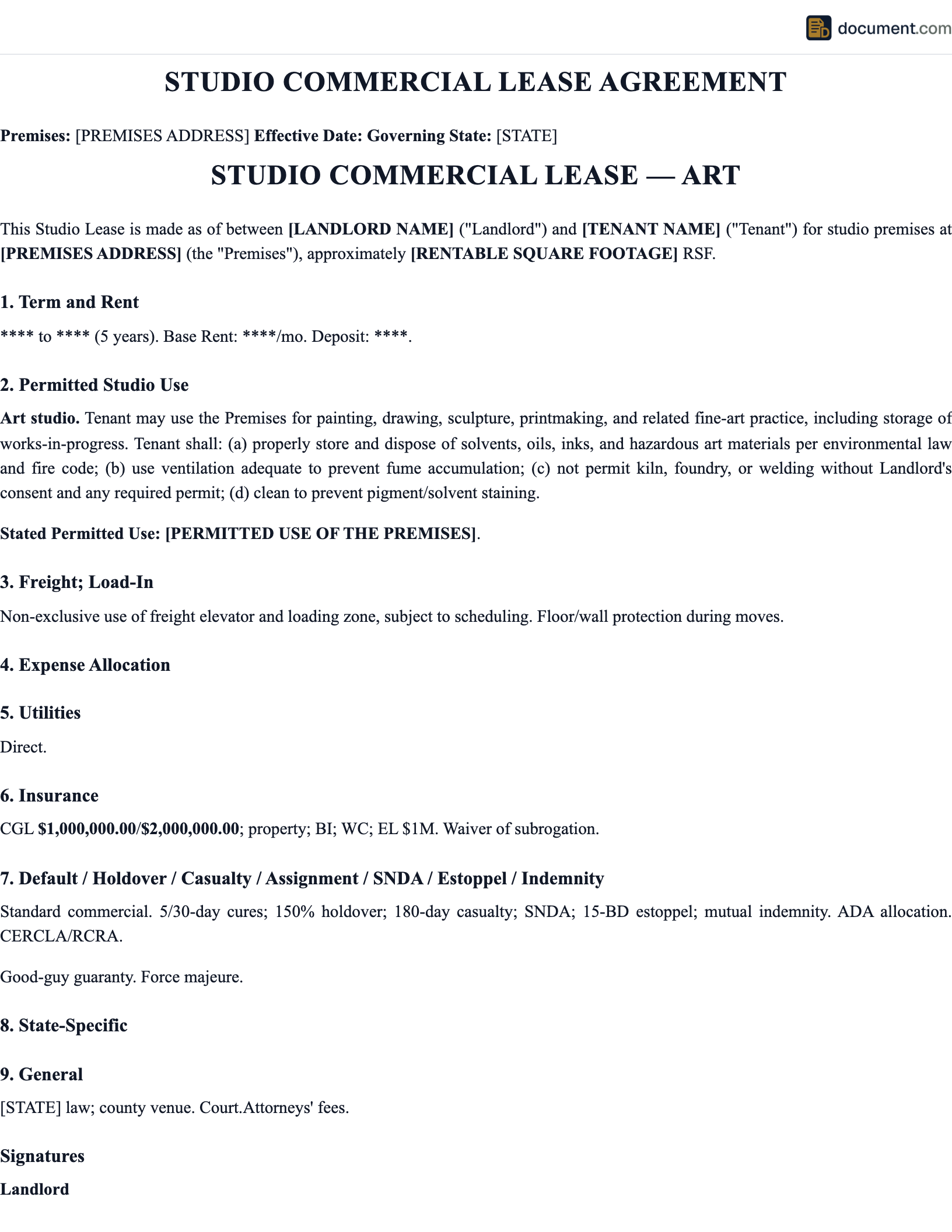
Sample Minnesota Studio Rental Agreement
Below is a preview of our Minnesota-specific template. Your customized document will include all fields and provisions required for filing in any Minnesota county.
STUDIO RENTAL AGREEMENT
STATE OF MINNESOTA
Legal Document Template
STUDIO OWNER / OPERATOR
Company: [Studio Name]
Address: [Studio Address]
Contact: [Phone/Email]
License #: [Business License]
RENTER
Name: [Full Legal Name / Entity]
Address: [Mailing Address]
Phone: [Contact Number]
Insurance: [Policy Number]
STUDIO DETAILS
Studio: [Room Name/Number]
Size: [Square Feet]
Type: [Photo/Music/Art/Rehearsal]
Equipment: [See Inventory List]
Access Hours: [Available Hours]
RENTAL TERMS
Rate: $[Amount] per [Hour/Day/Month]
Booking: [Date/Time]
Deposit: $[Amount]
Cancellation: [Policy]
Insurance Required: [Yes - Minimum Coverage]
Minnesota Studio Rental Agreement FAQ
Answers to common questions about filing a studio rental agreement in Minnesota, including requirements, fees, and procedures.
Official Minnesota Resources
Use these official state resources to verify requirements, find your local filing office, and access government forms for Minnesota.
Related Minnesota Documents
Depending on your situation, you may need additional documents alongside your Minnesota studio rental agreement.
Create your Minnesota Commercial Studio Lease Agreement in under 5 minutes.
Answer a few questions and download a Minnesota-compliant document, ready for the state agency.