



Michigan Studio Rental Agreement Overview
Michigan offers some of the most compelling opportunities for artist studio tenants in the country, primarily because of its abundant former industrial building stock and its relatively affordable commercial rents outside the immediate Detroit downtown core. Detroit, Hamtramck, and Pontiac have all seen significant industrial-to-creative conversion activity, with artists and small manufacturers moving into buildings that once served the auto industry. The physical characteristics of these buildings, including 16 to 24-foot ceilings, heavy floor loads, large freight elevators, and industrial electrical service, align naturally with the needs of sculptors, metalworkers, ceramicists, and fabricators who require serious infrastructure.
Michigan commercial studio leases are governed by contract law, not by any studio-specific statute. The written agreement determines what the tenant can do in the space, who bears utility costs, what alterations are permitted, and what restoration the tenant owes at the end of the lease. Michigan's Part 201 environmental remediation program is a distinct consideration for studio tenants in former industrial buildings: the lease should include a landlord representation about the absence of known contamination, and tenants who work with chemicals or hazardous materials should confirm that their operations comply with Michigan EGLE requirements for hazardous waste management.
$15
Filing fee
Required
Notarization
0
Witnesses required
Register
Filing office
Michigan Requirements
Michigan commercial studio leases are private contracts. No government filing is required for the lease to be enforceable. The statute of frauds requires a written agreement for any lease exceeding one year, but the key legal requirements are those the parties negotiate into the document.
Michigan Specific Note
Michigan's Part 201 Environmental Remediation statute gives EGLE authority to require cleanup of contaminated sites. Studio tenants in former industrial buildings should ask the landlord whether the property has been assessed under Part 201 and request copies of any existing Phase I or Phase II environmental assessments. Artists who work with chemicals, solvents, or other regulated materials must also understand their own obligations as potential small-quantity generators of hazardous waste under Michigan environmental law.
Key Provisions for Michigan Studio Leases
- Permitted use specificity: Define exactly what artistic activities are permitted, including fabrication methods, materials stored, and whether the space can be used for events or direct sales
- Environmental representations: Request a landlord representation that no known contamination exists at the property; attach any available Phase I or Phase II assessment as an exhibit
- Alteration and build-out rights: Define what physical modifications the tenant may make, including soundproofing, electrical upgrades, and ventilation improvements; specify whether these improvements revert to the landlord at lease end
- Electrical capacity and metering: For studios with high electricity demand, confirm the panel amperage and metering arrangement; negotiate a landlord obligation to upgrade service if existing capacity is insufficient
- Hazardous materials use: If your practice involves regulated materials, include an express landlord consent provision and confirm that local zoning and fire code permit storage of those materials at the property
- Zoning and permitted use confirmation: Verify that the municipality's zoning classification permits your studio use, including any public events or sales you plan to conduct on-site
How to Execute a Michigan Studio Rental Agreement
Michigan studio leases are private agreements. Here is how to get from finding a space to a signed, usable lease.
Inspect Physical Infrastructure Thoroughly
Michigan industrial conversions vary dramatically in their condition. Before negotiating terms, check ceiling height, floor load ratings, electrical panel capacity, ventilation systems, plumbing, and evidence of roof leaks or foundation issues. Former auto industry buildings may have floor drains, sumps, or below-slab infrastructure that can create complications for studio use.
Confirm Zoning and Fire Code Compliance
Contact the local planning and building department to confirm that studio use is permitted at the property's zoning classification and that the building has a valid certificate of occupancy for commercial use. Detroit, Hamtramck, and Pontiac each have their own zoning ordinances and building departments with separate procedures.
Negotiate a Comprehensive Lease
Michigan studio landlords, particularly in the recovering Detroit market, are often small investors who use informal lease forms. Insist on a written lease that covers permitted use, utility allocation, alteration rights, holdover terms, and the landlord's right to enter the space. A comprehensive lease protects both parties from misunderstandings that are common in informal industrial arrangements.
Execute with Proper Authority
Both parties sign through individuals authorized to bind them. Michigan commercial studio leases do not require notarization to be enforceable between the parties, though notarization is required if the lease will be recorded with the county Register of Deeds. Recording is uncommon for standard studio arrangements.
Pull Building Permits Before Starting Any Work
Any structural, electrical, plumbing, or mechanical work in a Michigan commercial space requires a building permit from the local building department. Work done without a permit in Michigan can result in orders to remove the work, fines, and difficulty selling or refinancing the building.
Tax and Cost Considerations for Michigan Studio Tenants
Michigan studio tenants benefit from some of the most affordable industrial rents in the Midwest, and the tax treatment of studio costs follows standard commercial lease principles.
| Cost Item | Michigan Treatment |
|---|---|
| Rent Deductibility | Studio rent paid for business purposes is deductible as an ordinary business expense at both the federal and Michigan Corporate Income Tax levels |
| Michigan Sales Tax on Rent | Michigan does not impose sales tax on commercial rent payments; studio rent itself is not subject to Michigan's 6% sales tax |
| Property Tax Passthrough | Triple-net studio leases in Michigan industrial buildings may include property tax passthroughs; gross leases absorb taxes into the base rent; confirm the structure before signing |
| Build-Out Cost Treatment | Tenant-funded improvements to studio infrastructure may be depreciable as leasehold improvements; consult a tax advisor on whether improvements revert to the landlord at lease end and how that affects depreciation |
| Michigan EGLE Compliance Costs | Artists generating hazardous waste above small-quantity generator thresholds face Michigan EGLE registration and disposal requirements; compliance costs vary by material type and volume |
Important Considerations for Michigan Studio Tenants
Michigan studio tenants should be aware of several state-specific issues that rarely arise in other markets.
- Detroit arts community resources: The Detroit Creative Corridor Center and organizations like the Knight Foundation have historically supported Detroit-area artists, and some programs provide subsidized studio space or development grants for artists working in the city. Research available programs through the City of Detroit's Office of Arts, Culture and Entrepreneurship before committing to market-rate space.
- Environmental history due diligence: The EGLE Remediation and Redevelopment Division maintains a public database of contaminated sites in Michigan. Before signing any industrial studio lease in Michigan, search this database for the property address and any adjacent parcels. Former auto plants, metal plating operations, and dry cleaning facilities are common sources of soil and groundwater contamination in Detroit-area industrial neighborhoods.
- Landlord stability in recovering markets: Some Detroit-area industrial property owners are individual investors who acquired buildings during the city's distress period. A building owner who is highly leveraged or facing tax delinquency may have difficulty maintaining the property or could lose the building to foreclosure during your lease term. Review the building's tax status with the Wayne County Treasurer's website before committing to a long-term lease.
- Live-work zoning in Michigan: Michigan municipalities vary considerably on whether live-work occupancy is permitted in commercially or industrially zoned buildings. Detroit has explored artist live-work designations in certain areas, but overnight occupancy in a standard commercial industrial space is generally not permitted without specific zoning approval. Confirm local ordinance rules before assuming a studio can serve as a residence.
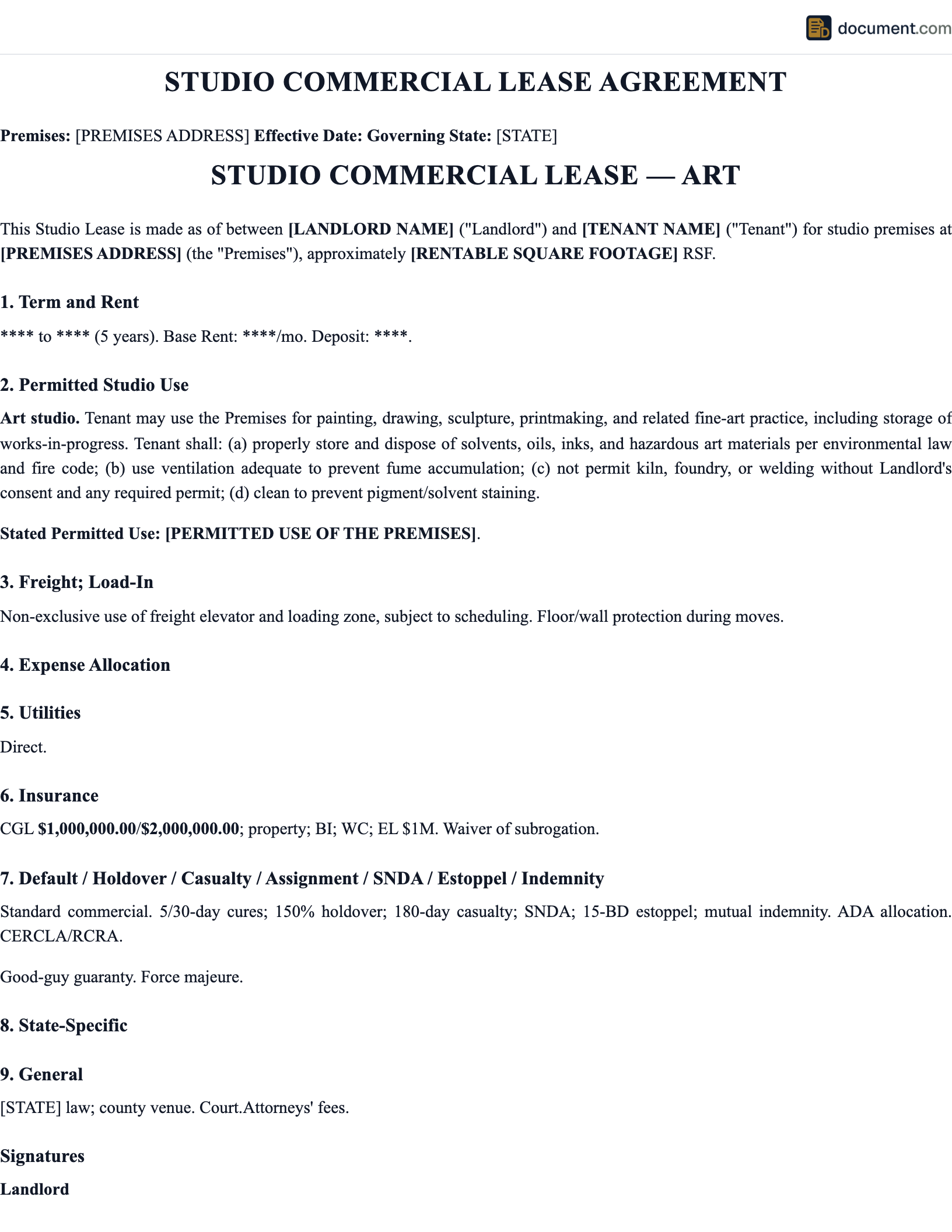
Sample Michigan Studio Rental Agreement
Below is a preview of our Michigan-specific template. Your customized document will include all fields and provisions required for filing in any Michigan county.
STUDIO RENTAL AGREEMENT
STATE OF MICHIGAN
Legal Document Template
STUDIO OWNER / OPERATOR
Company: [Studio Name]
Address: [Studio Address]
Contact: [Phone/Email]
License #: [Business License]
RENTER
Name: [Full Legal Name / Entity]
Address: [Mailing Address]
Phone: [Contact Number]
Insurance: [Policy Number]
STUDIO DETAILS
Studio: [Room Name/Number]
Size: [Square Feet]
Type: [Photo/Music/Art/Rehearsal]
Equipment: [See Inventory List]
Access Hours: [Available Hours]
RENTAL TERMS
Rate: $[Amount] per [Hour/Day/Month]
Booking: [Date/Time]
Deposit: $[Amount]
Cancellation: [Policy]
Insurance Required: [Yes - Minimum Coverage]
Michigan Studio Rental Agreement FAQ
Answers to common questions about filing a studio rental agreement in Michigan, including requirements, fees, and procedures.
Official Michigan Resources
Use these official state resources to verify requirements, find your local filing office, and access government forms for Michigan.
Related Michigan Documents
Depending on your situation, you may need additional documents alongside your Michigan studio rental agreement.
Create your Michigan Commercial Studio Lease Agreement in under 5 minutes.
Answer a few questions and download a Michigan-compliant document, ready for the state agency.