



Massachusetts Studio Rental Agreement Overview
Massachusetts has a deep tradition of artist communities, and Boston in particular offers some of the most distinctive studio spaces in the Northeast. The Fort Point Channel neighborhood, the SoWa district in the South End, and former textile mill conversions in the Merrimack Valley have all become home to working artists who rely on commercial studio leases to protect their access to these unique spaces. What makes Massachusetts studio leasing distinctive is the intersection of historic building stock, a city arts certification program in Boston, and industrial zoning overlays that affect what uses are permitted and what improvements require regulatory approval.
Commercial studio leases in Massachusetts are governed by contract law, not by any studio-specific statute. The written lease determines who controls the space, what modifications are allowed, how utilities are allocated, and what happens when a tenant wants to share the space with collaborators. Massachusetts's strong attorney-review culture applies here as it does to all commercial leases: landlords with desirable studio inventory present their own forms, and tenants who accept them without review may end up bound to unfavorable terms on soundproofing, restoration obligations, and holdover rates. The good news is that studio rents in Massachusetts outside of the immediate Boston core remain affordable compared to coastal cities, and landlords who want stable tenants often show genuine flexibility on lease terms.
$75
Filing fee
Required
Notarization
0
Witnesses required
Registry
Filing office
Massachusetts Requirements
A Massachusetts commercial studio lease is governed by contract law and by the terms the parties negotiate. No studio-specific statutes apply, but several practical issues require careful attention in the written agreement.
Massachusetts Specific Note
Tenants in Boston and Cambridge studio buildings should verify that the intended use is permitted under the applicable zoning ordinance. Boston's Zoning Code includes arts district provisions and artist live-work designations in certain neighborhoods, but those designations do not automatically apply to every studio building. Any physical modifications to the studio, including soundproofing, ventilation upgrades, or electrical panel changes, require a building permit and must comply with 780 CMR, the Massachusetts State Building Code.
Key Provisions for Massachusetts Studio Leases
- Permitted use clause: Be specific about what activities are allowed. A clause that says "artist studio" may be interpreted narrowly; specify whether fabrication, firing kilns, recording, or live performance is included in the permitted use
- Alteration rights and restoration: Define what improvements the tenant may make, whether a landlord consent process applies, and whether alterations must be removed at the end of the lease; studios often require significant physical customization that may not be removable without cost
- Soundproofing allocation: State clearly whether landlord or tenant bears the cost of any acoustic treatment and whether that treatment becomes the landlord's property at lease end
- Utility metering and capacity: Confirm whether the space has its own electrical meter and whether the panel amperage supports the tenant's equipment; negotiate a landlord obligation to upgrade electrical service if needed
- Window and light protections: Specify whether the landlord can block existing windows or construct improvements adjacent to the space that reduce natural light; include notice and approval requirements for any such changes
- Hazardous materials disclosure: Artists working with solvents, resins, or other chemicals must confirm that the space's ventilation system is adequate and that the lease permits storage of those materials; Massachusetts environmental regulations apply to commercial tenants that generate regulated waste
How to Execute a Massachusetts Studio Rental Agreement
Studio rental agreements in Massachusetts are not filed with any government office; they are private contracts between the tenant and landlord. Here is how to get from a space showing to a signed lease.
Confirm Zoning and Permitted Use
Before negotiating any terms, verify that the municipality's zoning allows your intended studio activities at the property. In Boston, contact the Inspectional Services Department. In Cambridge, contact the Inspectional Services Division. Some studio uses require a special permit or variance even in industrially zoned areas.
Inspect the Space Thoroughly
Check ceiling height, window placement and condition, electrical panel capacity, existing ventilation, floor load rating, and any signs of water intrusion. Historic Massachusetts mill buildings often have beautiful bones but infrastructure that requires significant investment to make functional for studio use.
Negotiate the Alteration and Improvement Terms
Define what work the tenant will do, who pays for it, and what survives at the end of the lease. A landlord who wants a long-term stable tenant may offer a tenant improvement allowance for soundproofing, ventilation, or electrical upgrades. Get any such commitment in writing as part of the lease or as an attached work letter.
Sign with Authorized Authority
Both parties must sign through individuals with authority to bind themselves or their entities. Massachusetts commercial studio leases do not require notarization to be enforceable between the parties unless the lease will be recorded with the Registry of Deeds, which is uncommon for standard studio arrangements.
Pull Required Building Permits Before Starting Work
Any structural, electrical, plumbing, or mechanical work in a Massachusetts commercial space requires a building permit from the local Inspectional Services Department. Work done without permits can result in fines, required removal, and problems at lease renewal or sale of the building.
Tax and Cost Considerations for Massachusetts Studio Tenants
Studio rent in Massachusetts is treated as a deductible business expense, and the cost structure differs meaningfully from traditional office leases.
| Cost Item | Massachusetts Treatment |
|---|---|
| Rent Deductibility | Studio rent paid for business creative work is deductible as a business expense at the federal and Massachusetts state level; confirm allocation if the space is also used for personal creative work |
| Massachusetts Sales Tax | Massachusetts does not impose a sales tax on commercial rent; however, if the studio agreement bundles taxable services such as equipment rentals, those components may be subject to Massachusetts sales tax at 6.25% |
| Utility Cost Structure | Separately metered spaces allow tenants to control and deduct actual utility costs; pro-rata utility sharing arrangements should be documented in the lease to avoid disputes |
| Build-Out Cost Treatment | Tenant-funded improvements to the studio may be depreciable as leasehold improvements under IRS rules; consult a tax advisor on depreciation schedules, particularly for soundproofing and electrical work |
| Property Tax Passthrough | NNN studio leases may include a property tax passthrough; gross leases in Massachusetts industrial buildings typically absorb property tax into the base rent with no separate passthrough |
Important Considerations for Massachusetts Studio Tenants
Massachusetts studio tenants face some issues that are specific to this state's building stock and regulatory environment.
- Boston artist certification: Boston's Mayor's Office of Arts and Culture operates an artist certification program. Certified artists may qualify for preference in subsidized studio programs and some city grant programs. Certification requires demonstrating professional artistic practice and is reviewed periodically.
- Live-work zoning limitations: Massachusetts municipalities vary significantly in whether they permit live-work occupancy in commercially or industrially zoned studio spaces. Some Boston neighborhoods permit it under an artist live-work overlay; others prohibit overnight occupancy in commercial zones entirely. Confirm occupancy rules before assuming a studio can also serve as a residence.
- Massachusetts environmental regulations: Artists working with hazardous materials, including solvents, acids, photo chemicals, or ceramic glazes, may be subject to Massachusetts DEP regulations for small quantity generators of hazardous waste. The lease should confirm that the landlord is aware of and consents to the storage and disposal of materials related to the tenant's practice.
- Historic designation impact: A studio in a Massachusetts Historic Landmark or locally designated historic district building may require approval from the Massachusetts Historical Commission or a local historic district commission for any exterior changes, including signage and window modifications. This process takes time and has uncertain outcomes; factor it into your planning timeline.
- Gentrification pressure in key neighborhoods: Studio districts in Boston's South End, Fort Point, and Somerville have experienced significant rent pressure as residential development moves into former industrial areas. If market-rate rents are your primary concern, locking in a longer lease term at a fixed rent with defined escalation caps provides more protection than month-to-month arrangements in these neighborhoods.
Sample Massachusetts Studio Rental Agreement
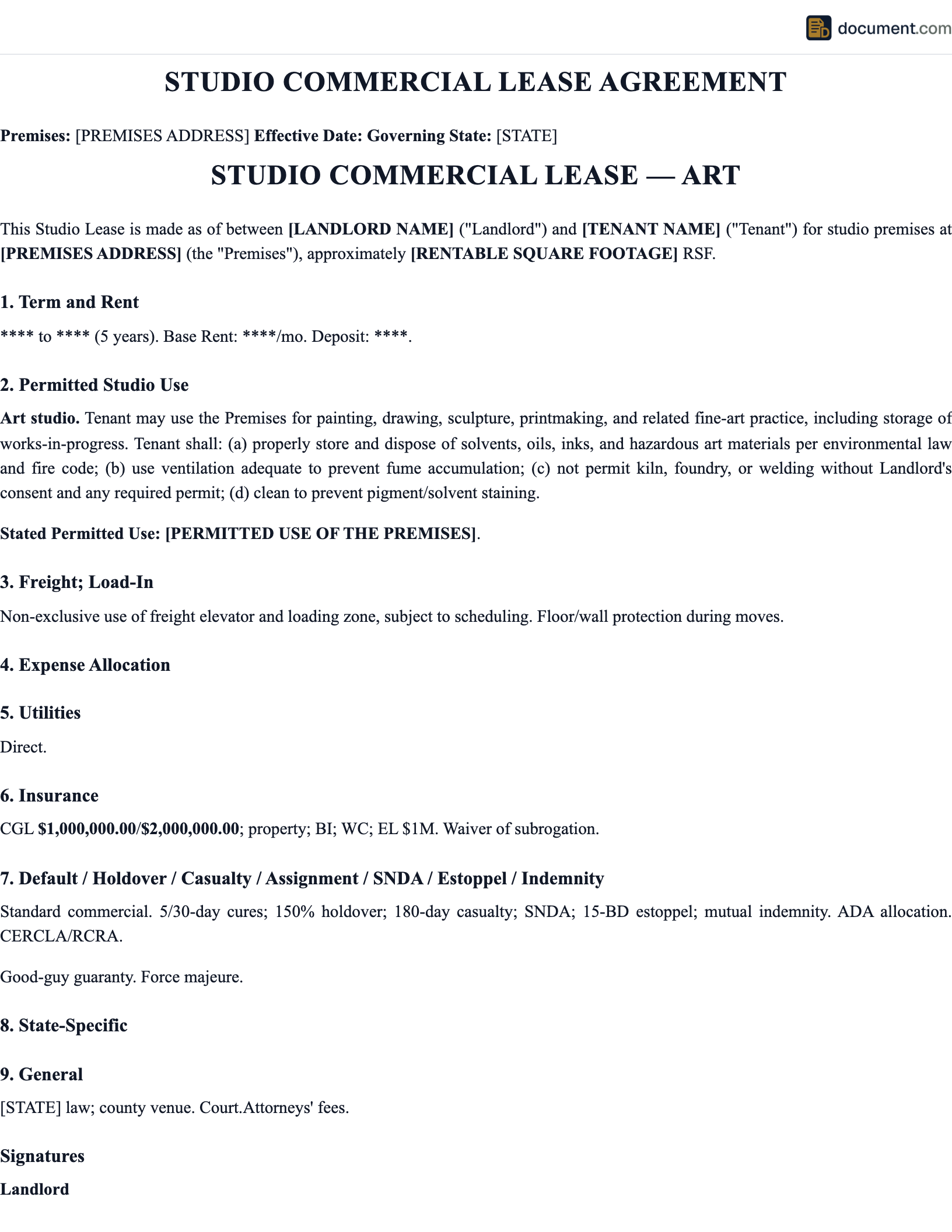
Below is a preview of our Massachusetts-specific template. Your customized document will include all fields and provisions required for filing in any Massachusetts county.
STUDIO RENTAL AGREEMENT
STATE OF MASSACHUSETTS
Legal Document Template
STUDIO OWNER / OPERATOR
Company: [Studio Name]
Address: [Studio Address]
Contact: [Phone/Email]
License #: [Business License]
RENTER
Name: [Full Legal Name / Entity]
Address: [Mailing Address]
Phone: [Contact Number]
Insurance: [Policy Number]
STUDIO DETAILS
Studio: [Room Name/Number]
Size: [Square Feet]
Type: [Photo/Music/Art/Rehearsal]
Equipment: [See Inventory List]
Access Hours: [Available Hours]
RENTAL TERMS
Rate: $[Amount] per [Hour/Day/Month]
Booking: [Date/Time]
Deposit: $[Amount]
Cancellation: [Policy]
Insurance Required: [Yes - Minimum Coverage]
Massachusetts Studio Rental Agreement FAQ
Answers to common questions about filing a studio rental agreement in Massachusetts, including requirements, fees, and procedures.
Official Massachusetts Resources
Use these official state resources to verify requirements, find your local filing office, and access government forms for Massachusetts.
Related Massachusetts Documents
Depending on your situation, you may need additional documents alongside your Massachusetts studio rental agreement.
Create your Massachusetts Commercial Studio Lease Agreement in under 5 minutes.
Answer a few questions and download a Massachusetts-compliant document, ready for the state agency.