
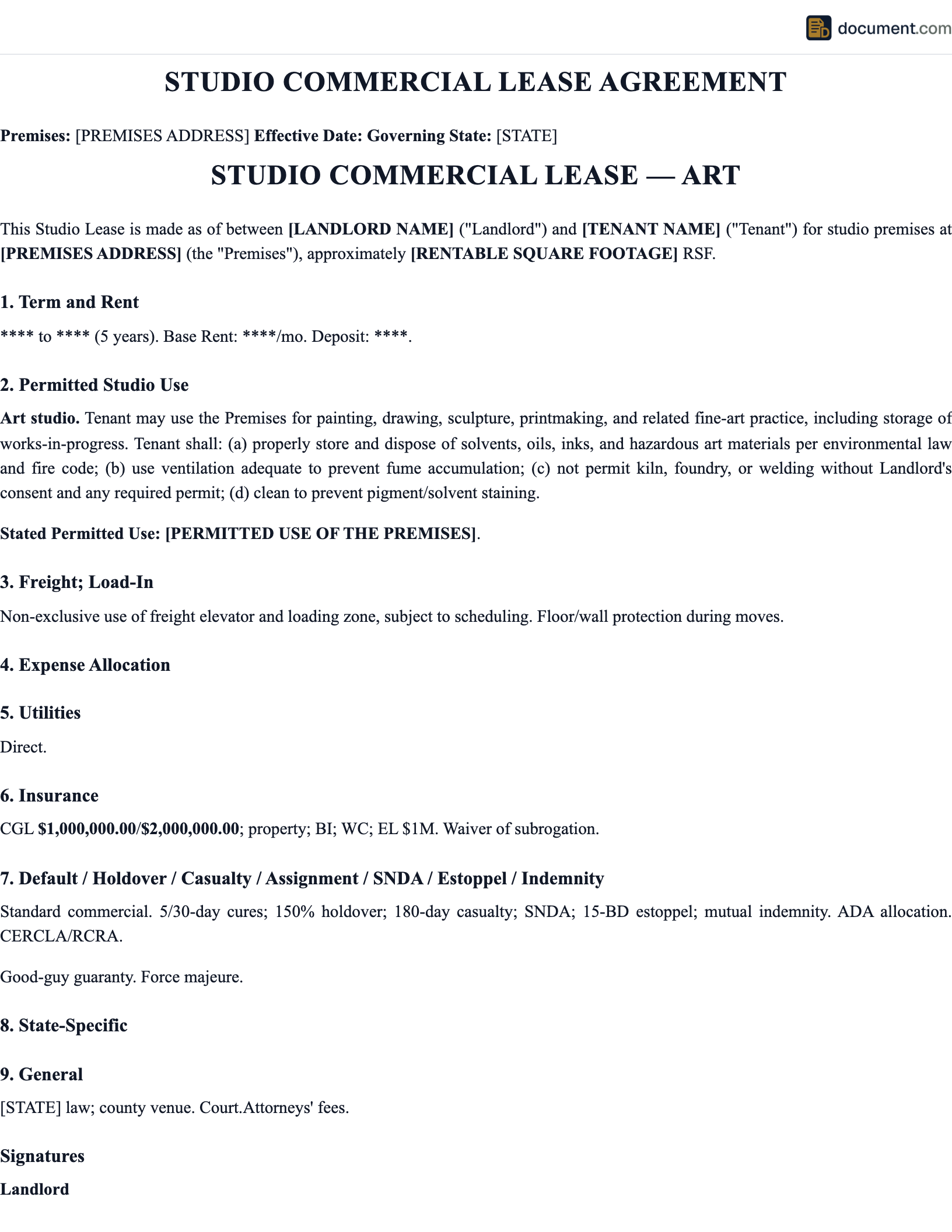



Maryland Studio Rental Agreement Overview
Maryland's working artist studio market is concentrated in Baltimore, which has one of the more established arts district ecosystems on the East Coast. Station North, Baltimore's designated arts and entertainment district anchored by Penn Station on the north end of Charles Street, has been attracting painters, sculptors, ceramicists, printmakers, photographers, and performance artists for decades. The adjacent Remington neighborhood, including the well-known Copycat Building, houses dense clusters of studio artists. Hampden and Charles Village round out Baltimore's studio geography. Outside Baltimore, Prince George's County's Gateway Arts District designation along Route 1 in Hyattsville and Riverdale has created a corridor of lower-cost studio space for artists priced out of the city.
Maryland commercial studio leases are pure contracts governed by the Maryland Real Property Article and general contract law. There is no Maryland statute specifically governing commercial studio tenancies. Unlike residential leases, commercial studio leases carry no statutory habitability protections, no mandatory rent increase notice requirements, and no security deposit caps. Maryland courts enforce commercial lease terms as written between parties presumed to have negotiated at arm's length.
The permitted use clause is the most consequential provision in a Maryland studio lease. Artists commonly assume a studio lease permits all types of creative activity, but landlords in gentrifying arts districts may object to spray painting, solvent use, metalworking, kiln operation, or amplified sound. Zoning in Baltimore's mixed-use arts districts must accommodate both the general commercial use and the specific activities involved. The Station North Arts and Entertainment District overlay provides broad permissions for creative uses, but confirming the specific address is within the district and that the building's certificate of occupancy supports the intended use is essential before signing.
$20
Filing fee
Required
Notarization
0
Witnesses required
Circuit
Filing office
Maryland Legal Requirements
Maryland commercial studio leases have no mandatory state form or required government filing. The following requirements govern execution and enforceability in Maryland.
Maryland Studio Lease Notice
The permitted use clause must describe every type of creative activity you plan to conduct in the studio. A clause that says only "artist studio" or "studio use" will not protect you if the landlord objects to spray painting, kiln operation, chemical darkroom use, or welding. Be specific about materials, equipment, and processes. Confirm that Baltimore City zoning for the specific address and the building's certificate of occupancy accommodate the stated uses before signing.
Lease Requirements
- Written Form for Terms Exceeding One Year: Maryland's statute of frauds requires commercial leases with a term exceeding one year to be in writing; shorter-term arrangements may be oral but should always be documented to prevent disputes
- Specific Permitted Use: List every type of artwork, process, material, and equipment use to be conducted in the space; include any planned retail sales of work, client visits, and whether apprentices, assistants, or studio sharing partners will be present
- Zoning Verification: Confirm the specific address falls within Baltimore's Station North Arts and Entertainment District overlay or another zoning classification that permits your intended use; contact the Baltimore City Department of Planning or Prince George's County Planning Department for confirmation
- Electrical and Utility Capacity: Studios with kilns, spray booths, welding equipment, or high-draw photographic equipment require specific electrical service; confirm panel amperage and circuit configuration before signing and address who is responsible for any necessary electrical upgrades
- Sublease and Space-Sharing Restrictions: Confirm whether the lease permits informal space-sharing with other artists; subletting or sharing without landlord consent when the lease prohibits it can constitute a material breach that triggers termination rights
- Renewal Options: Maryland has no statute granting commercial tenants renewal rights; negotiate a written renewal option with a specified rent structure and timely exercise deadline to protect your occupancy in a market where desirable studio space is limited
- Security Deposit Terms: Maryland imposes no cap on commercial security deposits; state the deposit amount, permitted deductions, and the return timeline clearly in the lease
How to Execute a Studio Lease in Maryland
Maryland commercial studio leases are private contracts with no required government filing. The steps below cover the negotiation and execution process for artists and creative professionals in the Baltimore and Prince George's County markets.
Inspect the Space and Verify Zoning
Before negotiating, physically inspect the studio. Check ceiling height for large format work or rigging. Test electrical capacity at the panel. Confirm natural light conditions, especially important for painters and photographers. Verify with the Baltimore City Department of Planning that the specific address falls within the Station North Arts and Entertainment District or another zoning classification that permits your intended activities, including any retail sales or client visits you plan to conduct from the space.
Negotiate the Permitted Use and Lease Terms
Draft or mark up a lease that names every type of creative activity, material, and equipment use you plan to conduct in the space. Negotiate a renewal option with a stated rent formula, and confirm whether the lease permits space-sharing with another artist. Station North studio buildings with strong arts district identity may be willing to permit informal space-sharing arrangements between artists as long as no formal subletting or sublease occurs without landlord approval. Get any permissions that matter to your practice in writing in the lease itself, not in a side email.
Address Noise and Building Access
Confirm your planned hours of studio use against Baltimore's noise ordinance and the landlord's building access policies. Station North studios near residential uses on Greenmount Avenue and Charles Street face more noise scrutiny than fully industrial buildings in Remington or the Copycat Building area. If your work involves metalworking, power tools, amplified sound, or other noise-generating activities, confirm in writing that the lease permits those activities during your intended working hours before signing.
Execute the Lease
Maryland commercial studio leases do not require notarization or recording to be enforceable between the parties. Both landlord and tenant, or authorized representatives if entities, sign the agreement. Pay the security deposit and first month's rent per the lease schedule and obtain written confirmation of receipt. Retain an original signed copy. If you are signing as an LLC or other business entity, confirm your operating agreement gives you authority to bind the entity to a commercial lease.
Document Move-In Condition
Maryland commercial leases do not require a move-in checklist, but creating one protects both parties. Photograph the entire space including walls, floors, windows, electrical panels, and any HVAC equipment. Document any existing damage, stains, or structural issues. Share the documentation with the landlord at move-in and retain a copy. Artist studios frequently accumulate paint, adhesive, and material residue during tenancy; documenting the pre-existing condition of surfaces protects the tenant from security deposit disputes at lease termination.
Tax Implications for Maryland Studio Tenants
Studio rent is deductible as a business expense for self-employed artists and creative professionals under both federal and Maryland income tax rules. Maryland's top individual income tax rate is 5.75 percent at the state level, plus local county income taxes that vary by county, ranging from 2.25 to 3.2 percent. Artists who sell original work, prints, ceramics, or other tangible personal property directly from their Maryland studio must collect Maryland sales tax at 6 percent on those retail sales and register for a sales tax license with the Comptroller of Maryland.
Maryland also assesses business personal property tax on equipment owned and used in a commercial location. Artists with significant studio equipment, including kilns, presses, welding equipment, or production machinery, should confirm with the local county assessment office whether their equipment is subject to business personal property tax reporting. The Maryland Department of Assessments and Taxation administers business personal property returns, which are filed annually. Failing to file can result in assessments with penalties.
Important Considerations for Maryland Studio Tenants
Station North and Remington have experienced gentrification pressure as Baltimore's arts districts attract market-rate residential development. Some artist buildings and studio clusters have faced redevelopment threats over the years. When evaluating a studio lease, investigate the landlord's long-term plans for the building and ask whether any redevelopment applications are pending with the Baltimore City Department of Planning. A low rent in a building slated for conversion is not necessarily a good deal if you face a mid-lease displacement.
Open studio events are a significant revenue and visibility driver for Baltimore artists, particularly during events like Artscape and Station North open studio weekends. If you plan to host open studio events, confirm that the lease permits it, that the building has adequate egress and occupancy capacity for visitors, and that your general liability insurance covers public events at the studio location. Some older Baltimore commercial buildings in arts districts have occupancy limitations that affect event hosting.
Holdover provisions in Maryland studio leases can create significant financial exposure. If you stay past lease expiration without a signed renewal, most Maryland commercial leases convert the tenancy to month-to-month at 125 to 150 percent of prior rent, with some leases adding consequential damages liability if an incoming tenant is delayed. Station North landlords with waitlists for studio space may have little incentive to negotiate favorable holdover terms. Begin renewal discussions at least 12 months before expiration to avoid the holdover premium.
Maryland Fees & Costs
Below is a breakdown of the typical costs associated with filing this document in Maryland. Actual fees may vary by county.
| Fee / Cost | Amount |
|---|---|
| Filing Fee | $20 first page |
| Notarization | $5 - $25 per signature |
| Certified Copy | $1 - $10 per page |
| Attorney Review (optional) | $150 - $500 |
Sample Maryland Studio Rental Agreement
Below is a preview of our Maryland-specific template. Your customized document will include all fields and provisions required for filing in any Maryland county.
STUDIO RENTAL AGREEMENT
STATE OF MARYLAND
Legal Document Template
STUDIO OWNER / OPERATOR
Company: [Studio Name]
Address: [Studio Address]
Contact: [Phone/Email]
License #: [Business License]
RENTER
Name: [Full Legal Name / Entity]
Address: [Mailing Address]
Phone: [Contact Number]
Insurance: [Policy Number]
STUDIO DETAILS
Studio: [Room Name/Number]
Size: [Square Feet]
Type: [Photo/Music/Art/Rehearsal]
Equipment: [See Inventory List]
Access Hours: [Available Hours]
RENTAL TERMS
Rate: $[Amount] per [Hour/Day/Month]
Booking: [Date/Time]
Deposit: $[Amount]
Cancellation: [Policy]
Insurance Required: [Yes - Minimum Coverage]
Maryland Studio Rental Agreement FAQ
Answers to common questions about filing a studio rental agreement in Maryland, including requirements, fees, and procedures.
Official Maryland Resources
Use these official state resources to verify requirements, find your local filing office, and access government forms for Maryland.
Related Maryland Documents
Depending on your situation, you may need additional documents alongside your Maryland studio rental agreement.
Create your Maryland Commercial Studio Lease Agreement in under 5 minutes.
Answer a few questions and download a Maryland-compliant document, ready for the state agency.