
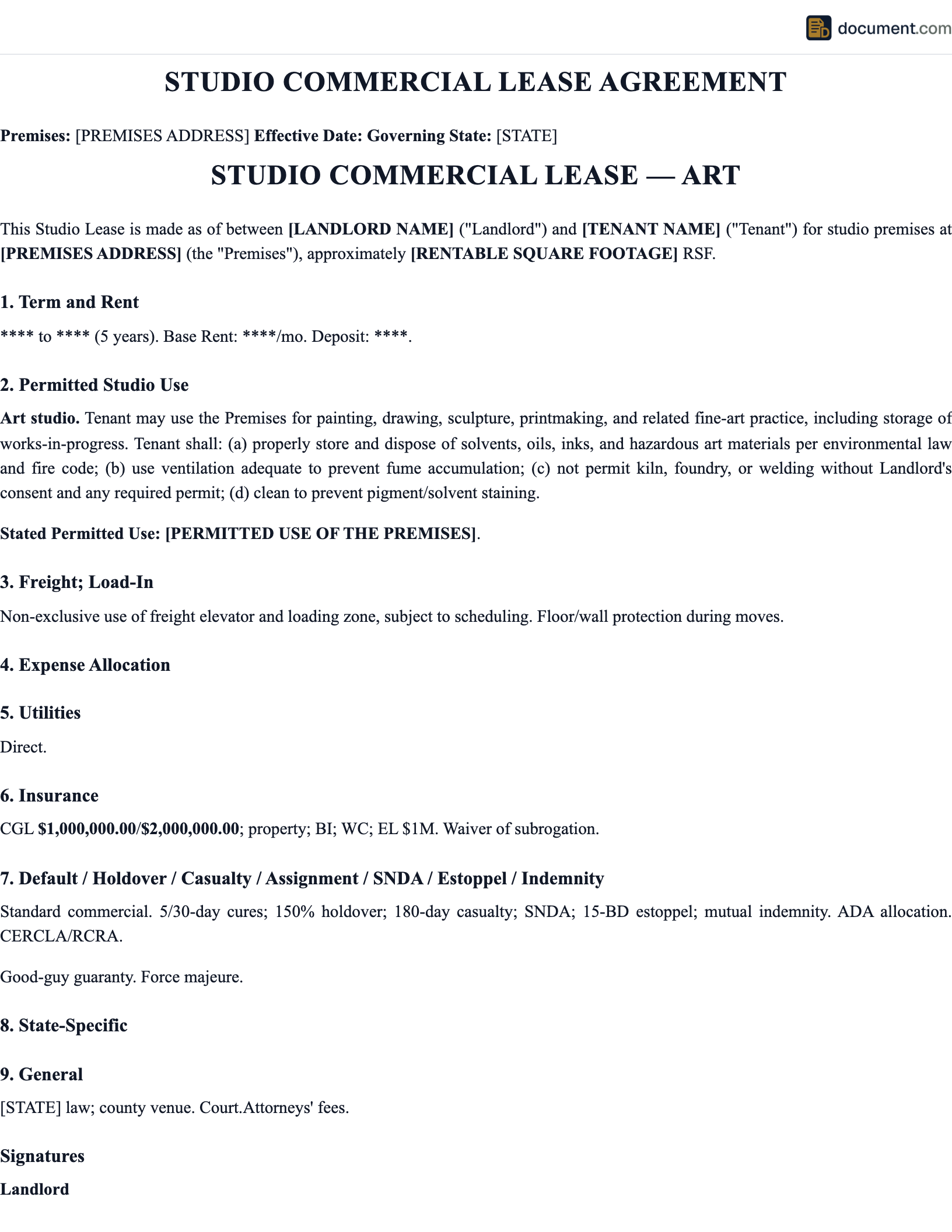



Maine Studio Rental Agreement Overview
Maine has a genuinely active studio leasing market driven by Portland's established creative economy. The East Bayside neighborhood and the Washington Avenue corridor are the center of Portland's arts district, with converted warehouses and industrial buildings housing painters, sculptors, photographers, ceramic artists, printmakers, and textile studios. Portland's Arts District Overlay Zone protects this industrial creative corridor from displacement pressure and maintains commercial zoning that permits light industrial and creative uses. Beyond Portland, studios in Bath, Rockland, Brunswick, and Bar Harbor serve a mix of working artists, fine craft producers, and photography operations that support Maine's tourism-driven gallery and hospitality economy.
Studio leases in Maine are purely commercial contracts. Title 14, Chapter 709, which governs residential tenancies, does not apply. The parties negotiate all terms, and whatever the signed agreement says is the binding framework. Maine courts enforce commercial lease provisions as written, including holdover penalty clauses, late fee structures, and permitted use restrictions. There is no statutory cap on commercial security deposits and no required return timeline beyond what the parties write into the agreement.
Cold climate considerations are embedded in Maine studio leasing in ways that do not exist in most states. HVAC provisions matter enormously in a state with heating seasons running from October through April. The permitted use clause must accommodate the full scope of creative production, including any spray painting, chemical darkroom use, ceramic kiln operation, welding, or woodworking, because a permitted use clause that simply says "studio" without specificity can create disputes when the landlord objects to specific activities. Getting the permitted use right at the drafting stage prevents conflict later.
$13
Filing fee
Required
Notarization
0
Witnesses required
Registry
Filing office
Maine Legal Requirements
Maine commercial studio leases are governed by contract law and general commercial landlord-tenant principles. There is no state-specific studio leasing statute. The following requirements apply to any commercial studio lease in Maine.
Maine Studio Leasing Notice
The permitted use clause is the most critical provision in a Maine studio lease. Artists and creative professionals often assume a studio lease permits all types of creative work, but landlords in converted industrial buildings may object to spray painting, solvent use, kiln operation, or welding if the lease only says "studio use." Spell out every type of work to be performed in the permitted use clause, and confirm that zoning and the building's certificate of occupancy accommodate those uses before signing.
Agreement Requirements
- Written Form Required: Any studio lease with a term exceeding one year must be in writing under Maine's statute of frauds; month-to-month leases may be oral but should always be documented in writing to avoid disputes
- Specific Permitted Use: The permitted use clause should list each type of creative activity, materials, equipment, and any customer or client visits to the studio space; a clause that says only "artist studio" is legally sufficient but practically inadequate
- Zoning Verification: Portland's Arts District Overlay Zone permits creative and light industrial uses in East Bayside and Washington Avenue; confirm that the specific building and proposed use are within an area that allows the activities listed in the permitted use clause
- HVAC and Utility Structure: Maine's long heating season makes HVAC provisions critical; the lease should specify who pays for heat, whether the building uses forced air or radiant heat, and whether the heating system is sufficient for a studio where exterior doors may be opened during work and deliveries
- Electrical Capacity: Studios with kilns, spray booths, welding equipment, or photographic lighting rigs require higher electrical service than standard office space; confirm the panel amperage and whether the circuit configuration supports the equipment before signing
- Noise and Hours: Portland has commercial noise ordinances that apply to studios in mixed-use areas; the lease should confirm permitted hours of operation and whether any activities produce sound levels that exceed local limits during evening or weekend hours
- Security Deposit Terms: Maine imposes no cap on commercial security deposits; clearly state the deposit amount, what conditions trigger deductions, and the timeline for return after lease termination
How to Execute a Studio Lease in Maine
Maine commercial studio leases are private contracts between landlord and tenant. There is no state filing requirement for commercial leases. The steps below cover the negotiation and execution process for a Maine studio lease.
Inspect the Space and Verify Zoning
Before negotiating terms, physically inspect the studio. Check ceiling height for large format work or rigging. Test electrical capacity at the panel. Confirm the heating system type and whether it can maintain working temperature through Maine winters with exterior doors opening during deliveries. Verify with Portland's Planning and Urban Development department that the specific address and your intended use fall within compliant zoning, including the Arts District Overlay Zone if applicable.
Negotiate the Permitted Use and Lease Terms
Draft or review a lease that names every activity you plan to conduct, every type of material you will use, and every category of equipment you will operate. Negotiate renewal options with stated rent caps. Portland studio inventory in East Bayside and Washington Avenue is limited, and losing a space at lease end without a renewal right is a real risk. Negotiate a right of first refusal on adjacent or expanded space if the building has room to grow.
Review Cold Climate Provisions
Maine's heating season is long and expensive. The lease should specify who pays for heat, whether the landlord guarantees a minimum temperature in the space, and what happens if the heating system fails during winter. If you will pay utilities directly, request prior years' heating bills before signing. Oil heat in older Maine commercial buildings can generate significant utility costs that affect the economics of a studio at posted rent levels.
Execute the Lease
Maine commercial studio leases do not require notarization or recording to be enforceable between the parties. Both the landlord and tenant, or their authorized representatives if entities, sign the agreement. Retain an original signed copy. Pay the security deposit and first month's rent as specified and obtain written confirmation that the deposit has been received and will be held as required by the agreement.
Document the Space at Move-In
Maine's commercial lease framework does not require a move-in condition report, but creating one protects both parties. Photograph the entire space including floors, walls, windows, and existing damage. Document the condition of any HVAC equipment, electrical panels, and loading dock or freight elevator if applicable. Share the documentation with the landlord at move-in and retain a copy to resolve any security deposit disputes at lease termination.
Tax Implications for Maine Studio Tenants
Studio rent is deductible as a business expense for self-employed artists and creative professionals under federal and Maine income tax rules. Maine's top marginal income tax rate is 7.15 percent, and deducting studio rent as a business expense directly reduces Maine taxable income. Artists who use a portion of their studio for retail sales of their work need a Maine sales tax permit; Maine imposes a 5.5 percent sales tax on retail sales of tangible personal property including artwork, ceramics, prints, and photography prints sold directly from the studio.
Maine's Business Equipment Tax Exemption (BETE) applies to qualified business equipment placed in service in Maine. Studio equipment including kilns, printing presses, photographic equipment, welding equipment, and production machinery may qualify for the BETE exemption, which eliminates local property tax on the equipment. BETE requires annual filing with the municipality where the equipment is located. Artists using significant equipment should review BETE eligibility with a Maine tax advisor.
Important Considerations for Maine Studio Tenants
Seasonal revenue patterns affect many Maine studio tenants. Artists in Portland, Rockland, Bar Harbor, and coastal communities experience strong summer gallery and retail seasons driven by tourism, and slower winter months. When negotiating lease terms, consider whether a percentage-of-sales rent structure or a seasonal rent adjustment provision would better match your income pattern than a flat monthly rent that does not account for winter revenue drops.
Holdover tenancy is a real risk in Maine studio leasing because desirable studio space is scarce. If you stay in the space past lease expiration without a signed renewal, Maine commercial landlord-tenant principles may allow the landlord to treat the holdover as a periodic tenancy at the same rent, or to claim double rent if the lease contains a holdover penalty clause. Some Portland landlords include holdover clauses at 125 to 150 percent of base rent to discourage holding over while a new tenant is waiting. Know whether your lease has such a clause before letting the term expire.
Renewable energy considerations are increasingly relevant for Maine studios with high electrical draw. Maine has net energy billing for commercial accounts, which allows solar generation to offset electrical costs. If you are in a space with roof access, investigate whether the landlord would permit or participate in a rooftop solar installation under a green lease addendum. Several Portland industrial building owners have entered green lease arrangements with long-term commercial tenants to offset utility costs.
Maine Fees & Costs
Below is a breakdown of the typical costs associated with filing this document in Maine. Actual fees may vary by county.
| Fee / Cost | Amount |
|---|---|
| Filing Fee | $13 first page |
| Notarization | $5 - $25 per signature |
| Certified Copy | $1 - $10 per page |
| Attorney Review (optional) | $150 - $500 |
Sample Maine Studio Rental Agreement
Below is a preview of our Maine-specific template. Your customized document will include all fields and provisions required for filing in any Maine county.
STUDIO RENTAL AGREEMENT
STATE OF MAINE
Legal Document Template
STUDIO OWNER / OPERATOR
Company: [Studio Name]
Address: [Studio Address]
Contact: [Phone/Email]
License #: [Business License]
RENTER
Name: [Full Legal Name / Entity]
Address: [Mailing Address]
Phone: [Contact Number]
Insurance: [Policy Number]
STUDIO DETAILS
Studio: [Room Name/Number]
Size: [Square Feet]
Type: [Photo/Music/Art/Rehearsal]
Equipment: [See Inventory List]
Access Hours: [Available Hours]
RENTAL TERMS
Rate: $[Amount] per [Hour/Day/Month]
Booking: [Date/Time]
Deposit: $[Amount]
Cancellation: [Policy]
Insurance Required: [Yes - Minimum Coverage]
Maine Studio Rental Agreement FAQ
Answers to common questions about filing a studio rental agreement in Maine, including requirements, fees, and procedures.
Official Maine Resources
Use these official state resources to verify requirements, find your local filing office, and access government forms for Maine.
Related Maine Documents
Depending on your situation, you may need additional documents alongside your Maine studio rental agreement.
Create your Maine Commercial Studio Lease Agreement in under 5 minutes.
Answer a few questions and download a Maine-compliant document, ready for the state agency.