
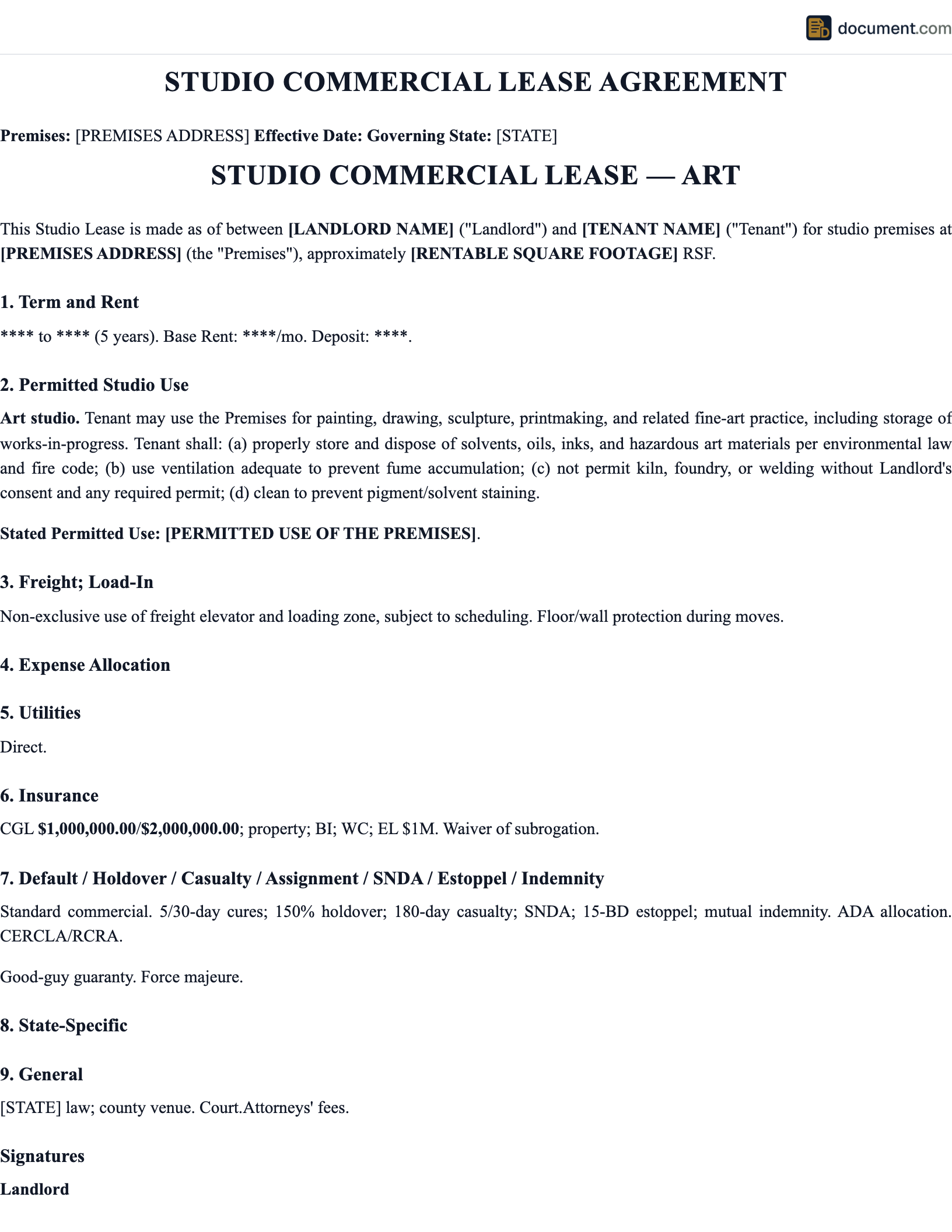



Louisiana Studio Lease Agreement Overview
Louisiana's studio and creative workspace market is one of the most distinctive in the country. New Orleans supports a large community of working musicians, visual artists, filmmakers, and audio engineers whose commercial needs are shaped by the city's unique culture, historic building stock, and genuine vulnerability to flood and storm damage. The Warehouse District, Bywater, and Tremé neighborhoods have emerged as informal creative districts with a concentration of studio and workshop spaces in former warehouses and commercial buildings. Many of these buildings are architecturally remarkable but physically challenging, with aging electrical systems, high humidity, inconsistent climate control, and potential moisture intrusion.
Louisiana studio leases are governed by Louisiana Civil Code Articles 2668 through 2729, not common law. The key differences for studio tenants include the lessor's statutory warranty against defects under Article 2696, the default permission to sublease under Article 2713 unless expressly prohibited, and the reconduction rules for holdover under Article 2720. These provisions do not exist in the same form in other states, and out-of-state form leases will not address them. A Louisiana studio lease should be drafted with civil code awareness by someone familiar with Louisiana commercial lease practice.
Louisiana's film tax credit program has made New Orleans a major film and television production hub, which has created demand for professional recording studios, sound stages, and post-production facilities alongside traditional creative studio spaces. Tenants in these specialized studio categories often have infrastructure needs, including three-phase electrical power, fiber connectivity, broadcast-grade sound isolation, and secure client file storage, that standard commercial lease templates do not contemplate and that require explicit negotiation and documentation.
$55
Filing fee
Required
Notarization
2
Witnesses required
Clerk
Filing office
Louisiana Legal Requirements for Studio Leases
Louisiana studio leases are governed by Civil Code Articles 2668 through 2729. The lease must be in writing for any term exceeding one year (Article 2681). For the lease to be registered in the parish conveyance records, it must be executed before a Louisiana notary public and two witnesses.
Louisiana Civil Law and Flood Risk Note
Louisiana civil law creates several important default rules for studio leases. Under Civil Code Article 2696, the lessor warrants the studio is free from defects preventing its intended use. Under Article 2713, the lessee may sublease or assign unless expressly prohibited. Flood and hurricane force majeure provisions are not optional in Louisiana; they are a practical necessity. Additionally, New Orleans studio spaces in historic districts are subject to Historic District Landmarks Commission or Vieux Carre Commission oversight that can affect exterior modifications and signage.
Key Requirements for Louisiana Studio Leases
- Written Form: Required for any term over one year under Civil Code Article 2681; registration with parish conveyance records requires notary and two witnesses
- Sublease Prohibition: Must be expressly stated; civil code default permits subletting without landlord consent under Article 2713
- Warranty Provisions: Address the lessor's warranty against defects (Article 2696); specify scope, waiver, and the procedure for defect claims
- Flood and Hurricane Force Majeure: Include specific provisions addressing named storm events, mandatory evacuations, building inaccessibility, and rent abatement triggers
- Permitted Use: Explicitly cover all creative activities including recording, post-production, client sessions, and any film industry support work
- Physical Specifications: Document ceiling height, electrical capacity, HVAC, humidity controls, and flood elevation as lease exhibits, especially in older New Orleans buildings
How to Execute a Louisiana Studio Lease
Executing a Louisiana studio lease does not require filing with a government office for the lease to be binding between the parties. Registration with the parish conveyance records is optional but strongly advisable. Follow these steps for a proper Louisiana studio lease execution.
Inspect the Building's Flood and Moisture History
For any New Orleans or South Louisiana studio space, ask the landlord for documentation of post-storm remediation, flood elevation certificates, and HVAC maintenance records. Test humidity levels and inspect for staining or moisture damage before signing. Photograph all conditions.
Negotiate Civil Law Provisions and Flood Terms
Address the lessor's warranty, sublease prohibition, holdover reconduction terms, flood insurance allocation, and force majeure provisions. Use a Louisiana-specific lease form or have a Louisiana commercial real estate attorney review any out-of-state template before signing.
Execute Before a Notary and Two Witnesses if Registering
If the lease will be registered in the parish conveyance records to protect against future building sales, both parties must sign before a Louisiana-commissioned notary public and two witnesses. This step is not required for the lease to bind the parties but protects the tenant's possessory rights against third parties.
Register with Parish Conveyance Records if Warranted
For studio leases exceeding one year, file the notarized, witnessed lease with the Clerk of Court for the parish where the studio is located. This is particularly important for studios in which tenants are investing in soundproofing, specialized electrical, or other permanent improvements.
Pay Deposit and Document Move-In Condition
Pay security deposit and first month simultaneously with lease execution. Document the full condition of the studio with photographs including any existing moisture staining, floor damage, wall conditions, window operability, and HVAC state before occupancy.
Tax Implications for Louisiana Studio Tenants
Louisiana studio rent is deductible as an ordinary business expense under federal and Louisiana income tax rules. Louisiana does not impose a statewide commercial rent tax. Artists who sell finished work or creative services from the studio in Louisiana must collect Louisiana state sales tax and hold a Louisiana sales tax permit. Film and media production studios should investigate Louisiana's film tax credit program, which offers meaningful incentives for qualifying production activity in Louisiana. Enterprise zone tax credits may be available for studio businesses in qualifying areas of New Orleans or Baton Rouge, including employment tax credits and sales tax exemptions on eligible equipment purchases.
Important Considerations for Louisiana Studio Leases
New Orleans studio tenants in the Warehouse District and Bywater should evaluate flood elevation carefully. Buildings built below base flood elevation have higher flood risk regardless of historical usage and may carry significantly higher flood insurance costs that a net lease will pass through to the tenant. Soundproofing investments in New Orleans historic buildings must comply with Historic District Landmarks Commission requirements if they affect any exterior element, including windows. New Orleans music studio operators who allow client sessions during Mardi Gras week should confirm that building access and parking logistics are addressed in the lease and that the operator has not historically closed during festival periods. Film and television production studio tenants should verify that the building's electrical service supports three-phase power requirements before signing and that the lease permits the equipment weight loads and deliveries involved in professional production operations.
Louisiana Fees & Costs
Below is a breakdown of the typical costs associated with filing this document in Louisiana. Actual fees may vary by county.
| Fee / Cost | Amount |
|---|---|
| Filing Fee | $55 first page |
| Notarization | $5 - $25 per signature |
| Certified Copy | $1 - $10 per page |
| Attorney Review (optional) | $150 - $500 |
Sample Louisiana Studio Rental Agreement
Below is a preview of our Louisiana-specific template. Your customized document will include all fields and provisions required for filing in any Louisiana county.
STUDIO RENTAL AGREEMENT
STATE OF LOUISIANA
Legal Document Template
STUDIO OWNER / OPERATOR
Company: [Studio Name]
Address: [Studio Address]
Contact: [Phone/Email]
License #: [Business License]
RENTER
Name: [Full Legal Name / Entity]
Address: [Mailing Address]
Phone: [Contact Number]
Insurance: [Policy Number]
STUDIO DETAILS
Studio: [Room Name/Number]
Size: [Square Feet]
Type: [Photo/Music/Art/Rehearsal]
Equipment: [See Inventory List]
Access Hours: [Available Hours]
RENTAL TERMS
Rate: $[Amount] per [Hour/Day/Month]
Booking: [Date/Time]
Deposit: $[Amount]
Cancellation: [Policy]
Insurance Required: [Yes - Minimum Coverage]
Louisiana Studio Rental Agreement FAQ
Answers to common questions about filing a studio rental agreement in Louisiana, including requirements, fees, and procedures.
Official Louisiana Resources
Use these official state resources to verify requirements, find your local filing office, and access government forms for Louisiana.
Related Louisiana Documents
Depending on your situation, you may need additional documents alongside your Louisiana studio rental agreement.
Create your Louisiana Commercial Studio Lease Agreement in under 5 minutes.
Answer a few questions and download a Louisiana-compliant document, ready for the state agency.