
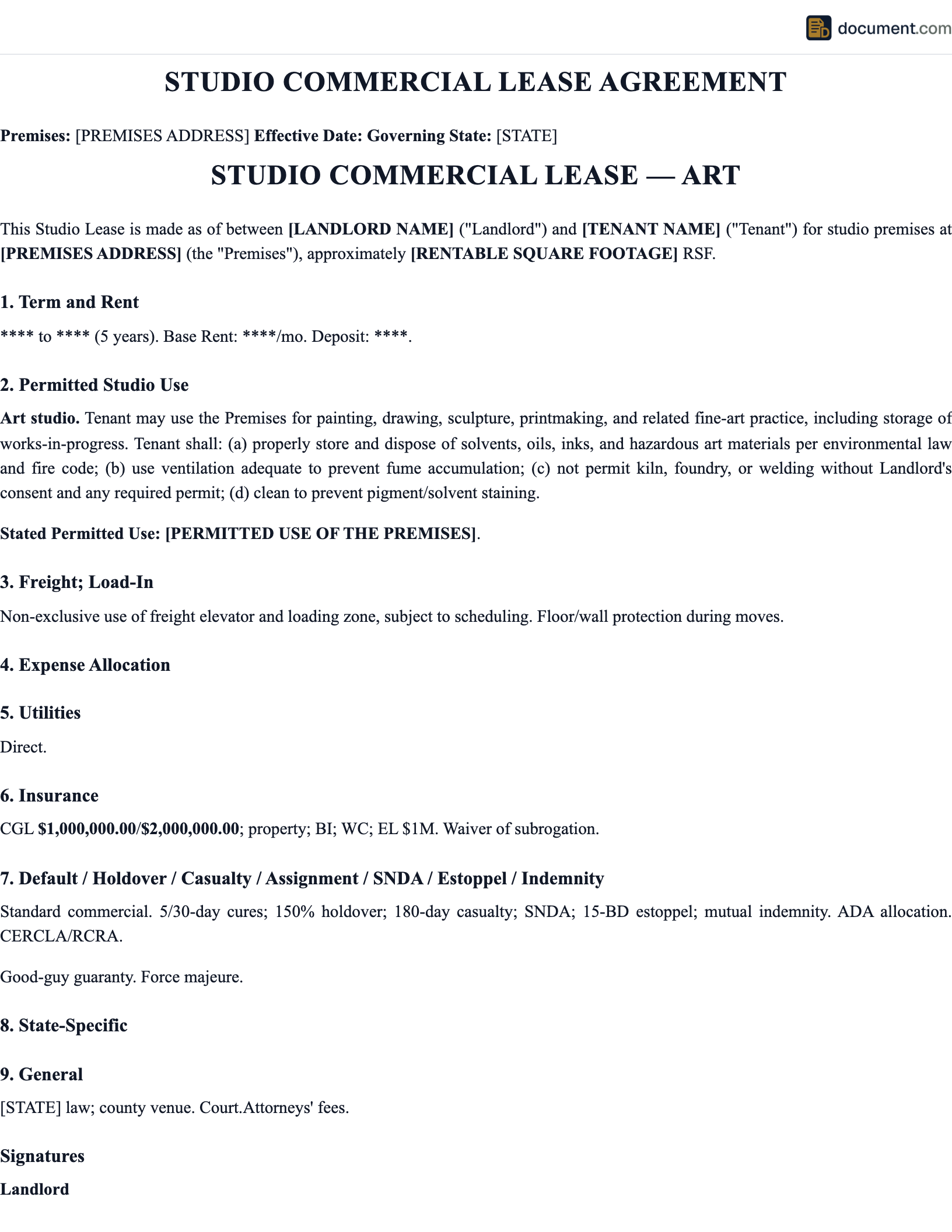



Arkansas Studio Rental Agreement Overview
Arkansas studio leasing occupies a niche that has grown steadily as the state's creative economy has developed. Little Rock's Argenta arts district in North Little Rock and the SoMa neighborhood south of downtown have established clusters of visual arts studios, photography spaces, and light production facilities. These neighborhoods offer older warehouse and mixed-use buildings with the high ceilings, loading access, and flexible floor plates that creative tenants need, at rents well below comparable space in larger Southern cities. Northwest Arkansas has developed a parallel creative market driven by the Crystal Bridges Museum, the Momentary arts venue, and the broader investment in arts infrastructure that the Walton family philanthropy has supported in Bentonville and Fayetteville.
Arkansas provides no regulatory framework specific to studio or creative space leasing. Commercial studio leases are ordinary commercial contracts enforced under Arkansas contract law. There are no required landlord disclosures, no security deposit limits, and no implied modification rights. The lease agreement is the complete record of the tenant's rights regarding the space, permitted use, modification authority, and surrender obligations. Tenants who do not negotiate specific provisions do not have them. Arkansas courts generally enforce commercial lease terms as written, reflecting the state's consistent posture that commercial parties negotiate at arm's length.
$7-16
Per sqft/year
None
Deposit cap
Contract
Law governs
Zoning
Verify per city
Arkansas Requirements
Arkansas imposes no mandatory requirements on commercial studio leases beyond the statute of frauds (written agreement required for terms over one year) and mutual execution. The lease must cover the provisions that matter for your specific use because Arkansas law will not fill gaps in your favor.
Arkansas Studio Lease Note
Arkansas provides no implied modification rights, no security deposit limits, and no mandatory disclosures for commercial studio tenants. All rights must be negotiated into the lease before signing. Verify zoning approval for your intended creative use with the applicable municipality before executing the lease.
Key Provisions to Negotiate
- Permitted Use: Define your creative use precisely, including client visits, equipment deliveries, production activities, and operating hours, to avoid future disputes with the landlord
- Modification Rights: Negotiate specific approval rights for electrical upgrades, lighting installations, flooring modifications, soundproofing, and any other alterations needed for your studio use
- Surrender Conditions: Clarify which modifications must be removed and restored at lease end versus which improvements become landlord property, to avoid restoration cost disputes
- Security Deposit: Arkansas sets no cap; negotiate the amount, whether interest accrues, and the specific conditions under which the landlord may make deductions
- Access Hours: Specify 24/7 access rights if your production work requires early morning or late-night sessions, as some Arkansas commercial buildings restrict after-hours access
How to File in Arkansas
Executing a studio lease in Arkansas follows a straightforward commercial real estate process. The steps below reflect what actually matters for creative tenants in Little Rock's arts districts or Northwest Arkansas's growing creative market.
Assess Physical Suitability for Your Studio Use
Evaluate the space for your specific needs: electrical capacity (amperage available for lighting or production equipment), ceiling height, natural light quality and direction, floor load rating for heavy equipment, and loading access for large deliveries. Argenta and SoMa buildings in Little Rock are often older warehouse conversions with good bones but variable electrical infrastructure. NWA spaces near Bentonville tend to be newer with better base infrastructure but may carry higher rents.
Verify Zoning for Your Intended Creative Use
Confirm with the applicable city (Little Rock Planning and Development, City of Fayetteville Planning, City of Bentonville, or other) that the building and specific suite are zoned for your intended studio use. Photography, video production, sound recording, light fabrication, and artist workshops each have different use classifications. Client visits and signage may have additional requirements. Verify zoning before signing, not after.
Negotiate Modification and Restoration Rights
If you need to install electrical panels, run conduit, add soundproofing, install lighting grids, or make other studio-specific modifications, negotiate these rights explicitly before signing. Arkansas provides no implied authority to alter commercial space. Specify which modifications require written approval, what contractor approval process applies, and which improvements you may leave versus remove at lease end.
Execute the Lease
Both parties sign the finalized lease. Arkansas does not require notarization for commercial leases to be enforceable between the parties, though some landlords request it. Deliver the security deposit at signing and retain a fully executed copy. Confirm the commencement date, rent abatement period if any, and the exact start of your rent obligation in writing.
Document Existing Conditions and Obtain Insurance
Before moving in, photograph or video the entire space and document any existing damage, staining, or deficiencies in writing with the landlord. This protects your security deposit when you vacate. Obtain the commercial general liability insurance your lease requires, add a commercial property policy covering your equipment, and confirm with your insurer that your studio activities (if they include client visits, production activities, or valuable equipment) are covered by the policy.
Arkansas Fees & Costs
Arkansas studio rents are some of the most affordable in the South for creative tenants. Little Rock's arts districts offer strong value, while NWA commands a modest premium due to the cultural investment and corporate-driven demand in Bentonville and Fayetteville.
| Fee / Cost | Amount |
|---|---|
| Studio Space (Little Rock arts districts) | $7 - $14/sqft/year |
| Studio Space (NWA/Bentonville) | $10 - $18/sqft/year |
| Security Deposit | 1 - 3 months base rent (no statutory cap) |
| Electrical Upgrades (if needed) | $1,000 - $8,000+ depending on scope |
| Commercial Liability Insurance | $400 - $1,500/year |
| Attorney Review | $500 - $1,800 depending on lease complexity |
Sample Arkansas Studio Rental Agreement
Below is a preview of our Arkansas-specific template. Your customized document will include all fields and provisions required for filing in any Arkansas county.
STUDIO RENTAL AGREEMENT
STATE OF ARKANSAS
Legal Document Template
STUDIO OWNER / OPERATOR
Company: [Studio Name]
Address: [Studio Address]
Contact: [Phone/Email]
License #: [Business License]
RENTER
Name: [Full Legal Name / Entity]
Address: [Mailing Address]
Phone: [Contact Number]
Insurance: [Policy Number]
STUDIO DETAILS
Studio: [Room Name/Number]
Size: [Square Feet]
Type: [Photo/Music/Art/Rehearsal]
Equipment: [See Inventory List]
Access Hours: [Available Hours]
RENTAL TERMS
Rate: $[Amount] per [Hour/Day/Month]
Booking: [Date/Time]
Deposit: $[Amount]
Cancellation: [Policy]
Insurance Required: [Yes - Minimum Coverage]
Arkansas Studio Rental Agreement FAQ
Answers to common questions about filing an studio rental agreement in Arkansas, including requirements, fees, and procedures.
Official Arkansas Resources
Use these official state resources to verify requirements, find your local filing office, and access government forms for Arkansas.
Related Arkansas Documents
Depending on your situation, you may need additional documents alongside your Arkansas studio rental agreement.
Create your Arkansas Commercial Studio Lease Agreement in under 5 minutes.
Answer a few questions and download a Arkansas-compliant document, ready for the state agency.