
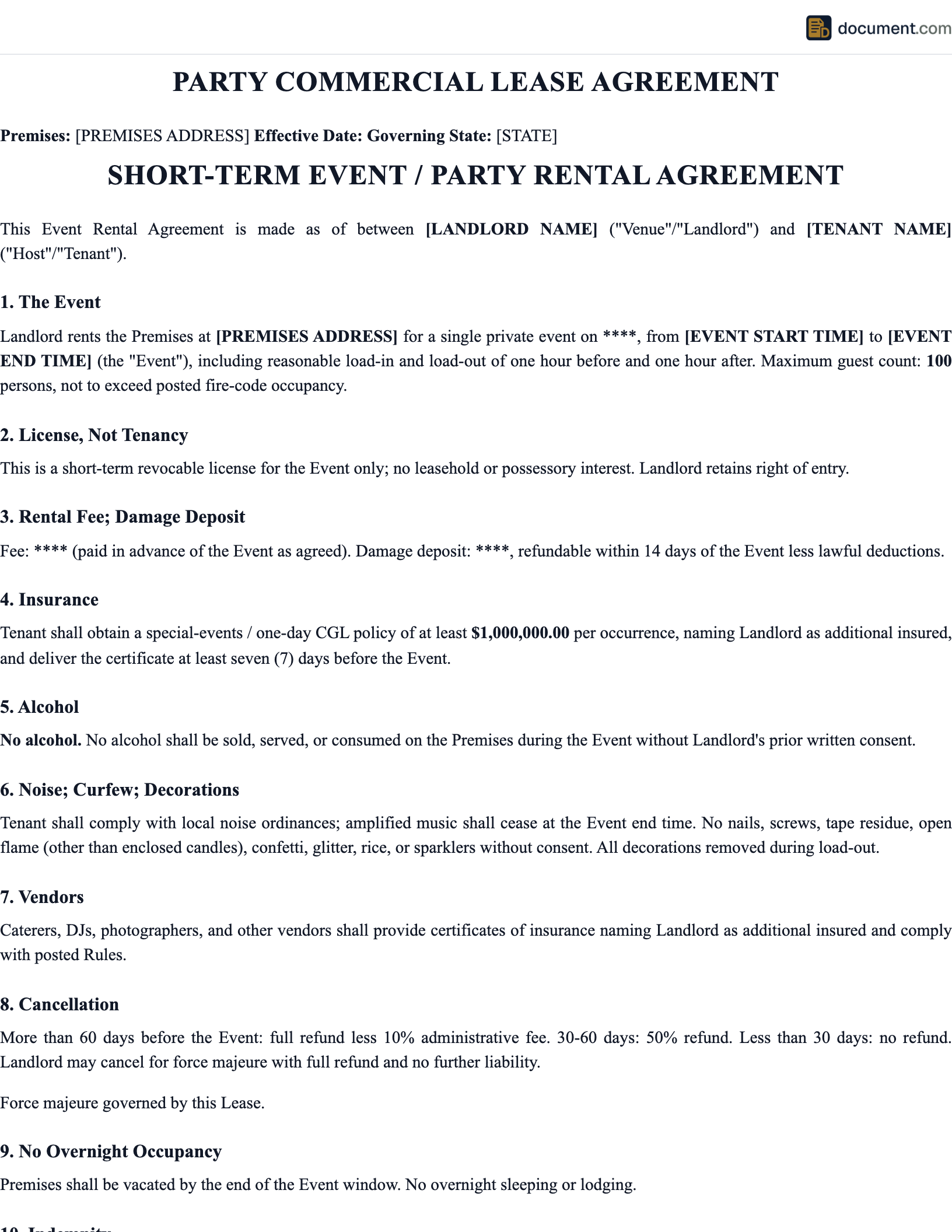



Minnesota Party Rental Agreement Overview
A party rental agreement in Minnesota is a short-term commercial contract governing the rental of equipment and supplies for events — lakeside weddings, Twin Cities corporate events, county fair celebrations, brewery gatherings, winter galas, and summer festivals. The agreement covers tents, tables, chairs, linens, dance floors, lighting, sound systems, bounce houses, heaters, and other event equipment. Minnesota's "Land of 10,000 Lakes" reputation drives a robust outdoor event market from May through October, while heated tent events extend the season through Minnesota's long winters.
Minnesota's legal framework includes a modified comparative fault system with a 50% bar, the Amusement Ride Safety Act administered by the Department of Labor and Industry (DLI), a Dram Shop Act that creates server liability for alcohol-related injuries, and some of the strongest consumer protection enforcement in the Midwest through the Attorney General's office. Minnesota's extreme climate — from severe winter storms to summer tornado risks — also requires robust weather contingency provisions in rental agreements.
Modified
Comparative fault
DLI
Inflatable oversight
Municipal
Liquor licensing
6.875%+
Sales tax (+ local)
Minnesota Liability & Insurance Requirements
Minnesota's modified comparative fault system under Minn. Stat. § 604.01 uses a "not greater than" standard — an injured party is barred from recovery if their fault is equal to or greater than the combined fault of all defendants. When the plaintiff's fault is below this threshold, damages are reduced proportionally. Minnesota also has a strong Dram Shop Act (Minn. Stat. § 340A.801) creating liability for commercial alcohol servers, making alcohol provisions in party rental agreements especially important.
Minnesota Amusement Ride Safety Act
The Minnesota Amusement Ride Safety Act (Minn. Stat. § 184B) requires all commercial inflatable devices to be registered with the Department of Labor and Industry (DLI), inspected annually by a licensed inspector, and operated by trained attendants. Operators must carry at least $1 million in liability insurance. The DLI conducts inspections and can issue stop-use orders and fines for non-compliant devices.
Key Liability Provisions for Minnesota
- Modified comparative fault: Plaintiff barred if fault equals or exceeds combined fault of defendants (Minn. Stat. § 604.01) — damages reduced by fault percentage when below threshold
- Assumption of risk: Minnesota recognizes implied assumption of risk — participants who voluntarily engage in known risks have reduced recovery
- Dram Shop liability: Minn. Stat. § 340A.801 imposes liability on licensed servers who sell alcohol to obviously intoxicated persons or minors
- Social host liability: Minnesota imposes liability on adults who knowingly furnish alcohol to persons under 21 (Minn. Stat. § 340A.90)
- Workers' compensation: Mandatory for all Minnesota employers under Minn. Stat. § 176.181
Minnesota Alcohol Regulations for Events
Minnesota's alcohol regulation involves the Department of Public Safety (Alcohol and Gambling Enforcement Division) at the state level and municipal licensing authorities locally. Minnesota is a license state — municipalities issue liquor licenses with the number often limited by local ordinance. Minnesota has historically strict alcohol regulations, including no Sunday liquor sales (recently relaxed) and 3.2% beer laws (now largely phased out).
Minnesota's Dram Shop Act (Minn. Stat. § 340A.801) is one of the more significant in the Midwest, creating a cause of action against commercial servers who illegally sell alcohol to obviously intoxicated persons or minors. Social host liability under Minn. Stat. § 340A.90 applies to adults who knowingly provide alcohol to persons under 21. The Dram Shop statute has a 6-year statute of limitations for injury claims. Party rental agreements should include detailed alcohol acknowledgment clauses.
Minnesota Event Liquor Permits
- Temporary On-Sale License: Required for events where alcohol is sold — issued by the municipality to qualifying organizations, typically limited to specific days per year
- Caterer's Permit: Licensed caterers may serve alcohol at off-premises events — must comply with both state and municipal requirements
- Private events (no sale): No license required when alcohol is provided free to invited guests — the host assumes social host liability for minors
- Municipal variations: Minneapolis, St. Paul, Duluth, and Rochester each have their own licensing procedures and timelines — check with the specific city clerk
Minnesota Permits & Safety Requirements
Minnesota enforces event safety through the Department of Labor and Industry (DLI) for amusement devices, the State Fire Marshal, and local fire departments. The state follows the Minnesota State Fire Code (based on the International Fire Code). Individual cities and counties may impose additional requirements.
Tent & Canopy Permits
Minnesota's Fire Code requires permits for tents exceeding 400 square feet. Applications are filed with the local fire department. All tent fabric must be flame-retardant and certified to NFPA 701. Heated tents require additional permits for propane heaters and CO2 monitoring — critical for Minnesota's cold-weather events. Tents must maintain proper exit widths, have fire extinguishers within 75 feet, and keep heating equipment at safe distances. Snow load calculations are required for winter tent events.
Inflatable Device Registration
The DLI requires all commercial inflatables to be registered, inspected annually, and operated by trained attendants under the Amusement Ride Safety Act (Minn. Stat. § 184B). Operators must carry at least $1 million in liability insurance, maintain inspection logs, and deflate devices when winds exceed 25 mph. Minnesota's freeze-thaw soil conditions can affect staking — operators should verify ground conditions before setup.
Fire Safety & Capacity
Minnesota uses the International Building Code for occupancy calculations. Local fire departments set maximum occupancy for event spaces. All enclosed spaces must have illuminated exit signs and clear egress paths. Large events in Minneapolis, St. Paul, and Duluth may require coordination with local emergency services and off-duty police details.
Severe Weather Provisions
Minnesota faces significant weather risks year-round: severe thunderstorms and tornadoes in summer, blizzards and extreme cold in winter, and flooding in spring. Agreements should include comprehensive force majeure clauses. Summer events should have a tornado shelter plan. Winter tent events require snow load management, propane heater safety protocols, and contingencies for extreme windchill advisories. The agreement should address equipment protection during weather emergencies and rescheduling procedures.
Key Agreement Terms for Minnesota
Minnesota party rental agreements must address the state's modified comparative fault system, DLI inflatable regulations, Dram Shop Act liability, municipal liquor licensing, and consumer fraud protections. Minnesota's extreme climate also requires detailed weather contingency provisions for both summer and winter events.
| Contract Term | Minnesota Standard |
|---|---|
| Security Deposit | 25-50% of total; must be reasonable — Consumer Fraud Act prohibits unconscionable terms |
| Cancellation Policy | Must be prominently disclosed; liquidated damages must be reasonable forecast of actual harm |
| Damage Liability | Renter liable for replacement cost; itemized equipment values recommended |
| Weather Clause | Force majeure for tornadoes, blizzards, extreme cold, and severe storms; inflatable deflation at 25+ mph |
| Liability Waiver | Generally enforceable if clear and voluntary — Minnesota courts uphold waivers for recreational activities |
| Dispute Resolution | Minnesota courts; arbitration enforceable; conciliation court (small claims) for disputes under $15,000 |
Sample Minnesota Party Rental Agreement
Below is a preview of key sections from a Minnesota-compliant party rental agreement. The full document includes Minnesota-specific comparative fault provisions, DLI inflatable compliance, Dram Shop alcohol acknowledgments, and weather contingency clauses.
PARTY & EVENT EQUIPMENT RENTAL AGREEMENT
STATE OF MINNESOTA
Short-Term Commercial Rental Contract
RENTAL COMPANY
Company: [Business Name]
Address: [Business Address, Minnesota]
MN Business License #: [Number]
DLI Permit #: [Number if applicable]
Insurance Policy #: [Number]
CUSTOMER / EVENT HOST
Name: [Full Legal Name]
Address: [Mailing Address]
Phone: [Contact Number]
Email: [Email Address]
EVENT DETAILS
Event Date: [Date]
Setup Time: [Time] | Event: [Start] to [End] | Breakdown: [Time]
Venue: [Address, City, County, Minnesota]
Expected Attendance: [Number]
Event Type: [Wedding / Corporate / Birthday / Festival]
Alcohol Served: [Yes/No] — If yes, License #: [Number or N/A]
MINNESOTA LIABILITY ACKNOWLEDGMENT
Customer acknowledges that Minnesota follows modified comparative fault under Minn. Stat. § 604.01. Customer assumes the inherent risks of using event rental equipment and agrees to follow all posted safety instructions. Customer agrees to indemnify and hold harmless the Rental Company from claims arising from Customer's negligence, except for claims arising from the Rental Company's own negligence or willful misconduct.
FINANCIAL SUMMARY
Equipment Rental Total: $[Amount]
Delivery & Setup: $[Amount]
Security Deposit: $[Amount]
Event Insurance (if applicable): $[Amount]
Minnesota Sales Tax (6.875% + local): $[Amount]
Total Due: $[Amount]
Minnesota Party Rental Agreement FAQ
Common questions about party and event equipment rental agreements in Minnesota, covering comparative fault liability, DLI inflatable regulations, Dram Shop Act exposure, municipal liquor licensing, and extreme weather considerations.
Official Minnesota Resources
Use these official Minnesota resources for alcohol licensing, inflatable device regulation, fire safety, and consumer protection relevant to party rental operations.
Related Minnesota Documents
Depending on your event, you may also need these related documents alongside your Minnesota party rental agreement.
Create your Minnesota Commercial Party Lease Agreement in under 5 minutes.
Answer a few questions and download a Minnesota-compliant document, ready for the state agency.