



Indiana Party Rental Agreement Overview
A party rental agreement in Indiana is a short-term commercial contract for renting event equipment — tents, tables, chairs, linens, dance floors, lighting, sound systems, bounce houses, and specialty items for weddings, corporate events, birthday parties, and community gatherings. Indiana's event rental market has grown significantly, driven by the popularity of barn weddings and farm venues across the state, Indianapolis's corporate event scene, and seasonal festivals in communities from Carmel to Bloomington to the Lake Michigan shore towns.
Indiana's legal framework for party rentals is shaped by its modified comparative fault system (51% bar), the Indiana Department of Homeland Security's amusement device regulations, the Alcohol and Tobacco Commission's licensing requirements, and the Deceptive Consumer Sales Act. Indiana's Tornado Alley location means severe weather preparedness is critical for outdoor events, particularly during spring and early summer. The state's non-economic damage cap provides some protection for rental companies, but thorough safety documentation remains essential.
51% Bar
Comparative fault
IDHS
Ride safety oversight
ATC
Alcohol control
7%
State sales tax
Indiana Liability & Insurance Requirements
Indiana's modified comparative fault system (IC 34-51-2-6) provides a balanced framework. The plaintiff's recovery is reduced by their percentage of fault, and if their fault exceeds 50%, they recover nothing. Indiana also caps non-economic damages (pain and suffering) in most tort cases, currently at approximately $700,000 (adjusted for inflation). This damage cap provides an additional layer of protection for party rental companies but does not affect economic damages or property damage claims.
Indiana Amusement Device Safety Code
The Indiana Department of Homeland Security (IDHS) regulates amusement devices under IC 22-15-7 and the Indiana Amusement Device Safety Code. All inflatable devices must be registered with IDHS, inspected annually by state-approved inspectors, and operated with liability insurance. Operators must report incidents and maintain operation logs. IDHS conducts inspections throughout the state, particularly during the busy county fair and festival season. Fines for non-compliance can be substantial, and IDHS can order immediate closure of unsafe operations.
Key Liability Provisions for Indiana
- Modified comparative fault: 51% bar — plaintiff recovers nothing if more than 50% at fault (IC 34-51-2-6)
- Non-economic damage cap: Indiana caps pain and suffering damages at approximately $700,000 (adjusted for inflation)
- Limited social host liability: Indiana does not extend dram shop liability to social hosts serving adults; liability exists for serving minors (IC 7.1-5-7-8)
- Product liability: Indiana follows the Indiana Product Liability Act (IC 34-20-1 et seq.) with a 10-year statute of repose
- Workers' compensation: Required for all employers with one or more employees (IC 22-3-2)
Indiana Alcohol Regulations for Events
Indiana regulates alcohol through the Indiana Alcohol and Tobacco Commission (ATC). Indiana is a license state where private businesses hold permits to sell and serve alcohol. Indiana does not have dry counties, but municipalities can restrict the number and type of permits issued. Indiana's alcohol regulations were significantly modernized in recent years, including allowing Sunday alcohol sales and expanding craft beverage permits.
Indiana generally does not impose social host liability on adults who serve alcohol to other adults at private events. The Dram Shop Act (IC 7.1-5-10-15.5) targets licensed retailers. However, providing alcohol to minors is a criminal offense and creates civil liability. Indiana's popular barn wedding and winery event venues frequently involve alcohol service, making clear alcohol provisions important in every party rental agreement.
Indiana Event Alcohol Permits
- Temporary beer/wine permit: Required for events where beer and wine are sold to the public — apply through the ATC
- Caterer permits: Licensed caterers may serve alcohol at off-premises events under their existing Indiana permit
- Private events: No ATC permit required for private events where alcohol is not sold to guests
- Service hours: Indiana restricts alcohol sales between 3 AM and 7 AM; carryout restrictions vary by day of week
Indiana Permits & Safety Requirements
Indiana event permitting is managed at the municipal and county level, with IDHS providing statewide oversight of amusement devices. Indianapolis, Fort Wayne, Evansville, South Bend, Carmel, and Fishers each have their own processes. Indiana's location in the Midwest tornado belt makes weather preparedness a priority for outdoor events, especially during March through June.
Tent Permits
Indiana municipalities require permits for tents over 400 square feet. Indianapolis Fire Department handles permitting within Marion County. All tent fabric must be flame-retardant (NFPA 701 or CPAI-84). Indiana's severe thunderstorm risk requires robust tent anchoring — engineers may need to certify anchor systems for larger tents. Fire extinguishers within 75 feet, unobstructed exits, and no-smoking signage are standard requirements. Applications should be submitted 10-14 days before the event.
Inflatable Device Registration
IDHS requires all inflatable devices to be registered, inspected annually, and operated by trained personnel with liability insurance. Proper anchoring (stakes or ballast), posted capacity limits, and continuous supervision are mandatory. Indiana requires deflation at 25+ mph winds. IDHS inspectors conduct both scheduled and surprise inspections at events statewide. Operators must report incidents within 24 hours and maintain detailed operation and maintenance logs.
Tornado & Severe Weather Preparedness
Indiana is in the heart of Tornado Alley, and severe thunderstorms, high winds, and tornadoes are common from March through June. Outdoor event agreements must include robust weather provisions. All tents should have a severe weather action plan. The agreement should specify who monitors weather conditions, when equipment must be taken down, and the protocol for guest evacuation. NOAA weather radio and smartphone weather alerts should be part of every event operator's toolkit.
Noise Regulations
Indianapolis enforces noise ordinances limiting excessive amplified sound after 11 PM in residential areas. Carmel has stricter limits, particularly near residential neighborhoods. Bloomington enforces specific noise restrictions near Indiana University. Fort Wayne and Evansville have their own ordinances. Rural barn and farm venues may have fewer noise restrictions, but the agreement should still address noise compliance. Many Indiana counties have adopted event-specific ordinances for farm wedding venues.
Key Agreement Terms for Indiana
An Indiana party rental agreement should address the state's comparative fault system, IDHS amusement device regulations, tornado and severe weather risks, and the growing barn/farm venue market with its unique logistical challenges.
| Contract Term | Indiana Standard |
|---|---|
| Security Deposit | 25-50% of rental total; clearly disclosed to comply with Deceptive Consumer Sales Act |
| Cancellation Policy | Clearly disclosed; include severe weather and tornado cancellation provisions |
| Damage Liability | Renter liable for replacement cost; address mud and terrain damage at rural barn/farm venues |
| Weather Clause | Force majeure for tornadoes, severe thunderstorms, and extreme cold; inflatable deflation at 25+ mph |
| Indemnification | Mutual indemnification enforceable; include specific inflatable safety and alcohol indemnification |
| Dispute Resolution | Arbitration enforceable under Indiana Uniform Arbitration Act; small claims for disputes under $10,000 |
Sample Indiana Party Rental Agreement
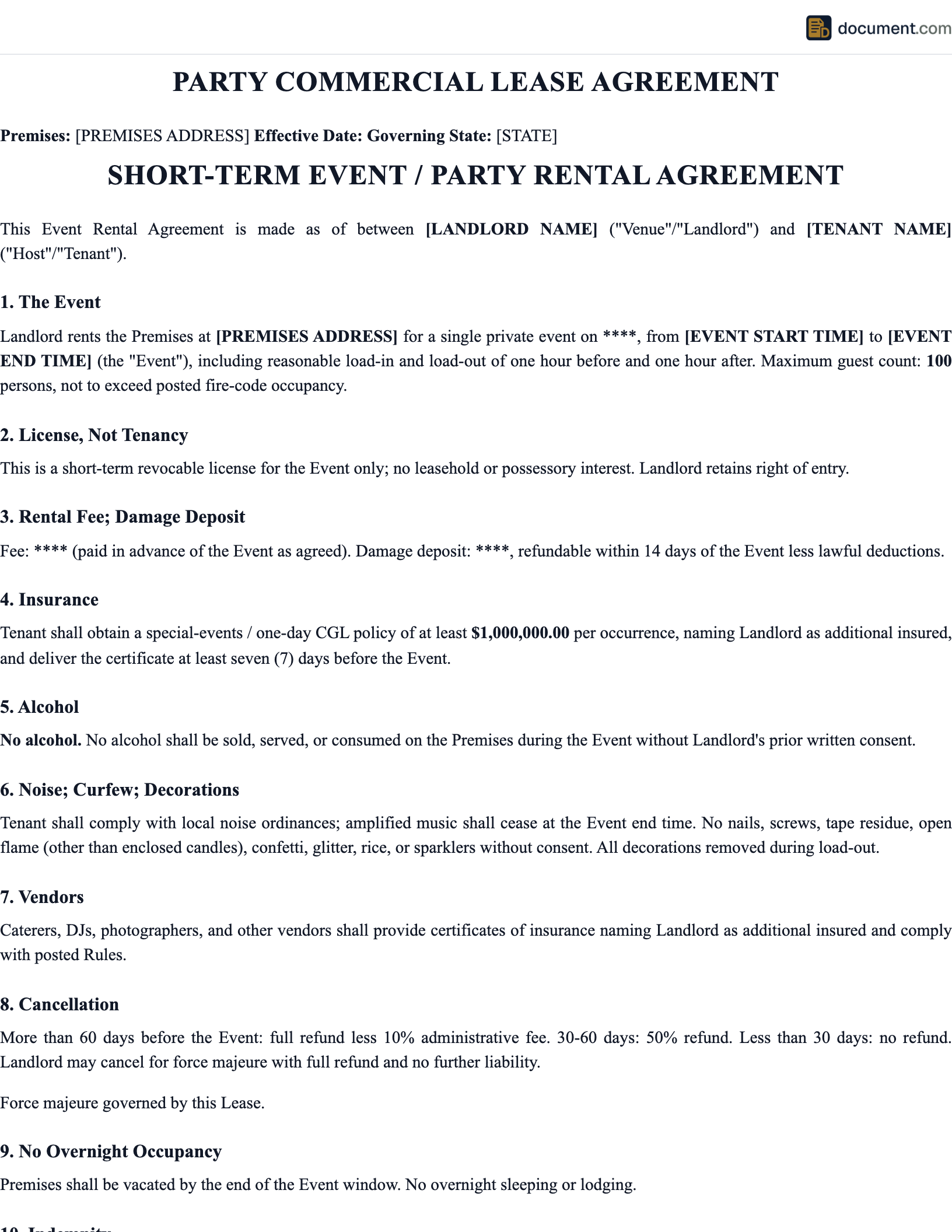
Below is a preview of key sections from an Indiana-compliant party rental agreement. The full document includes Indiana-specific comparative fault provisions, IDHS amusement device compliance language, ATC alcohol acknowledgments, and tornado preparedness clauses.
PARTY & EVENT EQUIPMENT RENTAL AGREEMENT
STATE OF INDIANA
Short-Term Commercial Rental Contract
RENTAL COMPANY
Company: [Business Name]
Address: [Business Address, Indiana]
IN Business License #: [Number]
IDHS Device Registration #: [Number if applicable]
Insurance Policy #: [Number]
CUSTOMER / EVENT HOST
Name: [Full Legal Name]
Address: [Mailing Address]
Phone: [Contact Number]
Email: [Email Address]
EVENT DETAILS
Event Date: [Date]
Setup Time: [Time] | Event: [Start] to [End] | Breakdown: [Time]
Venue: [Address, City, County, Indiana]
Venue Type: [Indoor / Outdoor / Barn / Farm]
Expected Attendance: [Number]
Event Type: [Wedding / Corporate / Birthday / Community]
Alcohol Served: [Yes/No]
INDIANA LIABILITY & WEATHER ACKNOWLEDGMENT
Customer acknowledges Indiana's modified comparative fault system (51% bar). Customer assumes responsibility for safe use of all rented equipment, agrees to follow safety instructions, and acknowledges that Indiana severe weather (tornadoes, thunderstorms, high winds) may require event modifications or equipment removal. Customer agrees to cooperate with Rental Company's weather-related safety decisions.
FINANCIAL SUMMARY
Equipment Rental Total: $[Amount]
Delivery & Setup: $[Amount]
Security Deposit: $[Amount]
Event Insurance (if applicable): $[Amount]
Indiana Sales Tax (7%): $[Amount]
Total Due: $[Amount]
Indiana Party Rental Agreement FAQ
Common questions about party and event equipment rental agreements in Indiana, covering liability, insurance, alcohol regulations, tornado preparedness, and local permit requirements.
Official Indiana Resources
Use these official Indiana resources for alcohol licensing, amusement device registration, fire safety, and consumer protection information.
Related Indiana Documents
Depending on your event, you may also need these related documents alongside your Indiana party rental agreement.
Create your Indiana Commercial Party Lease Agreement in under 5 minutes.
Answer a few questions and download a Indiana-compliant document, ready for the state agency.