



Hawaii Party Rental Agreement Overview
A party rental agreement in Hawaii is a short-term commercial contract for renting equipment and supplies for events — destination weddings, luaus, corporate retreats, birthday celebrations, baby showers, and community gatherings. Hawaii's world-renowned beach and garden venues, tropical climate, and status as a premier destination wedding location make it a unique market for party rentals. Equipment ranges from standard tents, tables, and chairs to island-specific items like tiki torches, bamboo furniture, tropical floral arrangements, and traditional lu'au supplies.
Hawaii's legal framework for party rentals is shaped by its modified comparative negligence system (51% bar under HRS 663-31), county-level permitting across four counties (Honolulu, Maui, Hawaii, Kauai), coastal zone management requirements for shoreline events, and the practical challenges of operating on islands — including inter-island shipping logistics, trade wind exposure, and salt-air equipment degradation. Hawaii's General Excise Tax (GET) of 4% (4.5% in Honolulu) applies to rental transactions, functioning differently from mainland sales taxes. Understanding these island-specific factors is essential for enforceable party rental agreements.
51% Bar
Comparative negligence
4 Counties
Permit jurisdictions
LCC
Liquor commission
4-4.5%
GET (not sales tax)
Hawaii Liability & Insurance Requirements
Hawaii's modified comparative negligence system (HRS 663-31) uses a 51% bar — an injured person can recover damages only if their negligence is not greater than the defendant's. If the plaintiff is 51% or more at fault, they are barred from recovery. For party rental companies operating on Hawaii's beaches and in its windy tropical environment, documenting safety protocols and obtaining customer acknowledgments is essential for building a strong defense.
Hawaii Coastal Zone & Beach Event Considerations
Events near Hawaii's shoreline may fall within the Special Management Area (SMA) regulated under the Hawaii Coastal Zone Management Act (HRS Chapter 205A). SMA permits may be required for events that involve temporary structures, significant gatherings, or any activity that could affect coastal resources. Each county's planning department administers SMA permits. Additionally, all Hawaii beaches are public up to the vegetation line, which affects how event areas can be secured and managed. Party rental companies should verify SMA requirements before installing tents or structures near the shoreline.
Key Liability Provisions for Hawaii
- Modified comparative negligence: 51% bar — plaintiff recovers nothing if their fault exceeds 50% (HRS 663-31)
- Limited social host liability: Hawaii's Dram Shop Act (HRS 281-78) targets licensed vendors; social hosts generally not liable for serving adults
- Product liability: Hawaii follows strict liability for defective products — rental equipment that causes injury due to defects creates liability
- Workers' compensation: Required for all Hawaii employers regardless of employee count (HRS Chapter 386); TDI also required
- Premises liability: Property owners owe reasonable care to invitees; beach events require special attention to natural hazards (waves, rocks, uneven terrain)
Hawaii Alcohol Regulations for Events
Hawaii regulates alcohol through county-level Liquor Commissions, not a single statewide agency. The Honolulu Liquor Commission, Maui County Liquor Control, Hawaii County Liquor Commission, and Kauai Liquor Control each administer licensing within their jurisdiction. This county-based system means that alcohol permits for events must be obtained from the specific county where the event takes place.
Hawaii does not have dry counties — alcohol is available statewide across all four counties. Social host liability is limited under Hawaii law. The Dram Shop Act targets licensed establishments, not private hosts serving alcohol to adults. However, providing alcohol to minors is prohibited. Hawaii's tourist-oriented event market means alcohol service (including traditional Hawaiian cocktails and luau beverages) is standard at most events.
Hawaii Event Alcohol Permits
- Special event permit: Required for events where alcohol is sold — apply through the county Liquor Commission at least 30 days in advance
- Caterer permits: Licensed caterers can serve alcohol at off-premises events under their existing county license
- Private events: No liquor permit needed for private events where alcohol is not sold to guests
- Beach/park restrictions: Open containers are prohibited in many county parks and beach areas — check specific county regulations for each venue
Hawaii Permits & Safety Requirements
Hawaii's four-county structure means event permitting varies by island. The City and County of Honolulu (Oahu), County of Maui (Maui, Molokai, Lanai), County of Hawaii (Big Island), and County of Kauai each maintain their own permit processes for temporary structures, special events, and amusement devices. Hawaii's tropical environment, persistent trade winds, and coastal setting create unique safety considerations not found on the mainland.
Tent Permits & Coastal Considerations
Hawaii counties require permits for tents over 400 square feet. Beach installations require sand-ballast anchoring systems (not ground stakes). Events near the shoreline may need SMA permits under HRS Chapter 205A. Tent fabric must meet flame-retardancy standards. Hawaii's consistent trade winds (10-20+ mph) require engineered wind-resistance for larger tents. All Hawaii beaches are public — event areas cannot block public beach access. Applications should be submitted 14+ days in advance.
Inflatable Device Safety
While Hawaii lacks a Florida-style statewide inflatable registration system, operators should comply with ASTM F2374 standards and carry at least $1 million in liability insurance. Hawaii's trade winds make inflatable operation particularly challenging — devices should be deflated at sustained winds over 25 mph. Beach setups require heavy-duty sand-ballast anchoring. Salt air and UV exposure degrade inflatable materials faster than on the mainland, requiring more frequent inspections and replacements.
Fire Safety & Capacity
Hawaii follows the International Fire Code for occupancy calculations. Beach and outdoor venues have different capacity considerations than enclosed spaces. Tiki torches and open-flame decorations common at luaus require fire department clearance in many jurisdictions. Honolulu Fire Department enforces strict rules about open flames at beach and park events. Portable generators must maintain proper clearances and comply with noise restrictions.
Noise & Environmental Regulations
Honolulu's noise ordinance (ROH Chapter 41) restricts excessive noise, particularly near residential areas and after 10 PM. Maui County enforces its own noise limits. Hawaiian cultural sites and conservation areas may have additional restrictions. Beach events near hotel properties must coordinate with resort management regarding noise levels. Environmental regulations may restrict the use of certain materials (e.g., non-biodegradable decorations) at beach events, and event waste removal is the responsibility of the renter.
Key Agreement Terms for Hawaii
A Hawaii party rental agreement must address the state's comparative negligence system, island-specific logistics, coastal zone management requirements, trade wind considerations, and the higher cost of equipment replacement due to Hawaii's remote location.
| Contract Term | Hawaii Standard |
|---|---|
| Security Deposit | 25-50% of rental total; higher deposits common due to replacement costs and shipping logistics |
| Cancellation Policy | Clearly disclosed; destination event cancellation terms should be flexible but protect against last-minute changes |
| Damage Liability | Renter liable for replacement cost; note that replacement costs are higher due to shipping to Hawaii |
| Weather Clause | Force majeure for hurricanes, tropical storms, and high surf advisories; inflatable deflation at 25+ mph trade winds |
| Inter-Island Delivery | Specify delivery logistics, shipping costs, and lead times for outer island events (Maui, Big Island, Kauai) |
| Dispute Resolution | Arbitration enforceable; District Court for disputes under $40,000; specify which island's court has jurisdiction |
Sample Hawaii Party Rental Agreement
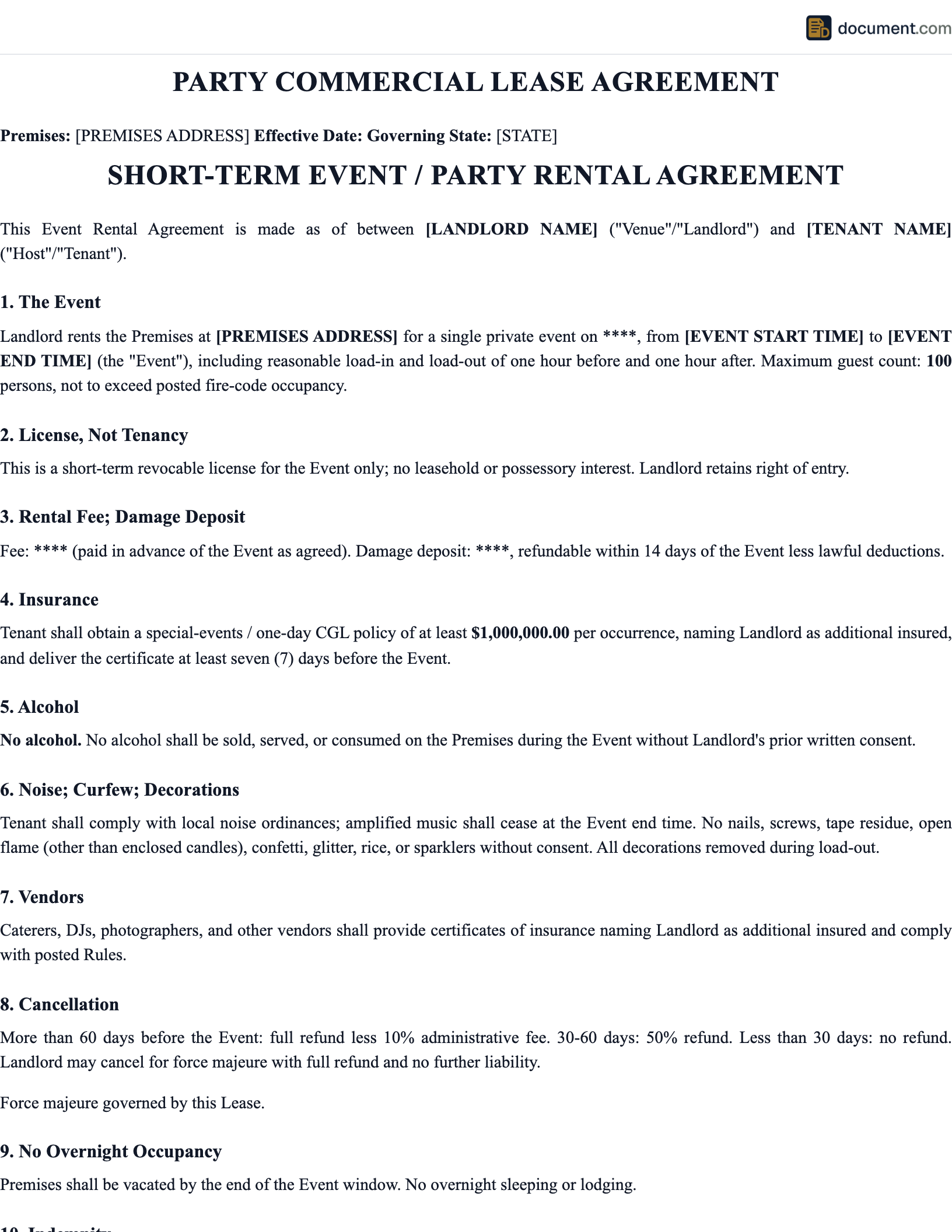
Below is a preview of key sections from a Hawaii-compliant party rental agreement. The full document includes Hawaii-specific comparative negligence provisions, coastal zone management compliance, trade wind safety clauses, and inter-island delivery terms.
PARTY & EVENT EQUIPMENT RENTAL AGREEMENT
STATE OF HAWAII
Short-Term Commercial Rental Contract
RENTAL COMPANY
Company: [Business Name]
Address: [Business Address, Hawaii]
HI GET License #: [Number]
Insurance Policy #: [Number]
CUSTOMER / EVENT HOST
Name: [Full Legal Name]
Address: [Mailing Address]
Phone: [Contact Number]
Email: [Email Address]
Destination Event: [Yes/No — Mainland or International Guest]
EVENT DETAILS
Event Date: [Date]
Setup Time: [Time] | Event: [Start] to [End] | Breakdown: [Time]
Venue: [Address, City, Island, Hawaii]
Beach/Shoreline Event: [Yes/No] — SMA Permit Required: [Yes/No]
Expected Attendance: [Number]
Event Type: [Wedding / Luau / Corporate / Birthday]
Alcohol Served: [Yes/No] — County Liquor Permit #: [Number or N/A]
HAWAII LIABILITY & WEATHER ACKNOWLEDGMENT
Customer acknowledges Hawaii's modified comparative negligence system (51% bar). Customer assumes responsibility for safe use of all rented equipment and acknowledges that Hawaii's trade winds, tropical weather, and ocean conditions may require equipment modifications or early removal for safety. Customer agrees to cooperate with Rental Company's weather-related safety decisions.
FINANCIAL SUMMARY
Equipment Rental Total: $[Amount]
Delivery & Setup: $[Amount]
Inter-Island Shipping (if applicable): $[Amount]
Security Deposit: $[Amount]
Event Insurance (if applicable): $[Amount]
Hawaii GET (4%/4.5%): $[Amount]
Total Due: $[Amount]
Hawaii Party Rental Agreement FAQ
Common questions about party and event equipment rental agreements in Hawaii, covering liability, insurance, alcohol regulations, beach event logistics, and island-specific permit requirements.
Official Hawaii Resources
Use these official Hawaii resources for alcohol licensing, fire safety, coastal zone management, and consumer protection information relevant to party rental operations.
Related Hawaii Documents
Depending on your event, you may also need these related documents alongside your Hawaii party rental agreement.
Create your Hawaii Commercial Party Lease Agreement in under 5 minutes.
Answer a few questions and download a Hawaii-compliant document, ready for the state agency.